
Related videos:
After the capture of Nicolás Maduro and the public statements by Donald Trump and Marco Rubio regarding Cuba, the rhetoric of the Cuban government has noticeably intensified. It's not new, but it is stronger. There is talk of threats, scenarios of war, resistance, and defense of the homeland. Within this context, the so-called war of the whole people takes center stage again, with exercises, training, and a popular preparation that is showcased on television and social media as a sign of strength.
The response from the government, led by Miguel Díaz-Canel and the rest of the leadership, has been clearly vengeful and defensive: to rally together, to alert, to prepare. From their perspective, it makes sense. But the logic of power and the reality of the people receiving that message are two very different things.
And here I want to make an important clarification, so there are no misunderstandings: when I talk about all this, I am not referring to the professional Armed Forces. An institutional army, with its training, discipline, and dependence on the State, will undeniably stay aligned with those in power. That is not where I am focusing. My reflection is aimed at the people, at popular organization, at what is being done with civilians in an extremely delicate social context.
Because today the Cuban people are not living an epic. They are living with power outages, scarcity, exhaustion, mass emigration, and accumulated frustration. That is not propaganda: it is daily life. And this is also evident on social media, where all possible views coexist, yes, but where a feeling of weariness, irony, and disenchantment predominates. There's no need to exaggerate anything: it's enough to read.
This is where the comparison comes in, without any fantasies.
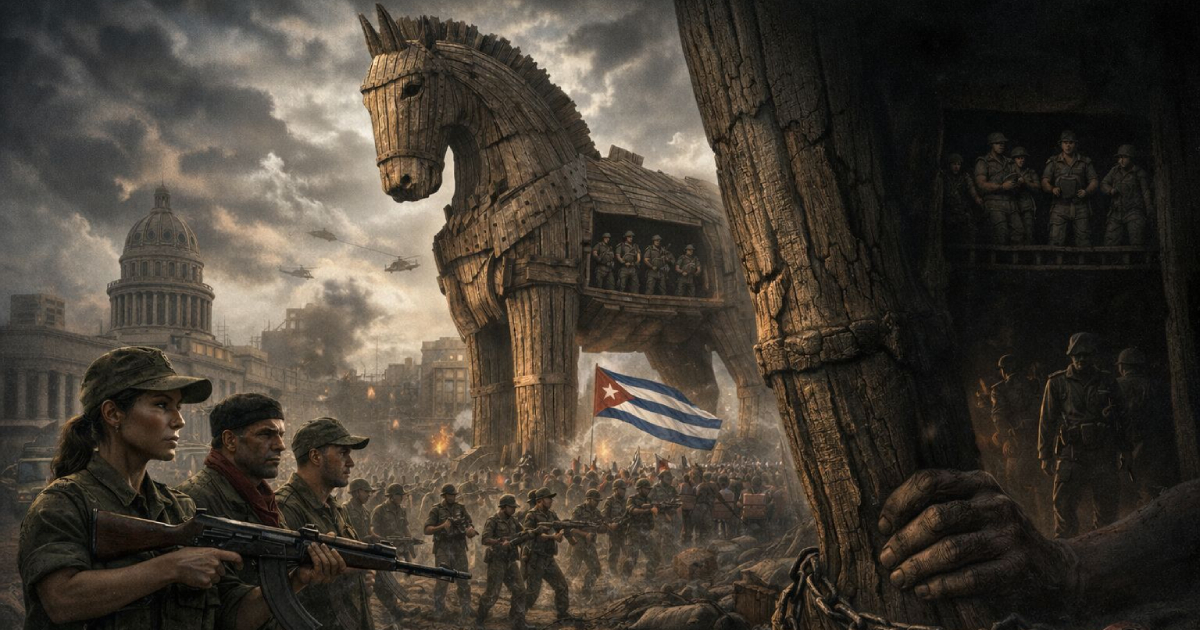
The Trojan horse, historically, was not an act of brute force. Troy did not fall because its army was weak, nor because the Greeks forced their way in. It fell because it brought something it believed to be harmless, even beneficial, within its walls. The mistake was not external; it was internal. And by the time they wanted to react, it was already too late.
Brought to the present, the Trojan Horse is not a conspiracy or a hidden enemy. It is a dynamic. When a power, attempting to protect itself, decides to militarize the populace amid deep social unrest, it may inadvertently be creating a breaking point. Because mobilizing a weary citizenry does not guarantee loyalty. Often what it generates is awareness of the contrast between discourse and reality.
The risk does not lie with the professional army. The risk lies in the gap that opens between that cohesive army and a populace that is asked to defend itself while surviving on the bare minimum. This gap is dangerous because it does not require violence to be decisive. A single push is sufficient. And that push does not have to be military; it can be information, support, companionship, the feeling of not being completely alone or trapped.
There will always be people who support those in power. It is legitimate. Everyone chooses their own position. Not everyone thinks alike. But it is also an obvious reality that the majority do not live from a place of control, but from a place of limitation. And that majority is not thinking about wars or external enemies: they are thinking about how to live tomorrow.
That's why I say we need to be careful. Militarizing the people may seem like control, but it can also be the Trojan mistake: relying on walls, discipline, and rhetoric, while the real breaking point is developing within the social fabric.
I am not calling for violence. On the contrary. A war among Cubans would be an absolute tragedy. What I propose is a reflection: the true defense of a country is not built by putting pressure on its people, but by providing them with hope, solutions, and legitimacy.
In Cuba, the greatest danger is not an invasion or an external enemy. The greatest danger is failing to understand what is happening internally in a timely manner. Because when a people stops sleeping soundly, an assault is not necessary. Sometimes, all it takes is a small push… and the doors open on their own.
Filed under:
Opinion article: Las declaraciones y opiniones expresadas en este artículo son de exclusiva responsabilidad de su autor y no representan necesariamente el punto de vista de CiberCuba.