
Related videos:
Amnesty International demanded that the Cuban government ensure "the immediate and unconditional release of all individuals imprisoned for political reasons and the end of repression" in Cuba, marking one year since the "opaque" process of selective releases, which, according to regime figures, benefited 553 people.
" Cuba must unconditionally release those who should never have been imprisoned," demanded Ana Piquer, regional director of Amnesty International for the Americas, in a statement from the NGO published on Monday.
Piquer stated that the ruler Miguel Díaz-Canel "must make a clear decision: to stop using the penal system to silence criticism and punish activism" and warned that "it is time to end the repression against those who peacefully exercise their rights to freedom of expression, assembly, and peaceful gathering."
The organization, based in London, stated that the process of releases, announced by the Cuban authorities on January 14, 2025, was "marked by opacity, lack of public information, absence of clear criteria, and the use of arbitrary conditions, as well as the devastating psychological impact on families."
The releases took place as part of an agreement reached after negotiations between the governments of Cuba and the United States, mediated by the Vatican, in the final days of Democratic President Joe Biden's term.
Amnesty International reminded that the process did not include "the state acknowledgment of the abuses committed during the arrests and sentences, and the lack of guarantees of non-repetition."
She was emphatic in stating that, despite the release of at least 211 individuals for political reasons, "selective or conditional releases do not replace the obligation of the authorities to cease the criminalization of freedom of expression or to guarantee a fair trial."
In this regard, he emphasized that "some individuals released in 2025 were forced into exile, while others were returned to prison, highlighting the persistence of deeply rooted authoritarian practices and the lack of guarantees to exercise human rights within the country without fear of reprisals."
This is evidenced in the cases of the dissidents José Daniel Ferrer, who was imprisoned again by the regime and ended up exiled in the United States, and Félix Navarro, who remains in prison after a court overturned his release.
"Cuban authorities have the obligation to guarantee the absolute and unconditional freedom of all prisoners of conscience," warned the NGO.
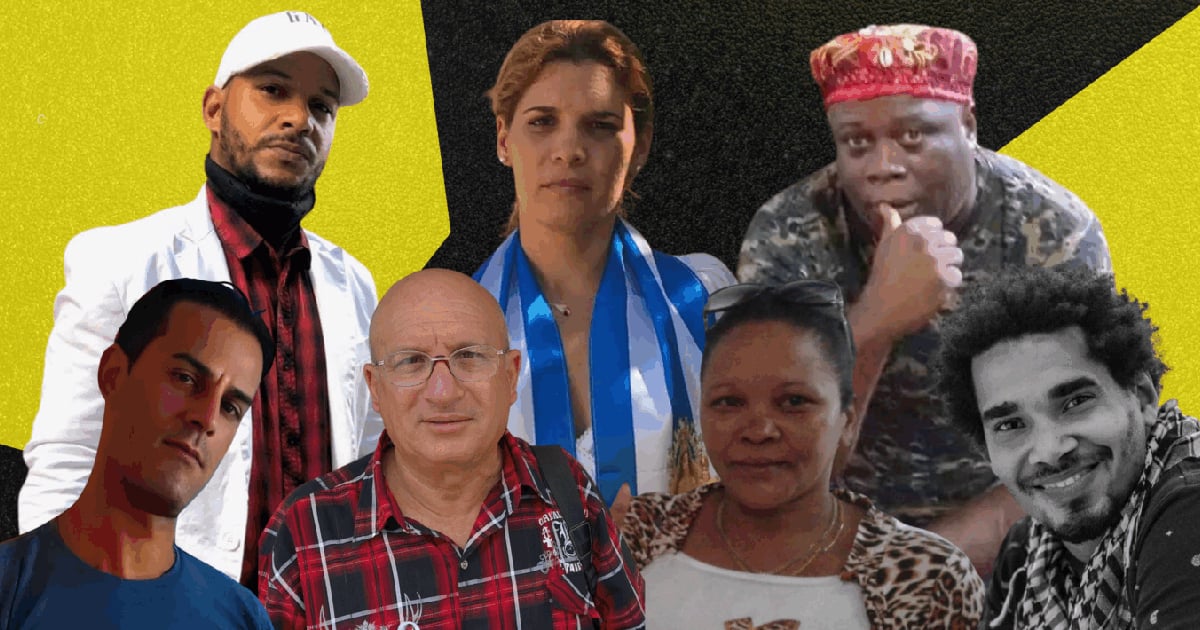
Her regional director for the Americas emphasized that “Sayli Navarro Álvarez, Félix Navarro, Loreto Hernández García, Donaida Pérez Paseiro, Roberto Pérez Fonseca, Maykel Castillo Pérez (Maykel ‘Osorbo’), and Luis Manuel Otero Alcántara should not spend another day in prison” and stressed that the regime must “put an end to politically motivated arrests once and for all.”
The releases of 2025 did not signify full freedom, claims Justice 11J
As the one-year mark approaches for the start of the penitentiary benefits process in January 2025, the independent platform Justicia 11J presented its report "Neither Free nor Whole: The Contextual Nature and Repressive Conditions of Releases in Cuba."
The document indicates that between January 15 and March 10, 2025, at least 212 individuals sanctioned for political reasons were benefited, and that 90% of the releases occurred within the first six days. After a month of silence, 21 additional releases took place, which, according to Justicia 11J, demonstrated a discretionary and non-linear handling of the process, aligned with political logics rather than verifiable legal criteria.
The organization asserted that "in no case were these full freedoms," as the released individuals "were subject to revocable prison benefits, with movement restrictions, police surveillance, frequent summonses, and explicit threats of return to prison."
Justicia 11J stated that “the legal figure used for the releases does not guarantee any stability nor does it prevent arbitrary detention,” and that “the released individuals remain subject to the political and judicial control of the State.”
He concluded that "the releases of 2025 did not close the repressive cycle, but rather shifted it: from prison to supervised release, from formal confinement to ongoing control."
A year ago, human rights organizations in Cuba and internationally criticized the releases and reported that they occurred in an “opaque, incomplete, unfair, and fraudulent” context. At the same time, they warned that more than half of those released were ordinary prisoners and not political detainees.
Filed under: