
Related videos:
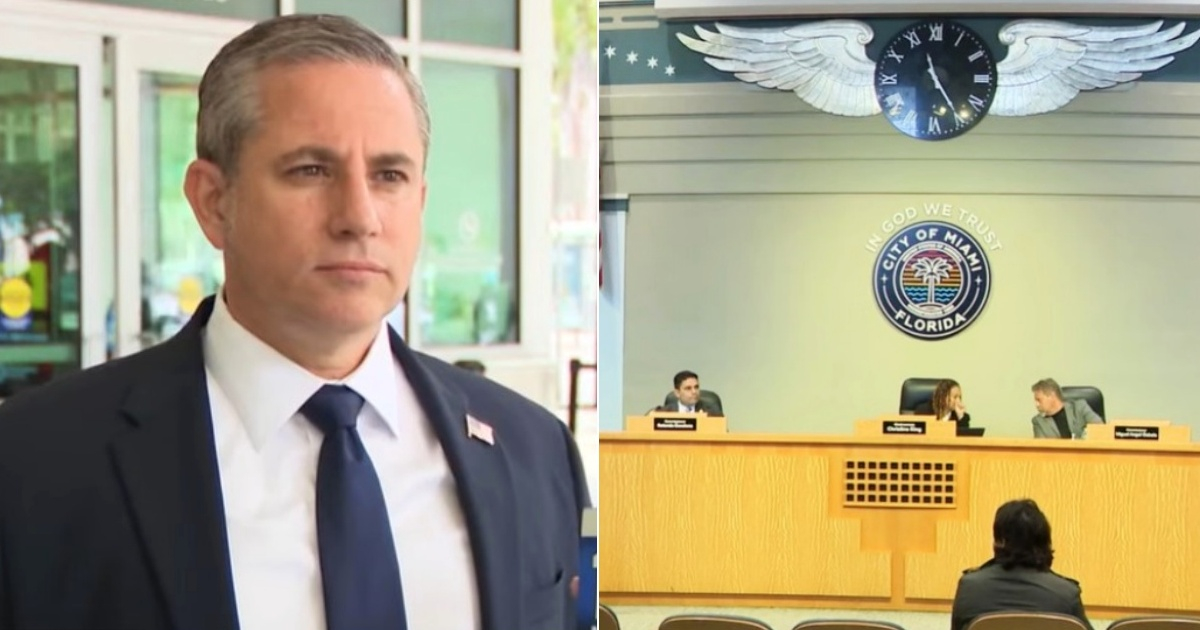
The City of Miami Commission unanimously approved the creation of a specialized task force that will investigate and oversee business licenses of companies that may have financial, administrative, or operational ties to the Cuban regime.
This measure, which will come into effect in the next ten days, aims to ensure compliance with federal sanctions and prevent financial support to the government of Havana from U.S. territory.
Commissioner Ralph Rosado, representative of District 4, emphasized the importance of the step taken:
"Today's vote makes it clear that the city of Miami will take the enforcement of federal sanctions laws seriously and will not turn a blind eye."
Unlike similar initiatives adopted by Hialeah—where the figure of Álex Otaola will be key—in this case, the working group will be composed of municipal employees from Miami alongside officials from the Miami-Dade County Tax Collector's Office.
Review, audit, and potential revocations
While the approval does not imply immediate actions against local businesses, it does establish a systematic framework for verification.
The proposal includes two key resolutions: a request to the Department of Justice to review all businesses registered in the city, and the authorization for the Tax Collector to audit companies with possible ties to entities controlled by the Cuban government.
Commissioner Rolando Escalona from District 3 explained the objective as follows:
"We passed two things: one is a resolution in which we ask the Department of Justice to review all the businesses in the city of Miami to ensure that those individuals doing business with Cuba comply with all regulations."
The other resolution would allow that if the Tax Collector detects irregularities and decides to revoke a business license, the city of Miami will do the same, closing any administrative loopholes that allow non-compliant businesses to continue operating.
Dariel Fernández, the current Tax Collector of Miami-Dade, emphasized the patriotic background of the decision:
"It represents that each government in Miami-Dade County simply wants to put every resident of this county first. I believe that the most important thing being discussed here is the national security of the United States of America."
In line with other jurisdictions in South Florida
The initiative aligns with recent actions taken in both Hialeah and Miami-Dade County, where licenses have already been revoked from businesses that could not justify legal operations with Cuban entities.
The stance in the city of Miami, however, stands out for its inter-institutional coordination and for being framed with a prior verification approach, before proceeding to sanctions.
In this regard, the authorities clarified that it is not a "witch hunt," but rather about ensuring compliance with the current laws.
However, the political message behind the measures is clear. One commissioner summed up the general sentiment of the legislative body as follows:
"We do not want business with Cuba here; we do not want business with the Cuban dictatorship at all. I fully agree with the resolutions that were passed today."
Legal scope and federal coordination
In the event that illegal operations are detected, the team may escalate the findings to federal authorities or directly recommend the suspension or revocation of business licenses at the municipal level.
Coordination with senior agencies could involve criminal proceedings if a violation of embargo laws or financing to sanctioned entities is demonstrated.
“Our parents and grandparents did not flee a dictatorship to be financing that same dictatorship from another country,” noted one of the commissioners, emphasizing the historical and moral coherence of the exiled community.
A new front against the financing of the regime
The measure is part of a growing trend in southern Florida: local authorities, supported by federal legislation, adopting mechanisms to curb any form of economic ties with the Cuban regime.
In a context where travel, remittances, and commercial operations are increasing ambiguously, municipal governments are opting for stricter verification and compliance systems.
This new team in the city of Miami represents another step in that direction.
Although their actions will depend on what the initial audits reveal, the political message has already been sent: in Miami, business dealings with the Cuban dictatorship will not be tolerated.
“It’s not a political game”: reactions and tensions
According to a report by Local 10, Dariel Fernández stated that his office is actively pursuing companies that conduct business with the Cuban government and that there is close collaboration with the Department of State.
“We are working together with the State Department,” said Fernández, adding: “We can review or revoke any local business tax in Miami-Dade.”
He also emphasized that the effort requires institutional backing and urged county and city officials to pass resolutions in support of it.
For his part, Ralph Rosado emphasized that Fernández has authority over occupational license permits and explained how some companies would be cooperating with the regime:
“They are doing this through the purchase of goods that truly have the support of the Cuban government.”
However, the measures have not been received unanimously within the business community.
Yfraín Villazón, an employee of Café Travel, a travel agency based in Miami-Dade that provides services to Cuba, expressed disbelief.
"No way," commented his colleague Leonel Vicent, who believed that the authorities should focus on larger corporations rather than small businesses.
He specifically mentioned airlines like American Airlines, which continue to operate flights to Cuba, to exemplify what he considers an uneven application of the policies.
In response to these criticisms, Fernández replied firmly:
"We don't care if you are a Democrat, Independent, or Republican. This is not a political game. I don't need to be in this position to play any games."
In short, the establishment of the review team in the city of Miami solidifies a trend of heightened scrutiny over economic activities that could directly or indirectly benefit the Cuban government.
With legal tools and institutional support, the measure aims to send a clear message: in Miami, there will be no tolerance for those who collaborate with a dictatorship from U.S. territory, not even under the guise of legitimate business.
Filed under: