
Related videos:
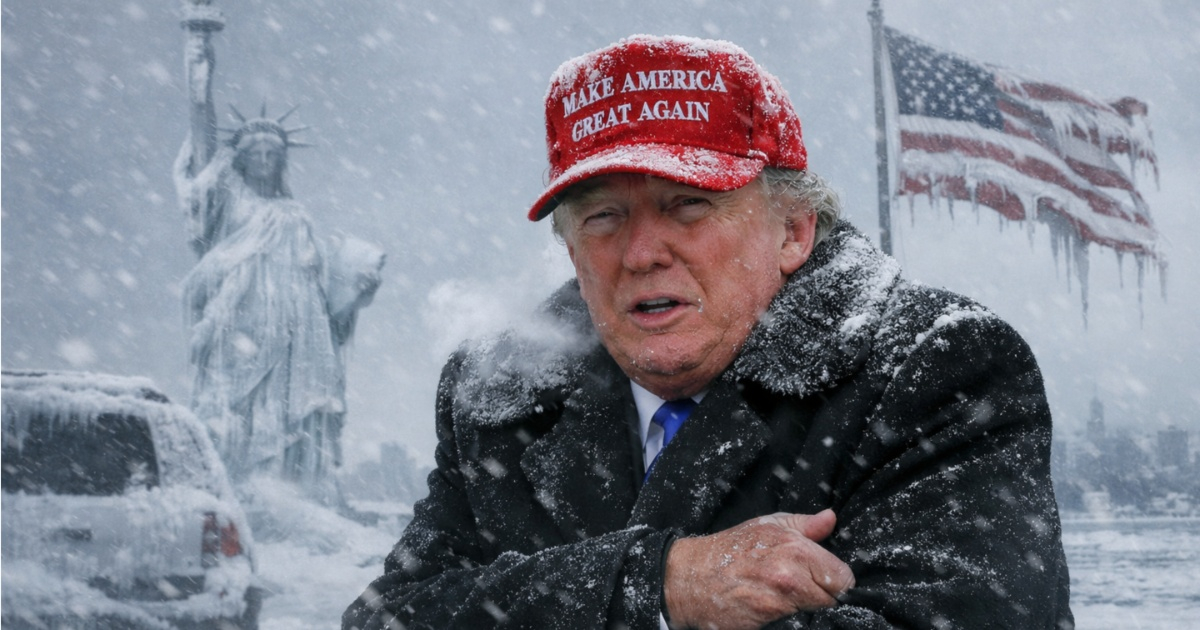
The President of the United States, Donald Trump, once again questioned global warming in response to the arrival of an extreme cold wave and a major winter system that, according to forecasts, would impact wide areas of the country.
In a post on Truth Social, Trump wrote this Friday that an "unprecedented" cold wave was expected in 40 states and asked, "Could the environmental insurgents explain what happened to global warming?"
His statements circulated while the National Weather Service (NWS) and U.S. media warned about a widespread winter event with snow, ice, and dangerous temperatures affecting much of the U.S., with potential impacts on travel, power supply, and public safety.
The forecasts describe a pattern of Arctic air and winter storms capable of bringing severe conditions from the central part of the country toward the east, featuring a combination of heavy snow, freezing rain, and dangerous wind chills in multiple regions.
In parallel, the Climate Prediction Center (NOAA) warned in its risk outlook that outbreaks of Arctic air would continue to affect the central and eastern U.S. by the end of January, with the most anomalous cold then concentrating in areas such as the Ohio Valley, the Mid-Atlantic, and the Southeast.
Despite Trump's post, an episode of extreme cold does not refute global warming.
Global warming is measured as the average trend of the planet over time, whereas weather can fluctuate dramatically from one day to the next or from one region to another.
Organisms and scientific communicators explain that it is a common mistake to use “it’s cold” as “proof” against climate change.
Can there be extreme cold on a planet that is warming?
Yes. And the relevant scientific discussion is not whether it "can" happen, but how it changes the probability and behavior of certain atmospheric patterns.
In particular, some studies explore whether the accelerated warming of the Arctic (often referred to as Arctic amplification) can influence the jet stream and episodes in which cold air moves toward mid-latitudes.
However, scientific institutions also emphasize that the exact relationship between climate change and certain behaviors of the polar vortex and the jet stream is not fully resolved and coexists with the natural variability of the system.
In simple terms: there can be strong cold spells even when, in the overall balance, the planet continues to warm.
Trump against global warming
Donald Trump's stance on global warming and climate change has been consistently skeptical and confrontational, both in rhetoric and public policy.
Trump has repeatedly questioned the existence of human-caused global warming.
On numerous occasions, he suggested that climate change is a hoax, an exaggeration, or a natural phenomenon that does not warrant significant economic changes.
For years, he claimed that the concept of climate change was "invented" or "used as a weapon" to harm the United States, particularly its industry.
Additionally, his rhetorical stance translated into concrete decisions. He withdrew the U.S. from the Paris Agreement (2017), arguing that it was detrimental to the economy and employment.
It reversed or weakened environmental regulations on emissions, fossil fuels, and energy standards, actively promoting coal, oil, and gas as pillars of U.S. economic growth.
Filed under: