
Related videos:
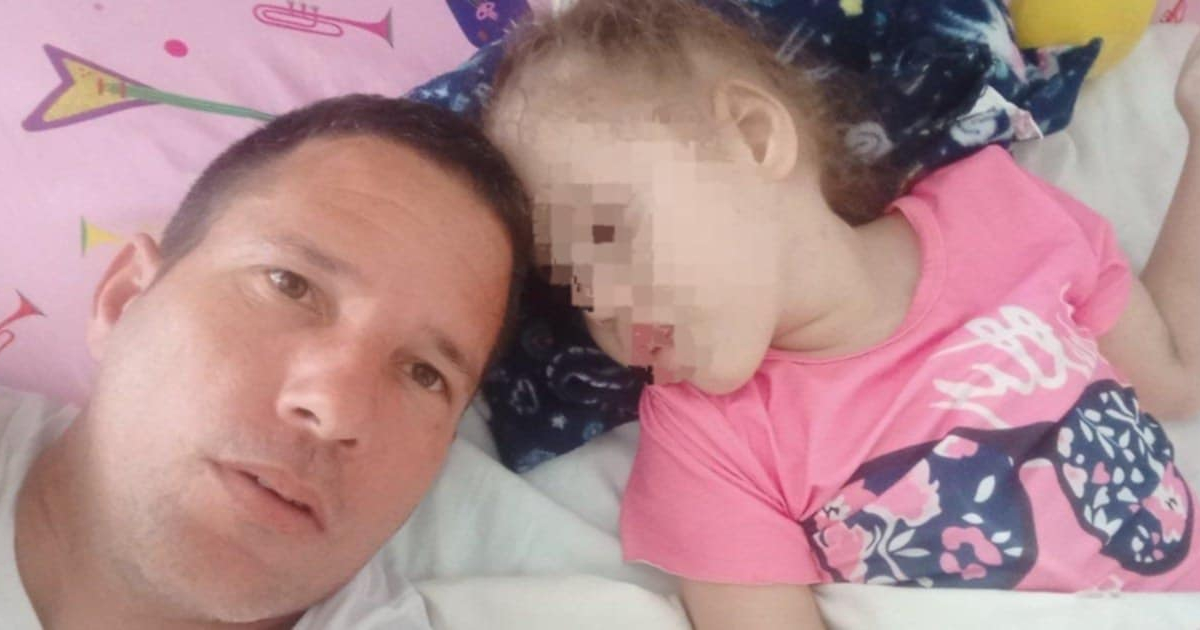
A Cuban father published two deeply emotional messages dedicated to his daughter Milena, a six-year-old girl suffering from Lennox-Gastaut syndrome, a severe neurological disorder that causes frequent seizures and severely limits her mobility and autonomy.
Baysel Acosta Moreno described with honesty and love on Facebook what it means to raise a sick daughter amidst so many hardships.
"For many, living is a joy when you wake up and have everything and lack nothing. For others, it is a constant struggle to survive for another 24 hours. For those of us with ill loved ones, it is a constant challenge in a world devoid of everything. Where everything becomes difficult and problems multiply according to needs," he wrote.
In another post, he expressed how difficult it is to have a child who must be in bed all the time or who only has hands that serve as crutches.
"There is no heart that can bear to see you there, motionless, like an object," she noted.
Baysel spoke of the pain of dreaming about seeing his daughter run and play like any child: "So many thoughts, so many dreams of seeing you one day be yourself, with your feet, with your hands, to see you run, shout, and be mischievous."
Nevertheless, he assured that giving up is not an option: "The word give up is useless."
Amid the daily hardships, the father highlighted the strength that arises from love: "With you, I learned to cry from sadness when you are sick, but also to cry from happiness when you win a battle."
And he concluded with a statement that has touched thousands: "If you see me cry, it doesn't matter, every tear carries all the love in the world and all the strength to be there with you until the end of the world."
Milena Acosta is one of the three girls benefiting from a solidarity campaign on GoFundMe launched by Cuban journalist Mónica Baró Sánchez, with the urgent goal of purchasing electric generators.
The minors depend on medical equipment connected to electricity, and due to the constant blackouts in Cuba, they must stay in a hospital at all times, as they would not survive at home without power.
So far, the fundraising for Milena and the other two patients has reached $1,853 of a goal of $12,500, an amount still insufficient to cover the purchase and installation of the generators that would allow the girls to be in their own home.
Baró explained that these generators are not ordinary plants, but rather equipment designed to ensure the continuous operation of ventilators, neurological devices, and assisted feeding systems.
"A generator does not cure an illness, but it allows you to breathe, eat, sleep, and live at home," he emphasized.
In addition to Milena, the campaign includes Valentina Ramos, a baby who has never lived outside of a hospital, and Yeilín, a girl with spinal muscular atrophy type 1 who relies on a mechanical ventilator 24 hours a day.
The situation of these families reveals an alarming reality: the Cuban state has ceased to guarantee the most basic needs for the most vulnerable.
There is no electrical backup, there are not enough supplies, and there are no institutional responses. The survival of these girls today depends on solidarity.
In a country where official propaganda speaks of "free healthcare," three seriously ill minors need international help to be able to live at home without the risk of a blackout threatening their lives.
As Baysel wrote: "I am not the perfect man, but I am a true father... and I learn that with you."
Filed under: