
Related videos:
As Cuba enters a new year filled with fears, shortages, and unsettling omens, priests and priestesses of santería took to the streets this Sunday to request something as basic as it is urgent: peace.
They did it with chants in Yoruba, ritual sacrifices, and collective prayers in Havana, in a context of increasing tension with the United States and an unrelenting economic crisis.
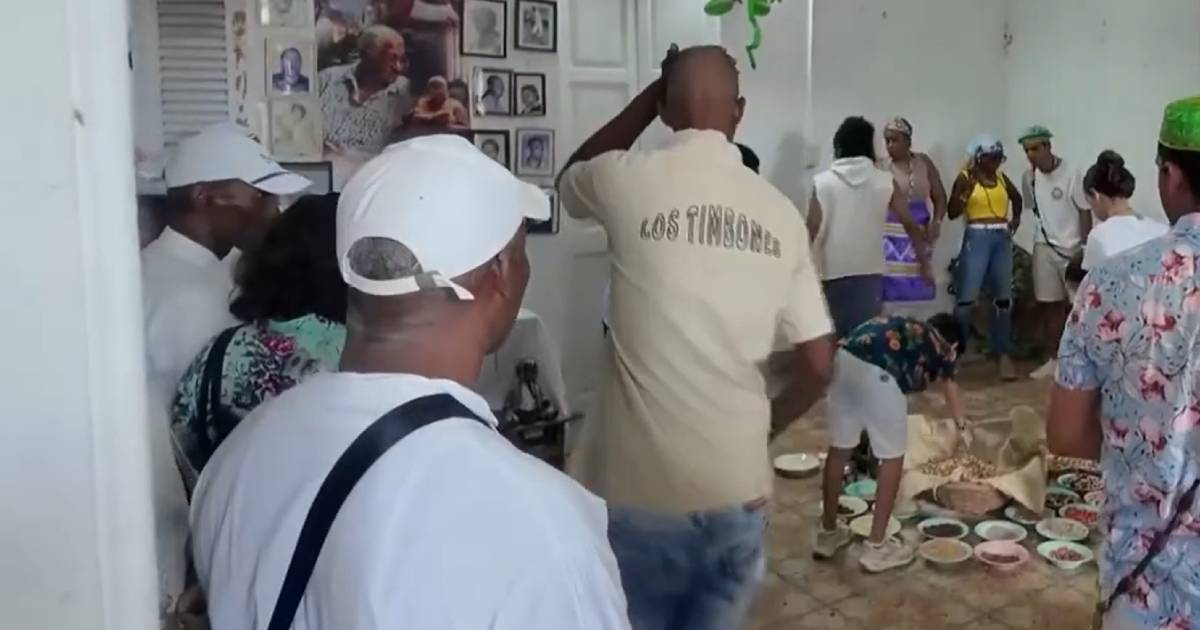
The scene, described by the Associated Press (AP), took place in the courtyard of an old house, where dozens of babalawos and faithful gathered to implore health, harmony, and spiritual protection for the Cuban people.
Dressed in white, surrounded by offerings and beneath the shade of a lush mango tree, they invoked Eggun, the deity of ancestors, and later Azowano, one of the representations of Saint Lazarus, a figure deeply revered on the island.
“It’s not just about religion; it’s about easing the burden of what’s to come,” explained Lázaro Cuesta, the priest who organized the ceremony, to AP. For many attendees, the ritual was a way to confront the collective fear facing a year that began with geopolitical shocks and signs of increased economic tightening.
At the end of December, the babalawos had already warned, through the traditional Letter of the Year, about the potential for conflicts, violence, and tensions that would affect Cuba and the world in 2026.
Days later, the international scene seemed to confirm those predictions: on January 3, the United States carried out a military operation in Caracas that resulted in the capture of then-Venezuelan President Nicolás Maduro and the death of 32 Cuban soldiers who were part of his security team.
The impact on the island was immediate. Venezuela is one of the main political and economic allies of the Cuban regime, and the blow shook both the ruling elite and the population.
In this climate of uncertainty, religion once again occupies a central space in the daily lives of many Cubans. The Letter of the Year 2026, released on January 1 by the Yoruba Cultural Association of Cuba, already warned of a cycle marked by conflicts that “do not end,” an increase in social and domestic violence, health issues, and the persistence of migratory exodus. It also called for strengthening family harmony, respecting traditions, and seeking spiritual refuge to face an increasingly fractured country.
During the ceremony on Sunday, several hundred people queued to be symbolically "cleansed" with live chickens, amidst ancestral chants. Among them was Yusmina Hernández, a 49-year-old housewife, who summed up the sentiments of many: "As religious individuals, we try to dispel all the negativity that comes into our lives."
The offerings included foods that are now hard to come by, such as eggs, beans, and corn, a detail that did not go unnoticed by the attendees and which underscores the extent to which the crisis permeates even the most sacred rituals. “This is done for the good of society, so that there is no conflict or violence,” explained Eraimy León, a 43-year-old babalawo, while watching the conclusion of the ceremony.
In a Cuba where the economy is suffocating under harsher sanctions, where migration continues to drain families, and where the future seems increasingly uncertain, Santería is once again a refuge, comfort, and warning. For many, asking the orishas for peace is not a symbolic gesture, but a vital necessity in the face of a 2026 that, from its very first days, is already being predicted to be an uphill struggle.
Filed under: