
Related videos:
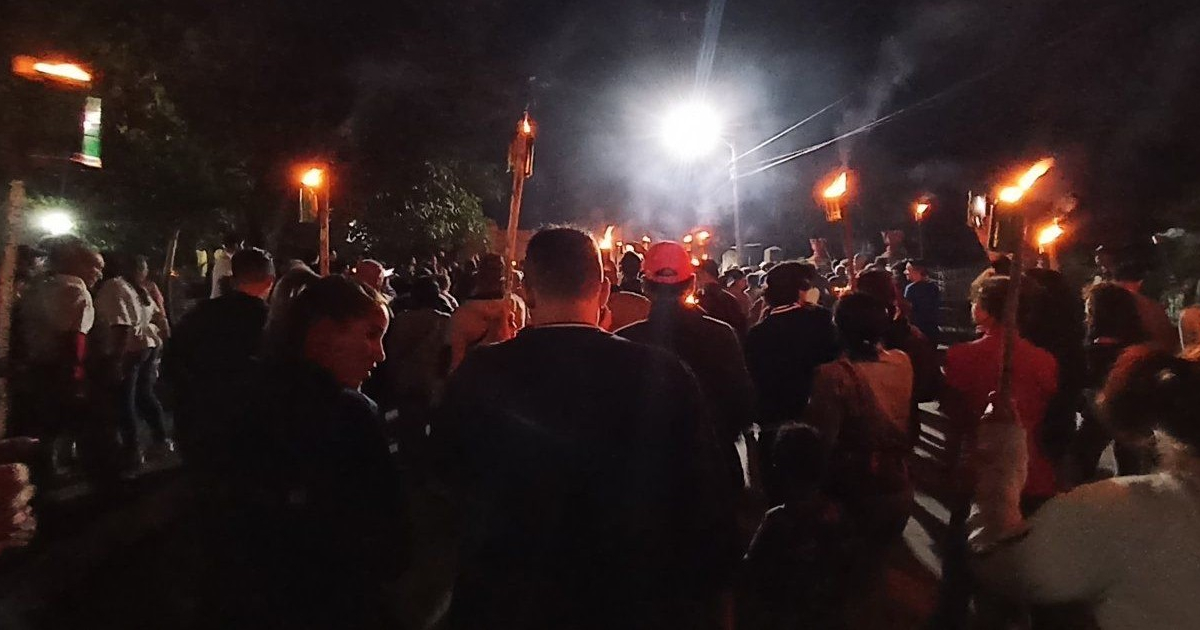
Cuba experienced another full day in darkness while the government organized the traditional Torch March in honor of José Martí, which this year is also dedicated to the centenary of Fidel Castro.
The scene—streets lit by fire in a country without electricity—synthesizes the contrast between official propaganda and the reality of millions of households subjected to prolonged blackouts, a direct result of an energy crisis that has been worsening for months without structural solutions.
According to the statement from the Electric Union (UNE), on Tuesday the service was affected for 24 hours. The peak impact due to a lack of generation capacity was 1,945 MW at 6:40 PM.
By Wednesday at 6:00 am, the availability of the National Electric System (SEN) was 1,170 MW, against a demand of 2,259 MW, resulting in an affected capacity of 1,084 MW; by noon, the estimated impact is expected to be 1,100 MW.
The situation is due to a thermoelectric plant that has deteriorated after decades of lack of investment and maintenance, with seven units out of service due to breakdowns and another under maintenance, in addition to 537 MW unavailable due to limitations in thermal generation.
For peak hours, the UNE anticipates the entry of unit 3 of the CTE Cienfuegos with 158 MW and the completion of unit 2 of the CTE Santa Cruz with 30 MW.
Nonetheless, the forecast indicates an availability of 1,398 MW compared to a maximum demand of 3,100 MW, resulting in a deficit of 1,702 MW. Therefore, if conditions remain the same, the impact would be 1,732 MW during that time.
In parallel, the 49 new photovoltaic solar parks contributed 2,236 MWh, with a maximum power output of 452 MW on average, a relief that is insufficient considering the magnitude of the structural gap in the system.
Meanwhile, in Havana, the Electric Company reported that on Tuesday the service was disrupted for 17 hours.
The highest deficit impact was 352 MW at 6:40 PM, and an additional 80 MW were added due to emergencies.
It was possible to restore the service for the deficit by 10:52 PM, but at the time of this report, six blocks (193 MW) remained affected, with a forecast for restoration in the morning.
The company itself warned that if the availability of the National Electric System (SEN) does not improve, blocks and circuits will be affected by energy contingencies without a scheduled timeframe.
The march of the torches is a sad metaphor for present-day Cuba: illuminated only by fire and slogans.
While millions of Cubans endure blackouts of over 24 hours in several provinces—and even 12 hours in Havana—the regime allocated resources to mobilize students, state workers, and military personnel for a political event.
The energy crisis is not an accident: it is the result of political decisions that have delayed the modernization of the system, discouraged investment, and prioritized propaganda over infrastructure.
The State has nurtured, through its centralized, opaque management and lack of accountability, a country that moves in the dark, where electricity has become intermittent, unpredictable, and, for many, almost a luxury.
While the torches burn in parades, the houses remain dark.
Filed under: