
Related videos:
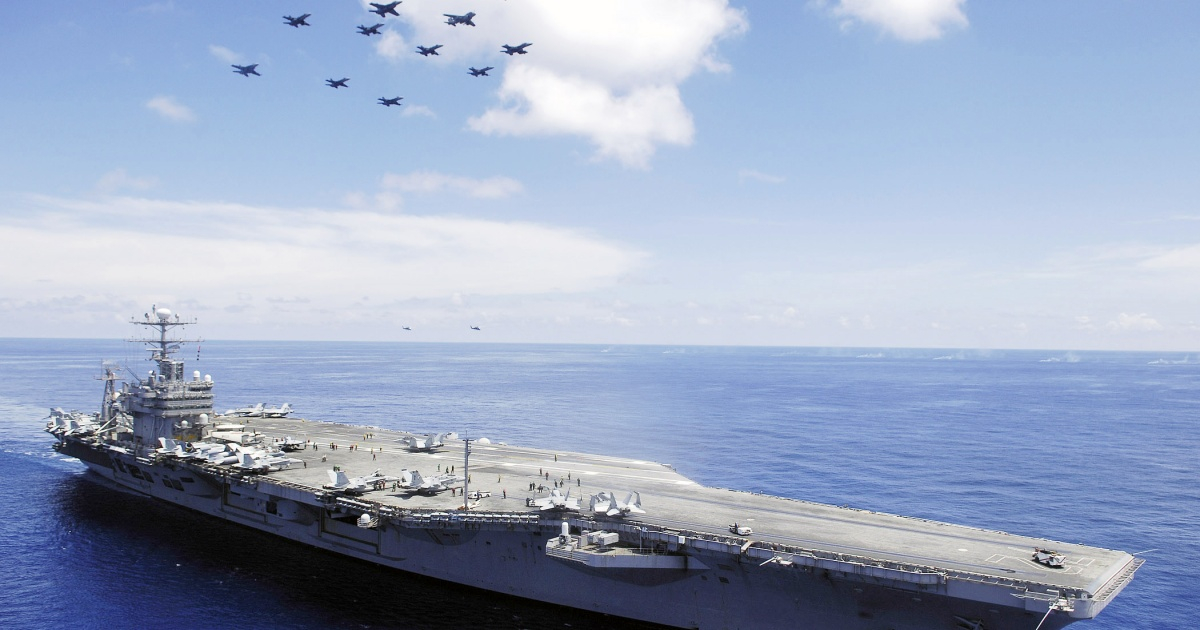
A U.S. fighter jet shot down an Iranian drone that approached "aggressively" towards the aircraft carrier USS Abraham Lincoln, stationed in the Arabian Sea.
The incident, which adds to other recent episodes of confrontation, occurs just days before an anticipated round of negotiations between Washington and Tehran regarding the Iranian nuclear program.
According to the spokesperson for the U.S. Central Command, Captain Tim Hawkins, the downed drone was identified as a Shahed-139, an Iranian-made unmanned aerial vehicle known for its ability to conduct reconnaissance missions and even carry explosives.
“The drone was flying with unclear intentions and approached the aircraft carrier despite the fact that U.S. personnel employed de-escalation measures,” explained Hawkins, in statements quoted by the U.S. press.
The aircraft continued its path towards the ship "despite warnings" and was shot down by an F-35C fighter launched from the USS Abraham Lincoln.
The White House supported the action.
The press secretary, Karoline Leavitt, stated that the Iranian drone acted "aggressively," and that the U.S. maneuver was an act of "self-defense and to protect the aircraft carrier and its crew."
According to official reports, the incident occurred about 500 nautical miles (over 900 km) south of the Iranian coast, with no reported material damage or injuries among U.S. personnel.
Tehran: The drone was carrying out a "routine mission."
From the Iranian government, the narrative is different.
According to the state agency Tasnim, the Shahed-139 was carrying out "a routine and legal mission for reconnaissance, surveillance, and photography" and "successfully transmitted images" before communication was lost, the interruption of which is still "under investigation."
So far, Iranian authorities have not confirmed whether the drone was part of a military operation near U.S. units, nor have they provided details on whether there were attempts at communication between both parties prior to the downing.
Another incident in the Strait of Hormuz
The downing of the drone was not the only point of tension between the two countries in the past 24 hours.
A few hours later, Iranian vessels and another drone "harassed" the Stena Imperative, a tanker with an American flag and crew that was sailing through the Strait of Hormuz.
According to Hawkins, the Iranians threatened to board the vessel.
A guided missile destroyer from the U.S. Navy, the USS McFaul, intervened at the scene and escorted the ship to a safe location, supported by air defense assets.
"Iran's unnecessary aggression near U.S. forces, regional partners, and commercial vessels increases the risk of collision, miscalculations, and regional destabilization," Hawkins warned.
Context of maximum tension
The increase in U.S. military activity in the region—which includes the deployment of the Abraham Lincoln and new air defense systems—is part of a broader strategy of pressure on Tehran, in response to the internal repression carried out by the Iranian regime and its refusal to limit its nuclear program.
The president Donald Trump, who ordered the deployment of the fleet to the Arab Sea in January, has insisted that he aims to send “a clear message” to the Islamic regime.
In a recent interview, he described the supreme leader of Iran, Ali Khamenei, as "a sick man who should rule his country properly and stop killing people."
Trump added that Iran "is the worst place in the world to live, due to poor leadership," while his administration continues to demand a complete renunciation of uranium enrichment from Tehran.
Negotiations on the horizon
Despite the hostility of recent hours, both sides have confirmed their intention to engage in dialogue.
The Iranian president, Masud Pezeshkian, announced this Tuesday that he has instructed his foreign minister, Abás Araqchi, to engage in negotiations with the United States, with a "fair" approach.
"I have asked my Minister of Foreign Affairs to conduct fair negotiations, whenever the appropriate conditions are met, without threats or unreasonable demands, within the framework of our national interests," Pezeshkian wrote on the social media platform X.
The White House has confirmed that special envoy Steve Witkoff will meet with senior Iranian officials on February 6 in Turkey.
According to an Arab official cited by AFP, the meeting was organized following efforts by Egypt, Qatar, Turkey, and Oman.
However, Iran has not yet confirmed the venue, although it acknowledged that there are several countries "willing to serve as hosts."
A distant nuclear agreement
The United States and the Islamic Republic already attempted a diplomatic rapprochement in the spring of 2025, but the talks collapsed following the outbreak of a twelve-day war in June, triggered by Israel. The main hurdle remains uranium enrichment.
“We say no to nuclear weapons and we fully agree with that point […] Of course, in return, we expect the lifting of the sanctions,” stated Iranian Foreign Minister Araqchi in an interview with CNN.
The nuclear agreement signed in 2015, which imposed severe limitations on Iran's atomic program, was nullified following the unilateral withdrawal of the United States during Trump's first term.
Since then, Tehran has resumed uranium enrichment beyond the permitted levels, claiming its right as a signatory of the Nuclear Non-Proliferation Treaty (NPT).
Internal repression continues
Meanwhile, inside Iran, repression against protests continues to escalate. State television reported the detention of four foreign nationals, allegedly involved in the unrest.
The NGO HRANA, based in the United States, reports that over 50,000 people have been arrested since the protests began, and that at least 6,872 have died at the hands of security forces.
Iranian authorities acknowledge more than 3,000 deaths, although they claim that most of these were law enforcement agents or civilians killed in "terrorist acts."
The government insists that the protests have been orchestrated from abroad, particularly by the United States and Israel.
Filed under: