
Related videos:
The severe energy crisis currently affecting Cuba has begun to directly impact international flight routes.
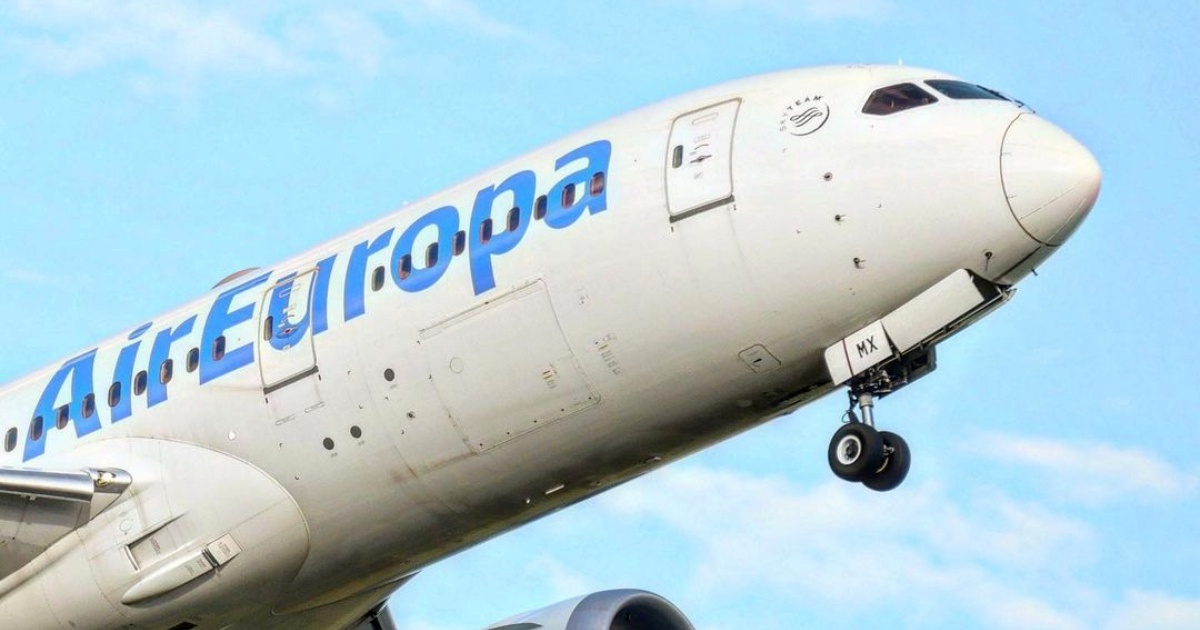
Starting this Tuesday, February 10, and at least until the 12th, Air Europa flights between Havana and Madrid will have to make a technical stop in Santo Domingo, Dominican Republic, to refuel.
The measure, confirmed by the airline itself, is a response to the total lack of aviation fuel at José Martí International Airport and other terminals in the country.
“Due to the lack of fuel at José Martí International Airport, if you are traveling from Havana to Madrid on February 10, 11, and 12, we would like to inform you that, although our operations are confirmed, there will be some adjustments to the flights, and a technical refueling stop in Santo Domingo will be necessary”, Air Europa reported this Monday in a statement cited by the agency EFE.
The airline expressed regret for the inconveniences caused by a situation "beyond the company's control," and warned that the scheduled departure and arrival times of flights may be subject to change.
This emergency logistical maneuver allows the service to remain active without the need for cancellations, but it adds complexity and potential delays to travelers' itineraries.
Technical stop in the Dominican Republic: A temporary solution
The change in Air Europa's operations comes after Cuban authorities issued a NOTAM ("Notice to Airmen") alerting about the unavailability of JET A1 fuel, the type used by most commercial aircraft.
The official statement, confirmed by sources to the EFE agency, indicated that "JET A1 FUEL NOT AVBL," which means that none of the international airports in Cuba can guarantee the necessary fuel supply for outbound flights.
The shortage of kerosene is affecting key terminals such as those in Havana, Varadero, Holguín, Santiago de Cuba, Camagüey, and Santa Clara, seriously jeopardizing the flight operations of airlines that connect the island with destinations in Europe, the United States, and Latin America.
Iberia and other airlines are still assessing their plans
Although Air Europa has been the first Spanish airline to take concrete measures, Iberia has also reacted by activating a fare flexibility policy to allow voluntary changes of date or route for passengers with already issued tickets to Cuba.
The company stated that for now there have been no cancellations or official changes to its schedule, but it is maintaining a “constant monitoring of the situation's evolution.”
Alongside Air Europa and Iberia, other airlines with regular flights between Madrid and Havana, such as World2Fly, Cubana de Aviación, and Air China, have not yet announced changes to their operations, despite the fact that the scheduled flights in the coming weeks could also be affected.
A precedent that revives strategies from the 90s
Given the inability to refuel in Cuban territory, the most viable solution for airlines is to introduce technical stops at nearby airports such as those in the Dominican Republic or Mexico, a strategy already employed during previous episodes of energy shortages in Cuba, such as those in the 1990s.
However, these types of logistical measures increase costs and operational complexity for airlines, which must readjust their routes in real time.
This emergency in the aviation sector is part of a much broader energy crisis that has been impacting Cuba since mid-2024 and has intensified with the implementation of new sanctions from the United States.
According to diplomatic sources, the Trump Administration signed an executive order in January imposing tariffs on countries that supply oil to Cuba, which has ultimately strangled the island's energy imports, especially following the halt of Venezuelan crude shipments.
Cuba produces only about one third of the energy it consumes and relies on external supply to keep essential sectors active, such as transportation, tourism, and public services.
In response, the Cuban government announced last week a package of emergency measures that includes drastic cuts in fuel use, hotel closures, reduced hours for public services, and the promotion of telecommuting.
The goal: to stretch the limited national energy reserves to the maximum while negotiating new sources of supply.
"The island barely produces one third of its energy needs," recently acknowledged an official from the Ministry of Energy and Mines, who described the situation as "unsustainable if immediate relief from the oil blockade is not achieved."
Repercussions on tourism and international transport
The inability to guarantee regular nonstop flights to and from Cuba could severely impact international tourism, especially during peak season.
The tourism sector, one of the few sources of foreign currency for the Cuban state, was already affected by the pandemic, the decline in visitors from Europe and Canada, and the contraction of the U.S. market.
For travelers, the situation creates uncertainty: changes in schedules, increased travel times, and the possibility of new cancellations if the supply of jet fuel is not restored in the coming days.
In the meantime, international airlines are hoping that the Cuban government can negotiate a quick solution to the shortages, or at least allow limited refueling for critical routes.
Filed under: