
Related videos:
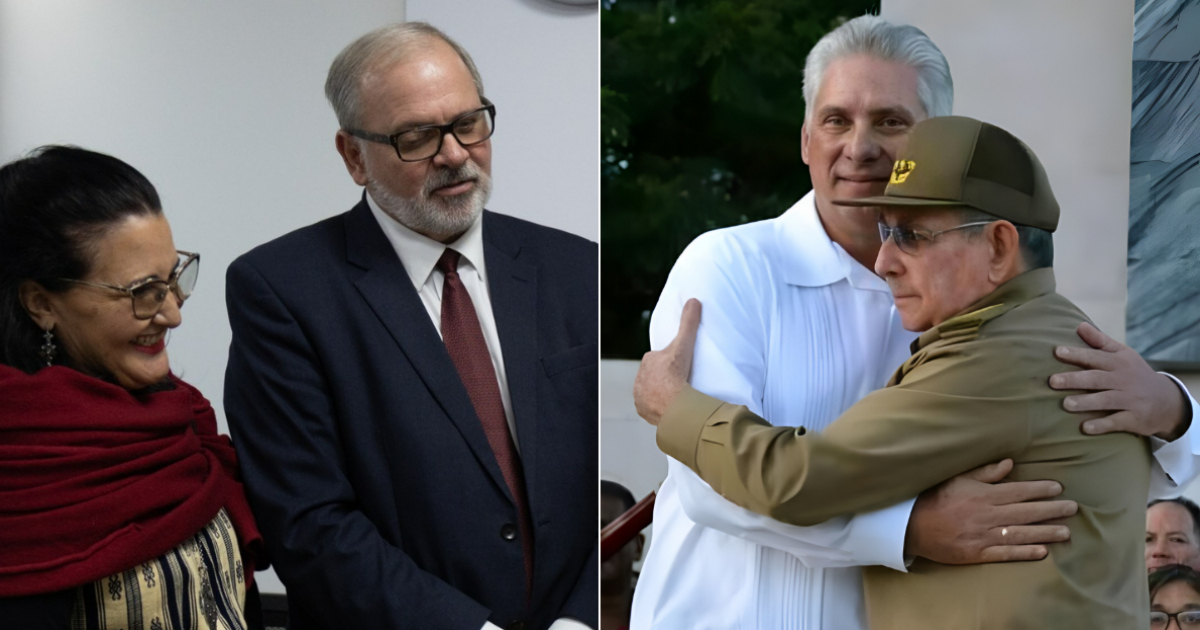
“Cuba's option is resistance and victory”. With that phrase, the ambassador of the Cuban regime in Mexico, Eugenio Martínez Enríquez, concluded his speech during the presentation in Mexico City of the essay Caliban, by Roberto Fernández Retamar, at an event organized together with the National Institute of Political Training of MORENA.
The event, described by the embassy itself as a space to reflect on “imperialism,” “barbarism, and fascism” in the current international stage, also served as a platform to reinforce the classic themes of Havana's official narrative: denouncement of the U.S. embargo, accusations of historical plunder against Western powers, and the exaltation of the “unity of Our America” against the colonizer.
In his speech, Martínez Enríquez stated that regional history is a constant struggle against external domination and criticized those who attribute the underdevelopment of the South to "ineptitude and corruption," rather than to centuries of plunder.
He also denounced a "worsened economic war" by the United States and spoke of "grotesque and cruel" threats against Cuba.
The message is consistent with the regime's discursive tradition. What is most significant is the context in which it is expressed. In recent years, Mexico has become a key partner for Havana following the gradual weakening of Venezuelan support.
During the 2022–2024 cycle, the bilateral relationship reached an unusual level of cooperation: the expansion of the Cuban medical program in Mexican territory, health agreements, energy management, and a favorable political climate under the government of Andrés Manuel López Obrador.
However, the 2026 scenario is different. Washington's pressure on countries that maintain energy cooperation or contract Cuban medical services has increased, raising the diplomatic cost of those ties.
Although the continuity government of Claudia Sheinbaum (MORENA) has reaffirmed its defense of the principle of non-intervention and has shown gestures of solidarity, the scope for deepening material cooperation is now narrower.
In that context, the speech of the ambassador of the Cuban regime took on a defensive character. The appeal to "resistance" and "victory" served as an ideological reaffirmation to a sympathetic audience, but it did not change the structural conditions facing the bilateral relationship.
The very own statement from the embassy acknowledged, albeit indirectly, the seriousness of the internal situation in Cuba by mentioning that the people have seen “their standard of living deteriorate, with long power outages that paralyze the economy.”
The explanation provided is solely external: the "illegal blockade" by the United States. There is no reference to the structural problems of the Cuban economic model, the sustained decline in national production, or the energy dependence that left the island exposed after the Venezuelan collapse.
The event in Mexico City —focused on an emblematic essay of the so-called "revolutionary thought" of Latin America— reinforces a strategic line of the regime: to shift the debate from the economic sphere to the symbolic.
The discussion about oil flows, health contracts, or financial sustainability is thus overshadowed by an epic narrative of the struggle against imperialism.
That strategy has been a constant in Cuban diplomacy: when material margins shrink, the emphasis is placed on ideological cohesion and political solidarity. The problem is that this worn-out rhetoric no longer substitutes for resources.
Mexico continues to be a key player for Havana, both due to its regional significance and its role in migratory and energy matters. However, the tone of the official discourse contrasts with a relationship that is no longer at its peak of expansion.
The statements regarding "barbarism and fascism" in the international arena coexist with a reality in which bilateral agreements must navigate external pressures and increasingly visible internal debates.
The ambassador's final phrase—“resistance and victory”—summarizes the symbolic core of the totalitarian regime since 1959. However, in Mexico in 2026, that slogan is projected onto a less favorable scene than in recent years.
The "revolutionary diplomacy" can mobilize political support and spaces of solidarity, but it faces concrete limits in a more tense hemispheric environment.
Between the epic of the presented essay and the constraints of the present, the distance is remarkable. It is within that gap that official propaganda finds its greatest challenge.
Filed under: