
Related videos:
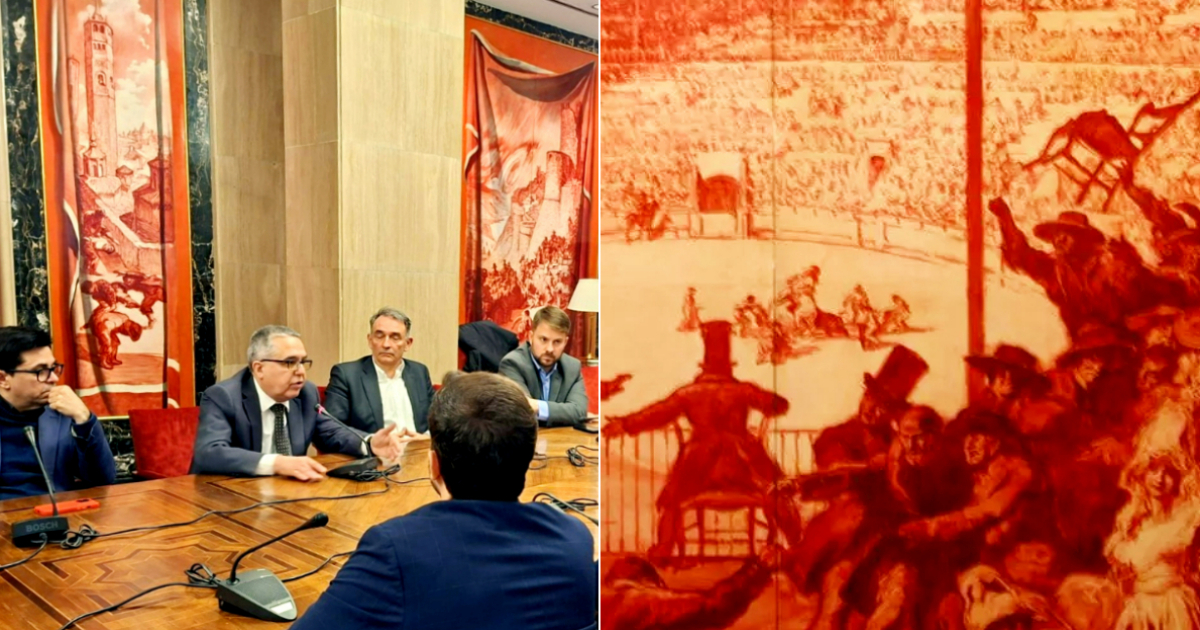
In the Sert Hall of the Congress —that reddish room where Josep Maria Sert painted Spain in an epic, tragic, and almost Goyaesque key— several deputies from the Spanish left staged their latest act of international solidarity: a parliamentary initiative “in support of Cuba against the aggression of the United States.”
The scene could not have been more theatrical. Under the enormous sanguine canvases featuring steep ravines, exhausted caravans, and human figures trapped in impossible abysses and peaks, representatives from Podemos, IU, ERC, and EH Bildu, among others, conveyed their support to the Cuban ambassador in Spain, Marcelino Medina González.
Everything was very solemn. Very institutional. Very red. Very to the liking of D. Enrique Santiago Romero, leader of the Communist Party of Spain, who took a seat to the left of the ambassador of the Cuban regime, the guest of honor at the micro event.
The historical paradox hung in the thick air of the room this Tuesday, where 13 mainland deputies and the ambassador of the isle exchanged their respective and similar pamphlet-like speeches, their decalogues of slogans, and anti-imperialist cries.
Those same political groups that built much of their identity on antifranquista memory —on the constant denunciation of the dictatorship, repression, and the lack of freedoms— are now taking cheerful photographs alongside the diplomatic representative of a 67-year dictatorship.
A dictatorship that imprisons opponents, represses demonstrations, and has pushed millions of citizens into exile. But, of course, this "strange dictatorship" is ideologically aligned. And it is well known that ideological blood does not stain the same way.
The Sert Room, popularly known as the "red room," seemed to take on an even more literal tone. The sanguine technique, with its earthy monochrome and baroque drama, gave the space an almost macabre atmosphere.
No one present noticed those rugged landscapes of the good Josep Maria, an unintentional metaphor for modern Cuba: a people struggling with ravines, rocks, and abysses in a kind of infernal journey, filled with obstacles, while sturdy figures watch this calvary from afar, high up on castles, squares, and cliffs.
In one of the murals, the men struggle at the edge of the abyss; in another, caravans move through hostile terrain, with agonizing and desperate movements. Sert was not seeking photographic realism, but rather monumental allegory.
But this time the allegory was too obvious: while the wall depicted human effort against adversity and oppression, the oval table discussed how to diplomatically shield those who have turned these calamities into a system for an eternity lasting 67 years.
Ambassador Medina González expressed gratitude for the "solidarity" and denounced the "aggressive and cruel escalation" by the United States. And, as is customary in any good ideological roundtable, the classics resurfaced: the empire, interference, the blockade.
Meanwhile, on X, a user reminded those present that “direct support or sympathetic backing is complicity with the Dictatorship.” That Cubans want rights, democracy, and to rebuild a country devastated by a totalitarian experiment.
The contrast proved difficult to ignore. In the hall that was decorated to exalt the people and the Spanish spirit, so closely aligned with the Cuban spirit that they feel like brothers, another landscape was depicted the eve before: fratricidal and almost suicidal—a “political understanding” with a regime that does not tolerate free elections or an independent press.
In Sert's trompe-l'œil —those deceptive canvases that turn the room into a theatrical stage— politics takes on a scenic dimension. But this time the set was too coherent with its purpose: painted drapery framing a diplomatic choreography where everything was already said before it even began.
The story has a sharp sense of humor. The political heirs of those who denounced the lack of freedoms in Spain during Franco's regime now endorse initiatives that support a system which bans opposition parties and criminalizes dissent. In the past, "dictatorship" was a non-negotiable term. Today, it depends on the color of the uniform.
Perhaps that's why the Sala Sert was the perfect setting, with its murals, inspired almost by Goya, where the heroic and the grotesque coexist without shame, all infused with red, the blood of the innocent and the wrath of the wicked.
Because, in the end, politics is also a stage. And few stages are as fitting as a room where the tragedy is painted on the walls while, around the table, a farce of selective solidarity is signed.
Filed under: