
Related videos:
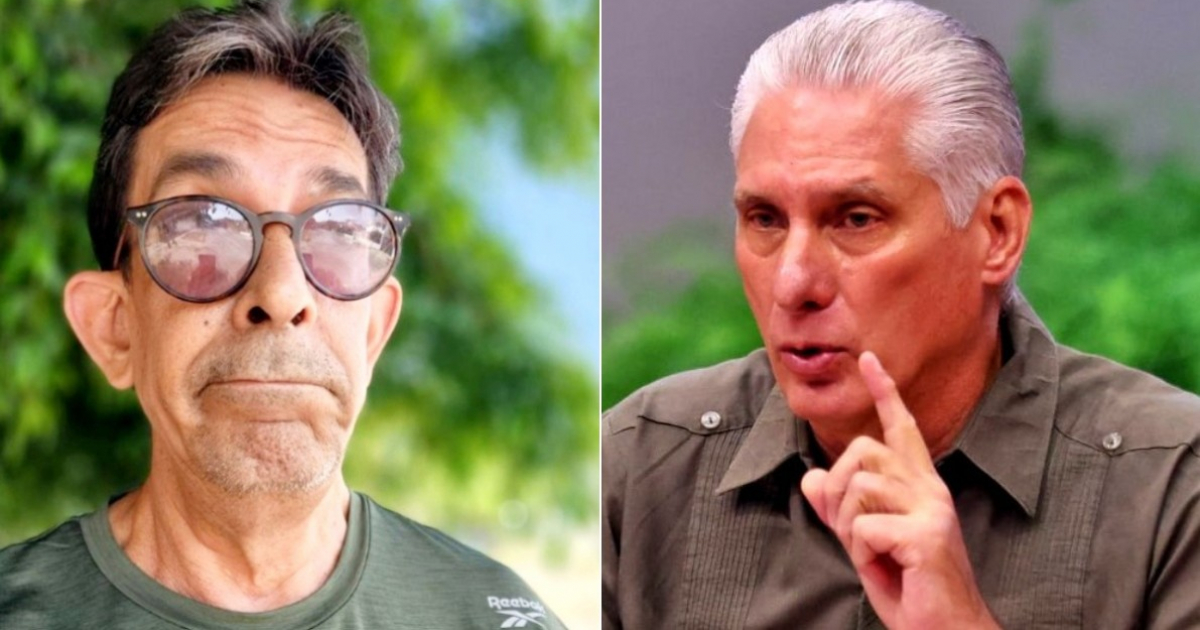
The energy and economic crisis that Cuba is experiencing has found one of its most forceful critics in the voice of comedian Ulises Toirac, who criticized the government's "nothingness": a deliberate immobility of power in the face of the collapse the country is enduring.
In a post on Facebook, Toirac depicted an island nearly paralyzed by the fuel shortage and the extreme rise in gasoline prices.
"I only occasionally hear a car passing by on the street. Every now and then. A liter of gasoline costs around three thousand pesos, and the drivers, which is their hustle, charge you an arm and a leg to cross from one municipality to another. And it’s not for nothing," he wrote.
The image being described is not rhetorical. Cuba is experiencing an oil crisis that has drastically reduced mobility, affected both public and private transportation, paralyzed services, and worsened power outages.
Toirac does not attribute this situation to external factors as the main cause, but rather to the incapacity of the system itself.
Although he acknowledges that U.S. sanctions exacerbate the situation, he questions the official narrative that attributes every difficulty solely to Washington.
"It's not a situational issue or something that came out of nowhere because the American government imposes greater restrictions. Of course, it caps the bottle, choking what had been... a trickle of supply that we were bringing in at a low price," he explained, making it clear that the structural problem already existed.
The comedian emphasizes that the root of the disaster lies in the internal productive fragility and the government's lack of measures to try to resolve the chaos.
"The decision-making is limited to weathering the storm. To survive the day. Zero emerging decisions for the medium or long term. It's like watching someone bleed out and not doing anything to stop it," he questioned.
That inaction, he argues, is not coincidental. It is a political stance. "Believe it or not, it is a decision. Not acting is a position. If you move, there is the decision to move. If you do nothing, it’s not that there is no decision; it’s that the decision is to not act."
Finally, the actor reminded that the currency devalues more each day, which leads to more misery and "more people falling into the desperate situation of not being able to make ends meet."
"Problems are not solved with slogans. Life is at stake, and there is a risk of not being able to finish stating them," he concluded.
Gasoline at impossible prices
In a second message, Toirac provided further details about the actual cost of fuel in the informal market. He clarified that he does not own a vehicle and was quoting figures he had heard, but confirmed that the prices are even higher than he initially mentioned.
"In one part of my previous post, I stated that a liter of gasoline costs 3,000 pesos. (…) That’s what I’ve heard. Someone even told me that that price is already outdated, that it’s even more expensive now. We are talking about black market prices, of course," he clarified.
He added that a 40-liter tank costs around 300 dollars. "A gas tank for 300 dollars, yes. The fuel is in a situation***."
The explanation provided reflects the total distortion of the Cuban economy: "In Cuba, nothing is related to anything. Everything costs according to how difficult or less difficult it is to obtain it (...) When you buy, the price includes 'the loss'."
In a market characterized by extreme scarcity, the value of products is defined by their absence, not by a stable economic logic. Some goods, so scarce, are what drive up the dollar in the informal market.
A paralyzed country
The description from the comedian aligns with what millions of Cubans are experiencing: nearly empty streets, mountains of accumulated trash, sporadic transportation, and a widespread feeling of neglect.
"There is a weariness of absence. The street is a solitude adorned by mountains of trash. Nothing seems to function day or night," he wrote.
The lack of fuel impacts electricity generation, food distribution, and workforce mobility. Without sufficient oil, the already weakened economy spirals further down.
Production is almost nonexistent, blackouts are intensifying, and inflation is accelerating. In this context, the official response has been administrative and reactive, lacking structural changes to reverse external dependence and internal inefficiency.
Toirac encapsulates the feeling of collective exhaustion: "It's really hard for me to crack jokes."
Humor, which for years served as a release valve, now stumbles upon a reality that, according to him, threatens something much deeper.
His concept of "Naditud" thus becomes a direct criticism of the government's paralysis in the face of a crisis that is not only energetic but also structural.
Filed under: