
Related videos:
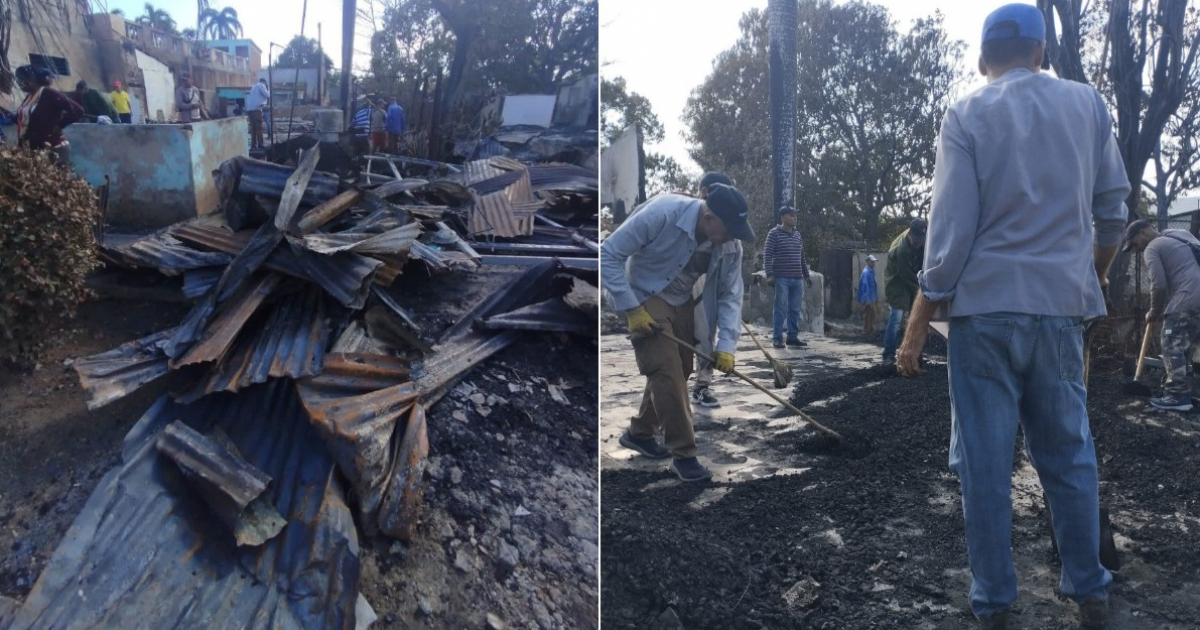
Workers from the Education and Sports sectors have been summoned to assist in the cleanup of debris from the three houses that were destroyed by fire on the night of February 16, near Las Américas park in San Germán, in the municipality of Urbano Noris, Holguín.
After the fire completely devastated the three houses, what remained the next day was a landscape of twisted zinc sheets, charred wood, and belongings turned to ash.
According to a report on Facebook by the station Radio SG La Voz del Azúcar, workers and residents of the area participated in the cleanup efforts "in the remnants of these damaged homes."
The released images show people sweeping and picking up charred remains in front of the central park, trying to clear the area where just a few hours earlier three homes stood.
Complaints about delays and lack of water
On social media, numerous comments questioned the response to the emergency. Several users stated that the firefighters arrived when the fire had already consumed the structures.
"The firefighters arrived when there was nothing left," wrote one person. Another pointed out, "The firefighters arrived so late that there were no houses left."
If the response had been faster and had adequate resources, the damage could have been less severe. But, as the neighbors report, the combination of delays and lack of materials left families without the ability to save their homes.
A witness who claimed to have been at the scene stated that the first fire truck arrived at 9:32 PM and that the lack of water was crucial. According to their account, the fire spread without sufficient resources to address it in time.
In the comments, there was a repeated complaint that the municipality did not have a fire truck available and that the water shortage worsened the situation.
A vulnerable infrastructure
Videos shared on social media show houses engulfed in flames.
In a post, user Ricardo Amador Rodríguez described the scene as a fire that "advances relentlessly" and highlighted "the fragility of an infrastructure that was never truly prepared to face an emergency of this magnitude."
In another post, user Dennis Domínguez claimed that the fire started in the home of a disabled person who was cooking in the yard and who had been experiencing structural issues in their house, including a lack of a roof, since the previous cyclone. According to his account, it was the neighbors themselves who helped save lives and some belongings.
There were also comments highlighting structural difficulties in the municipality, such as communication problems when the power service is interrupted, which leaves homes cut off, even without operational landline phones.
The fire and the official version
According to official information, the fire was extinguished by members of Command #6 of the Holguín Fire Department, with organized support from local residents.
The authorities stated that there were no human casualties and that "a significant amount of material goods" was successfully rescued.
However, so far the causes of the fire have not been publicly specified, which remain under official investigation.
The broadcaster also reported that medical attention was being provided to the victims and that efforts were underway to relocate their belongings to safe places. Additionally, it stated that the locations to be handed over to the four affected families had already been identified.
Victims in a context of shortages
Although the authorities assured that there were no fatalities and that locations were identified to relocate the families, the reality is that these people are left with nothing.
In the current crisis of the country, losing a home means much more than the destruction of walls and roofs. With a chronic shortage of building materials, high prices, and a complete absence of basic goods, it is extremely difficult to replace what has been lost. Even those who are employed face enormous obstacles in acquiring appliances, clothing, or essential items.
Rebuilding a house or constructing a new one in the same location is an impossible task.
The affected individuals not only lost their belongings but also the security of a home in an economic landscape that complicates any attempt at a swift recovery.
While state workers and neighbors collect the charred remains, uncertainty lingers over how these families will rebuild their lives after a tragedy that exposed not only the vulnerability of the homes but also the structural limitations to cope with emergencies and recover after the disaster.
Filed under: