
Related videos:
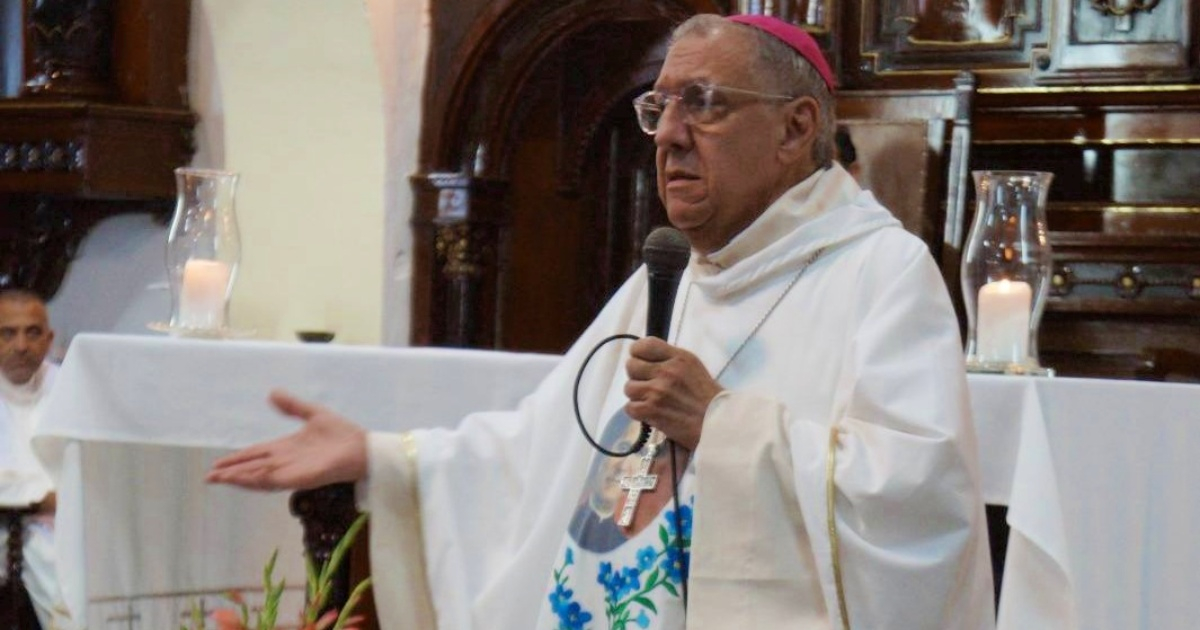
Amid the growing crisis facing the Island, Bishop of Santa Clara, Mons. Arturo González Amador, delivered an unusually direct message from the altar of the Santa Clara de Asís Cathedral.
"Cuba has to change, the way we are living is inhumane", he said, according to a post on social media.
His words were spoken on February 15th, during the celebration of the Sixth Sunday of Ordinary Time, at a well-attended mass that also became a space for reflection on the dramatic national reality.
The homily, initially focused on the day's Gospel, turned into an explicit call to not ignore the suffering of the Cuban people.
From the Gospel to the pain of the country
During his reflection on the Sermon on the Mount, Mons. González explained that Jesus invites us to go beyond external acts and to look at the heart.
"The Lord speaks to us through actions, through what is visible, through what can be perceived externally, to a morality of the heart, of the interior," he affirmed.
He emphasized that social ills do not begin with the visible act, but rather at the inner root.
"Jesus goes much further than the external act, asking where that feeling of hatred arises, where that feeling of murder comes from, where these acts are born; they are born in the heart," he said.
However, it was at the conclusion of the Eucharist that the bishop directly addressed the crisis in Cuba and the decision of the Episcopal Conference to postpone the ad limina visit to the Vatican.
"We must allow ourselves to be moved by the suffering of this people."
The bishop recalled the message issued by the Cuban Episcopate on the occasion of the recent Jubilee and cautioned that the situation has not only failed to improve, but has also worsened.
"The situation has not only remained serious and difficult since our message during the last Jubilee, but it has worsened," he emphasized.
It was then that he uttered the phrase that has resonated both inside and outside the country: “Cuba must change, the way we are living is not humane.”
Mons. González insisted on the need for a "sincere and effective dialogue" and demanded concrete actions.
"We must sit down, we must talk, we must listen, and when we witness the suffering of our brothers, we must take real steps for the common good. We have to be moved by the suffering of this people and do something for them," he affirmed.
According to the Press Office of the Diocese of Santa Clara, the prelate commented that, when asked by a journalist what message he would convey to the world regarding Cuba, he replied: “I have a simple thing to say: do not forget about Cuba, look at the reality, the pain of this people.”
"Where should the parents be? Next to the children."
Mons. González clarified that the trip to Rome was not canceled, but postponed.
The visit was originally scheduled from February 16 to 20, 2027, but it was moved up by Pope Leo XIV to February 2026 as a "gesture of closeness."
"You surely heard that the bishops had suspended the visit to the Holy Father. It was not suspended, it was postponed," he explained.
The immediate trigger was logistical difficulties related to fuel for the flights, but the underlying reason was something else: the severity of the national situation.
"It is very concerning that all the bishops left Cuba and would be absent if any difficult or painful situation occurred.", he noted.
He then posed the question that set the pastoral tone for the decision: “The bishops chose: Where should parents be? Where are they when there is difficulty? Beside their children. Standing by our people.”
For the prelate, leaving the country in the current context would have been inconsistent with the pastoral mission of accompaniment.
International eco and more direct critiques
The bishop's statements were even reported by the Catholic News Agency (ACI Prensa), based in the United States, which titled: “Bishop of Cuba: How we are living ‘is not human’, the country ‘has to change’.”
In parallel, other voices within the Cuban Church have adopted an even more confrontational tone for a long time.
The priest Alberto Reyes, from the Archdiocese of Camagüey, is a true critic of the Cuban government on social media. Reyes stated on Facebook that "the Cuban model has been a failure."
Addressing sectors of the Latin American and European left, he wrote: “while you refuse to accept it and take pride in continuing to tell a dead person, ‘Cheer up, you can go on!’ my people suffer, my people endure, my people are dying.”
Reyes compared the national reality to "a life similar to that of nations at war," where the population has no control over its present or future, and he requested that if failure is not acknowledged, at least "they should remain silent, learn to be quiet, which can also be a dignified option."
The priest concluded with a quote from Oscar Wilde that encapsulates the mood of many Cubans: "We are all in the mud, but some of us are looking at the stars."
The decision to postpone the visit to the Vatican, beyond its logistical aspects, has been presented by the bishops as a gesture of support amid the economic and social crisis affecting the country.
In a Cuba marked by blackouts, shortages, massive exoduses, and increasing despair, the bishop's phrase encapsulates the feelings of many citizens: "The way we are living is not human."
Filed under: