
Related videos:
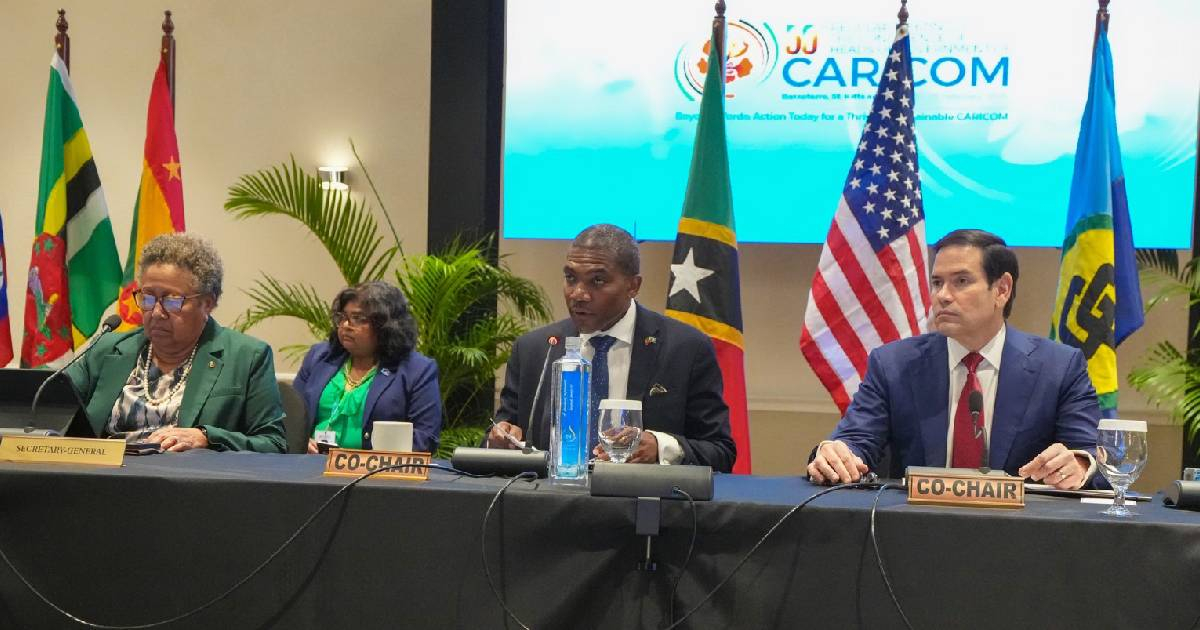
The United States Secretary of State, Marco Rubio, participated this Wednesday in the Conference of Heads of Government of the Caribbean Community (CARICOM), where he placed the fight against the illicit arms trade that fuels violence and instability in the Caribbean, especially in Haiti, at the center of the regional agenda.
During the meeting with regional leaders, Washington released a fact sheet on the Caribbean Basin Security Initiative (CBSI) and an official statement detailing new and strengthened cooperation actions to disrupt the illegal flow of weapons and ammunition to the region, noted the Department of State in a statement.
According to the entity, foreign terrorist organizations and transnational criminal networks not only traffic drugs that affect the United States but also illicitly introduce weapons into Caribbean countries, exacerbating violence.
In light of this situation, the U.S. government has intensified intelligence sharing, joint investigations, and coordinated operations with Caribbean law enforcement, the statement details.
Agencies such as the Bureau of Alcohol, Tobacco, Firearms and Explosives (ATF), Customs and Border Protection (CBP), Homeland Security Investigations (HSI), and the Bureau of Industry and Security of the Department of Commerce employ advanced technology to detect and intercept illegal shipments at points of entry and exit, as well as to strengthen export controls.
The State Department, for its part, provides technical assistance and mentorship to Caribbean officials to improve arms tracking, evidence collection, and the execution of joint investigations, the text emphasizes.
It also supports specialized units such as the Transnational Criminal Investigation Units (TCIU) in the Dominican Republic and Haiti, and the CARICOM Arms Intelligence Unit (CGIU), based in Trinidad and Tobago.
Additionally, Washington has strengthened forensic training and ballistic analysis in countries such as the Bahamas, Guyana, Jamaica, the Dominican Republic, and Saint Lucia, as well as security programs for arsenals to prevent the illegal diversion of weapons.
During the summit, Rubio held bilateral meetings with several Caribbean leaders. In his meeting with the Prime Minister of Trinidad and Tobago, Kamla Persad-Bissessar, he discussed strengthening cooperation in security and economic prosperity. The Secretary highlighted Trinidad and Tobago's ongoing support for U.S. military operations in the southern Caribbean as an example of collaboration to combat drug trafficking.
Rubio also met with the Prime Minister of Saint Kitts and Nevis, Terrance Drew, with whom he discussed expanding cooperation to combat transnational crime and curb irregular migration.
The information sheet presented by the State Department lists several recent cases that illustrate joint efforts. In February 2026, a Homeland Security task force dismantled a criminal network led by Dominican nationals operating in several U.S. states, seizing over one kilogram of fentanyl and methamphetamine, as well as 17 firearms.
In May 2025, customs authorities in Jamaica, trained with U.S. support, seized 238 firearms and over 23,000 rounds of ammunition hidden in water heaters at the port of Kingston, marking the largest weapons seizure in the agency's history.
Other cases in the Dominican Republic, Haiti, and several states in the U.S. have resulted in convictions for smuggling and illegal arms exportation, leading to prison sentences and significant fines.
With this diplomatic and operational offensive, Washington aims to consolidate a regional strategy that combines prevention, law enforcement, and judicial cooperation to curb arms trafficking, which directly affects the security and stability of the Caribbean.
Filed under: