
Related videos:
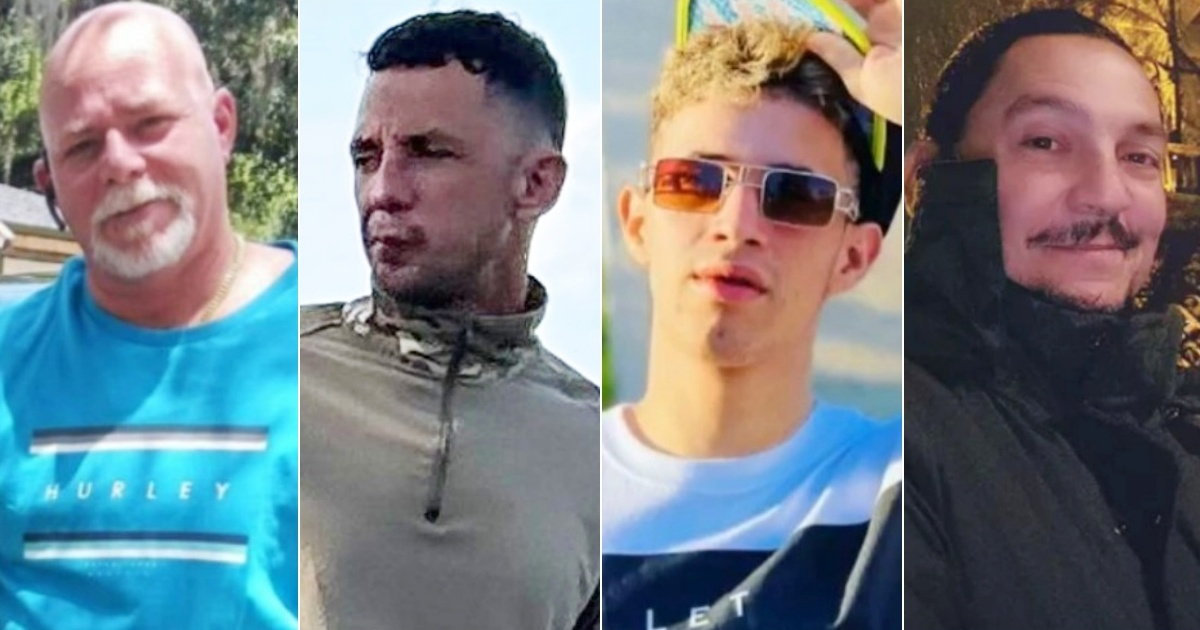
Four names have emerged at the center of an incident that has sparked a new crisis between Havana and Washington: Pavel Alling Peña, Michael Ortega Casanova, Ledián Padrón Guevara, and Héctor Duani Cruz Correa.
They died on Wednesday off Cayo Falcones, in Corralillo, Villa Clara, when a boat registered in Florida was intercepted by Cuban Border Guard troops.
The island's government claims it was an “armed infiltration with terrorist intentions.”
Family members and friends in the United States provide a different perspective and describe the deceased as family-oriented individuals, workers, and exiled activists.
This is the profile of each one of them, based on what is known so far.
Michael (Michel) Ortega Casanova
At 54 years old, originally from Morón, Ciego de Ávila, Michel Ortega Casanova resided in Tampa. His death was the first officially confirmed following the incident on Wednesday
His brother, Misael Ortega, told journalist Mario J. Pentón that Michel had a stable family and business life in the United States, where he owned a transportation company.
He assured that he was unaware of being involved in an armed operation and emphasized that "he was not a person obsessed with or a militant of armed groups."
Ortega Casanova was a member of the Republican Party of Cuba and participated in exile activities.
In Tampa, the organization Casa Cuba declared three days of mourning in his honor.
Its vice president, René Montes de Oca, described him as: "A brother in ideas and a friend."
Family members have questioned the official Cuban version and point out that they have not received direct information from U.S. authorities regarding the ongoing investigation.
Héctor Duani Cruz Correa
He was 42 years old. The authorities of Monroe County in Florida identified him as Héctor Duardy Cruz Cabrera, while the Cuban regime included him in their official statement as Héctor Duani Cruz Correa.
His wife, Yarisleidis, learned of his death hours after reporting his disappearance to the police.
In statements to Univision, she explained that her husband had recently returned from Puerto Rico, where she studies, and that she had not heard from him since the Friday before the incident.
According to his testimony, he worked as a mason and performed maintenance tasks at a residence in Big Pine Key, in the Florida Keys.
The vessel involved was reported stolen from that marina and belonged to the owner of the house where Cruz was doing work.
When asked about possible political or military ties, her response was emphatic: “No, he doesn’t belong to anything; he is the noblest, healthiest person. He doesn’t talk, he doesn’t get involved with anyone; all he does is good and work.”
In the midst of her pain, she insisted, "My husband is the most calm, kind, and good person, the best human being that a mother has ever given birth to."
Those around him describe him as a man dedicated to his work and family, detached from organized political structures.
Pavel Alling Peña
Born in Camagüey, Pavel Alling Peña was a graduate in Art History, a literature teacher, and a writer.
His public profile is far from that of an armed fighter: he was known for his intellectual activity and reflections on national identity.
In a video previously posted on her Instagram account, she spoke out about annexationism.
His words have circulated strongly following the news of his death: “I will give my opinion on annexationism, and this is my personal opinion.”
In that same message, he stated: "Cuba is not just a territory on the map. It is a collective heartbeat."
And he made his stance clear: "I don't want annexation and I don't intend to discuss it with anyone."
He also stated that he would not exchange "sovereignty for annexationism."
His speech combined a defense of freedom for Cuba with a rejection of the idea that the solution lay in annexation to the United States. His death has caused shock among those who knew him as a professor and creator, and it has raised questions about the role he played in the intercepted vessel.
Ledián Padrón Guevara
At just 25 years old, Ledián Padrón Guevara is the youngest of the deceased.
He lived in Houston and, according to testimonies shared by journalist Javier Díaz, he had moved to Miami with the intention of starting training related to a possible action against the Cuban regime.
In the early hours following the incident, his name was not on the list of survivors, which led his relatives to fear the worst. He was ultimately confirmed among the deceased.
From exile, some associates describe him as part of a generation frustrated by the lack of change in Cuba and more inclined toward direct confrontation.
The confrontation and the conflicting accounts
According to the Ministry of the Interior (MININT), the Florida-registered vessel was intercepted in Cuban territorial waters.
The official version holds that he did not comply with the order to stop and opened fire, which resulted in an armed exchange.
The Deputy Minister of Foreign Affairs, Carlos Fernández de Cossío, claimed that it was an "attempt at armed infiltration for terrorist purposes" and that the vessel was found carrying assault rifles, sniper rifles, pistols, Molotov cocktails, night vision equipment, bulletproof vests, ammunition, and "monograms of counter-revolutionary organizations with a terrorist agenda."
The official list of those involved included ten individuals.
In addition to the four deceased, the following individuals were identified as survivors: Cristian Ernesto Acosta Guevara, Conrado Galindo Sariol, José Manuel Rodríguez Castelló, Leordán Cruz Gómez, Amijail Sánchez González, and Roberto Álvarez Ávila.
According to Havana, two of them were on a national list of individuals linked to terrorism investigations.
Meanwhile, the Cuban government reported the detention on land of Duniel Hernández Santos, whom it described as the group's contact and "confessed to his actions."
People who identify as close associates have questioned that account and present him as someone without a history of violence.
From Washington, the narrative has been more cautious. A U.S. official confirmed that at least one of the deceased and one of the injured were American citizens, and that another held a K-1 visa.
The owner of the boat, a 65-year-old man, reported the vessel as stolen from a dock in the Florida Keys.
Secretary of State Marco Rubio stated that the United States will independently investigate the incident.
"I have plenty of reasons to want our own information. In the U.S., we do not make decisions based on what the Cuban authorities say," said Marco Rubio.
He emphasized that it was not a U.S. operation and there was no government personnel involved.
In Miami, in front of the iconic Café Versailles, activists and family members held a vigil.
Some referred to the events as "a massacre" and spoke of "disproportion" in the use of force. Others insisted that, although there are pro-armed struggle positions within the exile community, that does not automatically label those involved as "terrorists."
An unfinished story
Beyond the diplomatic dispute and the exchange of accusations, four men have died and six remain in custody in Cuba.
For the Cuban government, the case fits into the narrative of an organized aggression from the exile community. For family members and loved ones, these are workers, activists, or idealistic youths whose accounts of the events have yet to be heard.
The investigation continues in both countries. For now, the waters off Villa Clara hold more questions than answers.
Filed under: