
Related videos:
The interim president of Venezuela, Delcy Rodríguez, spoke out this Tuesday regarding the escalating violence in the Middle East and adopted a cautious tone in light of the worsening conflict following the recent joint attacks by the United States and Israel against Iran.
In a message shared on her social media, Rodríguez announced that she had a phone conversation with the Emir of Qatar, Tamim bin Hamad Al Thani, in which she expressed Venezuela's “solidarity” in light of the “serious situation of instability and violence that has erupted in the Middle East” and which, she claimed, has placed the entire region “on the brink of a dangerous escalation of war.”
Rodríguez reaffirmed that, in the opinion of his government, "only dialogue and diplomacy can pave the way to peace" and advocated for the "immediate and urgent" reactivation of negotiations, strictly adhering to the principles of sovereignty and independence of states and the values enshrined in the Charter of the United Nations.
Rodríguez also conveyed his condolences "for the loss of civilian human lives across the region" and reiterated the call to respect international law and to preserve peace.
The statement comes amid a large-scale military offensive that has included Israeli airstrikes against strategic facilities in Tehran and other Iranian cities, as well as attacks against the body responsible for designating the successor of the deceased supreme leader Alí Jamenei.
The escalation has generated military responses from Iran and heightened tension in several countries in the Persian Gulf.
Unlike previous statements that were more direct in condemning the actions of Washington and Tel Aviv, the message shared on Tuesday by Rodríguez focused on a general call for diplomacy and concern for regional stability, without explicitly mentioning the United States or Israel.
The contact with the emir of Qatar is significant, given Doha's role as a mediator in various regional conflicts and as a key player in diplomatic conversations in the Middle East.
Qatar is also home to the U.S. airbase of Al Udeid, which has been mentioned in recent reports regarding potential Iranian attacks in response to the offensive.
The statement from the interim president of Venezuela comes at a sensitive political moment for Caracas, following Nicolás Maduro's arrest in January and the ongoing transition supervised by the United States.
In this context, the Venezuelan government seems to be opting for a cautious discourse that emphasizes dialogue and international law, amidst a conflict that threatens to escalate and affect global energy and diplomatic stability.
The historic alliance of Chavismo with Iran
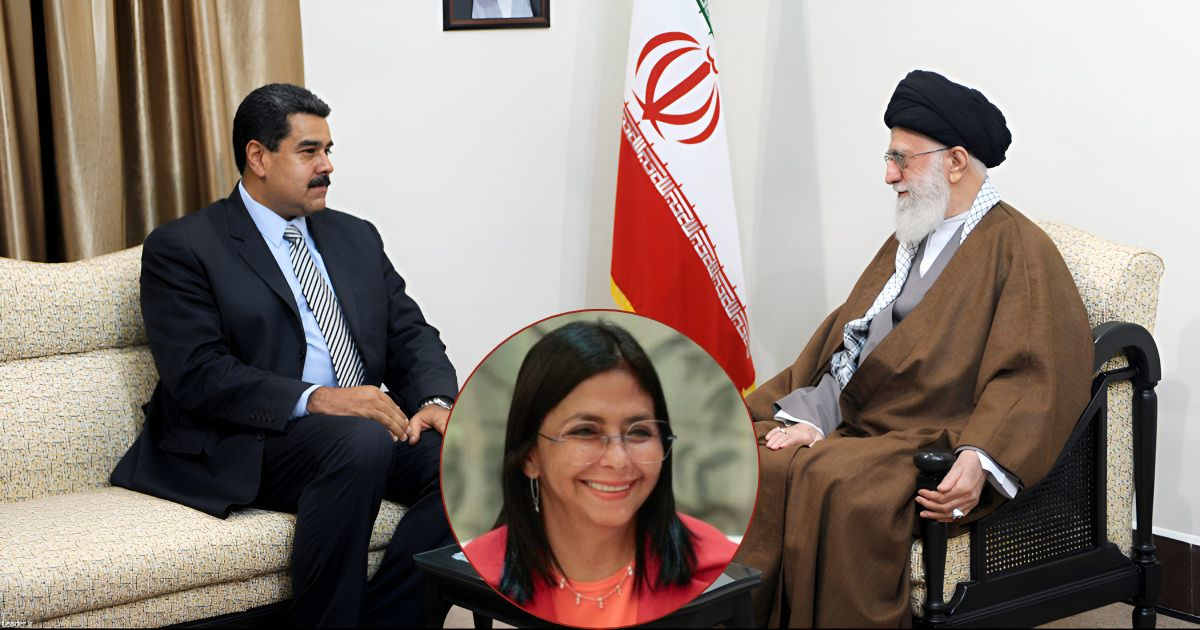
Before the capture of Nicolás Maduro on January 3 and the beginning of the current political transition in Venezuela, the relationship between chavismo and Iran was one of the strongest pillars of Caracas's foreign policy.
For over two decades, both governments built a strategic alliance based on energy cooperation, economic agreements, and an ideological alignment characterized by their open confrontation with the United States.
The approach was solidified under the leadership of Hugo Chávez, who established a close relationship with Tehran within the framework of a shared narrative against what both governments referred to as "imperial hegemony."
Since then, Venezuela and Iran have signed dozens of agreements in sectors such as oil, petrochemicals, housing, industry, and defense, in addition to developing mechanisms to circumvent international sanctions.
With Nicolás Maduro, that alliance not only remained intact but deepened. In 2022, both countries signed a 20-year strategic cooperation agreement that strengthened ties in energy, economy, and technology.
During the toughest years of U.S. sanctions, Iran sent fuel shipments to Venezuela and collaborated in the reactivation of refineries, while Caracas provided political support to Tehran in international forums.
In that context, the statements from chavismo were often categorical in defense of Iran against Israel or Washington, with direct condemnations of U.S. military actions and explicit support for the Islamic Republic.
For this reason, the tone now adopted by interim President Delcy Rodríguez—focused on calls for dialogue, diplomacy, and respect for international law, without direct mentions of the United States or Israel—marks a significant contrast with the traditional rhetoric of chavismo.
The current caution reflects a different political scenario for Caracas, amid an internal transition and under a new correlation of forces on the international stage.
Filed under: