
Related videos:
U.S. federal authorities are investigating an oil operation involving a cargo ship loaded in Colombia and an energy sector intermediary who in the past was linked to business dealings with Colombian entrepreneur Álex Saab, considered by Washington one of the main financial operators of the chavismo.
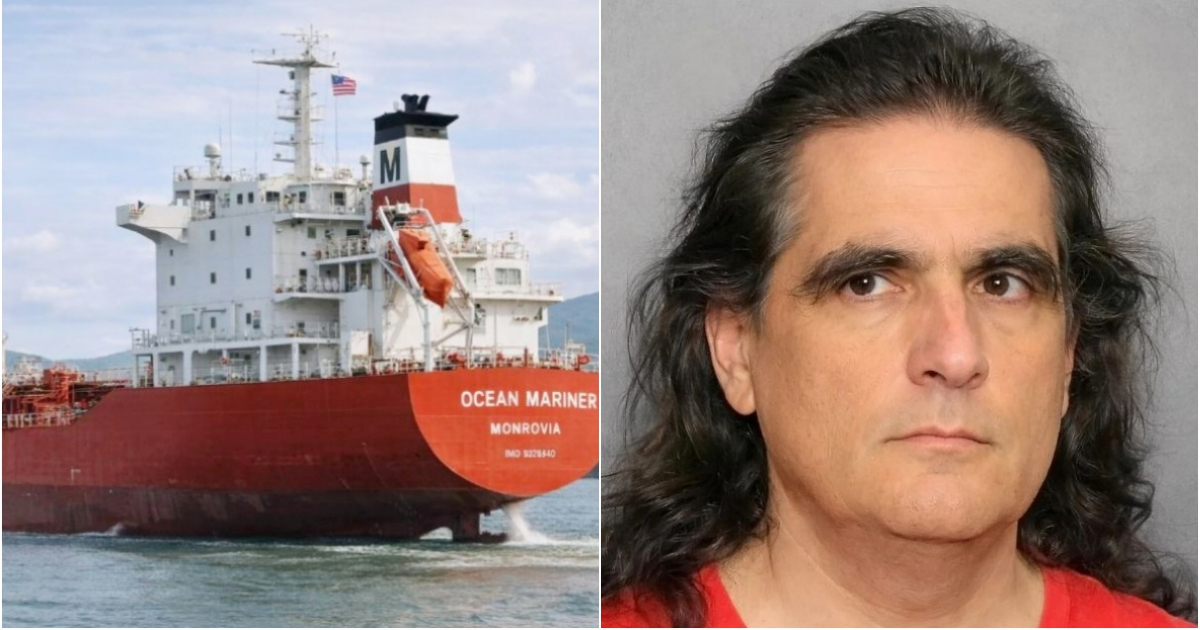
The case revolves around the petroleum vessel Ocean Mariner, which set sail in early February from the Colombian coast and, according to an alert sent by U.S. authorities, may have had Cuba as its final destination, in a context marked by Washington's sanctions against the island.
According to exclusive revelations from the Colombian newspaper EL TIEMPO, the incident is part of a confidential file being examined by the FBI regarding possible maneuvers to circumvent U.S. sanctions on Cuba and an alleged smuggling of subsidized diesel from Colombia.
A tanker under suspicion
The Ocean Mariner, a ship registered under the flag of Liberia, departed on February 5, 2026, from the Sitio Nuevo Port Authority in Palermo (Magdalena), located about 12 kilometers from Barranquilla.
According to the official export documents, the shipment consisted of fuel oil, a heavy fuel used for power generation and industrial machinery.
However, the vessel was intercepted by the U.S. Coast Guard in the Caribbean after suspicions arose that it was illegally headed for Cuba.
The alerts were not limited to the cargo's destination.
A senior official from the U.S. Department of Homeland Security sent an email to the National Tax and Customs Office (DIAN) of Colombia stating that the cargo may not be fuel oil, as indicated in the documents, but rather subsidized smuggled diesel.
After the incident at sea, the tanker changed its route and ended up unloading the fuel in the Bahamas, where the cargo was sold to the multinational Trafigura Group PTE Ltd., one of the largest commodity traders in the world.
A multi-million dollar operation involving several companies
The business operation involved at least three identified companies, according to the investigation published by EL TIEMPO:
- ISM Engineering Services, Assembly, Service Stations SAS (ISM), as the fuel selling company.
- Monarch Security Latin America Inc., as the intermediary of the operation.
- Trafigura Group PTE Ltd., as the end buyer.
The business exceeded 6.9 million dollars.
According to the report, a fourth company whose name has not been publicly revealed would have participated.
So far, the entrepreneurs involved maintain that the operation was completely legal, and they assert that no authority has requested formal explanations from them.
The name of an intermediary indirectly linked to the Saab environment
In the midst of the investigation, the name Felipe de la Vega Vergara emerged, a well-known broker in the hydrocarbons sector.
According to sources cited by EL TIEMPO, at least one person familiar with the negotiation mentioned De la Vega as a possible intermediary in the transaction.
The interest in his figure can be explained by his past business ties with the company Trenaco SAS, in which Carlos Gutiérrez Robayo, brother-in-law of Colombian president Gustavo Petro, was involved.
That company gained prominence in 2016, when it became known that Álex Saab -who was already under investigation by the U.S. as a suspected frontman for Nicolás Maduro- showed interest in acquiring it.
In an interview with the Colombian newspaper, De la Vega denied any connection to the operation of the oil tanker.
"I have no idea who they are or why I am being mentioned. As I already stated, I was not the one who mediated this sale nor did I offer that product to any other company or buyer," he claimed.
The businessman also acknowledged that he has worked for years as an intermediary in transactions in the energy sector.
"I do not export or import; I introduce potential buyers or sellers to different companies in the sector, both in Colombia and internationally. I also advise on logistics matters. This involves many companies. I have not worked with sanctioned countries or products," he said.
He also stated that he has not had any relationship with the brother-in-law of President Petro for over eleven years.
Inspections before the vessel's departure
Before authorizing the departure of the Ocean Mariner, Colombian authorities conducted inspections of the cargo.
In the operation, the DIAN, the Fiscal and Customs Police (Polfa), and an official from Ecopetrol participated.
According to EL TIEMPO, the initial alert that raised suspicions in Washington came when the ship was being loaded at the port of Palermo.
Despite the warnings, Colombian authorities found no legal grounds to detain the ship, so the captain of the vessel -John Paul Lamis Fojas- was granted permission to set sail.
Additionally, the Ministry of Mines and Energy sent a letter on February 1 clarifying the nature of the exported product.
"According to the technical and tariff information contained in the declarations, the products involved in the operations correspond to fuel oil, which is not subject to the stabilization regime of the Fuel Price Stabilization Fund (FEPC), which is why its export does not require prior authorization or certification," the letter states.
The authorities also confirmed that fuel samples were taken for analysis at the Reficar laboratory, the Ecopetrol refinery, although at the conclusion of the investigation the results were still not available.
The companies defend the legality of the business
The selling company ISM assured that the shipment was indeed fuel oil and that all legal requirements were met.
Additionally, he explained that the deal was conducted under the Free On Board (FOB) modality, which means that the seller's responsibility ends when the ship leaves the port.
For its part, the company Camin Cargo Control Inc., responsible for the routine inspection of the cargo, clarified that the identification of the fuel does not correspond to the inspection companies.
"We do not name the content ourselves. That is done by the sellers or buyers. We have no further comments on this matter."
Petro denies irregularities and criticizes U.S. policy.
The Colombian president Gustavo Petro reacted to the media reports defending the legality of the operation.
In messages posted on the social network X at the end of February, the president stated that the shipment was carried out by a private company and denied that the Colombian state had participated in the sale or transport of the fuel.
"Who is loading the ship is a private company, and to that private oil company, they provide documents for the ship that is purchasing the oil, stating that it is headed for the Dominican Republic," said Petro, who insisted that there was no irregularity whatsoever.
"There is no Colombian irregularity, either public or private," he stated.
The leader also took advantage of the controversy to question the U.S. embargo against Cuba and stated that “there is no crime in freely transporting oil in the Caribbean”.
The international context: Saab comes back on Washington's radar
The case arises at a time when the name of Álex Saab is once again coming to the attention of U.S. authorities.
According to Reuters, Washington has recently communicated to Venezuelan authorities a list of individuals it wishes to have detained or kept in custody, including Saab.
The Colombian businessman, regarded for years as one of the most influential financial operators of Chavismo, was arrested in Cape Verde in 2020, later extradited to the United States, and charged with bribery and money laundering in connection with a scheme involving housing contracts in Venezuela.
In 2023, he was released by the Joe Biden administration as part of a prisoner exchange with the government of Nicolás Maduro.
The fact that an intermediary mentioned in the operation of Ocean Mariner had previous business ties with structures in which Saab expressed interest has added an additional dimension to the case, although there is no official confirmation so far that the cargo was intended for Cuba or that this intermediary participated in the transaction.
In any case, the episode places Cuba at the center of Washington's investigations into energy operations in the Caribbean, especially those that could help circumvent U.S. sanctions against the island.
Although Colombian authorities and the involved businessmen insist that the shipment from the Ocean Mariner was legal and that its declared destination was the Dominican Republic, suspicions that the fuel might end up in Cuban territory—along with the emergence of intermediaries indirectly linked to business networks associated with Álex Saab—have led U.S. federal agencies to examine this and other similar transactions in the region more closely.
Filed under: