
Related videos:
Italy and France have aligned themselves with the stance expressed by the Spanish Prime Minister, Pedro Sánchez, regarding the war in Iran, asserting that while it is one thing to refrain from supporting or participating in the conflict, it is quite another to strengthen the protection of allied countries in the face of a military escalation in the region.
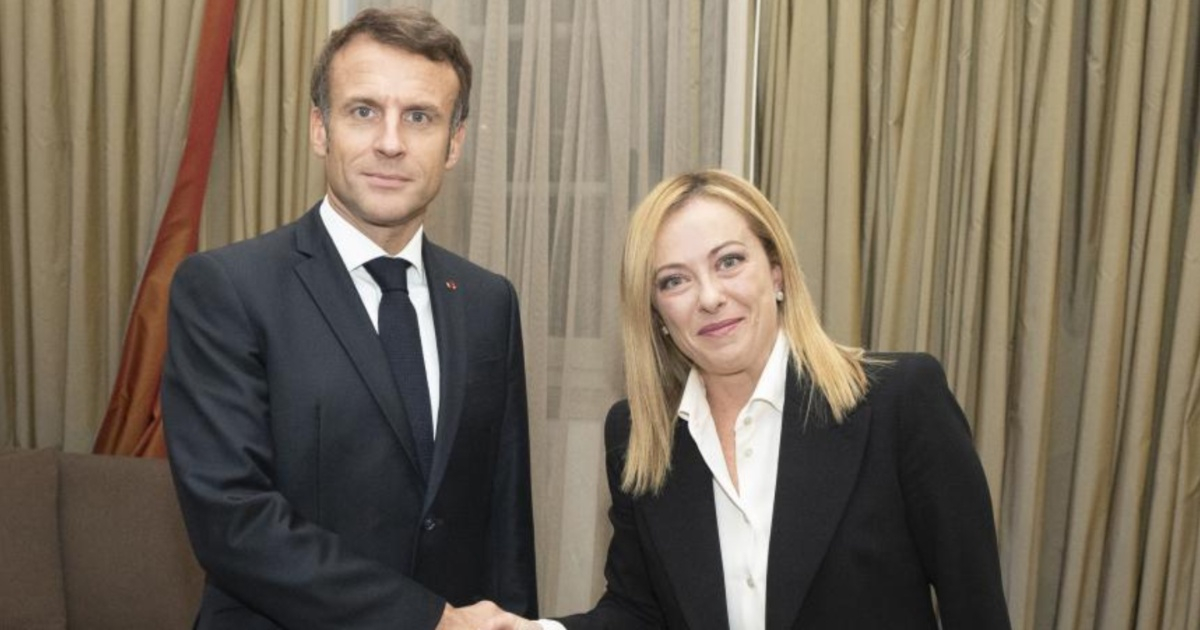
According to a report from the newspaper Onda Cero, both Italian Prime Minister Giorgia Meloni and French President Emmanuel Macron have emphasized that their countries are not at war with Iran nor do they wish to get involved in it, despite having deployed military resources for defensive purposes in the Eastern Mediterranean.
The text places this alignment amid the open tension between Donald Trump and Pedro Sánchez after the Spanish government denied U.S. forces permission to use the bases in Morón and Rota for an offensive against Iran.
Following that decision, according to the provided material, Trump threatened to "cut all trade" with Spain, while Sánchez appeared to criticize the conflict as "illegal" and to revive the slogan "No to war" from 2003.
The response from the U.S. president included derogatory remarks against Spain, which he referred to as "losers."
In that context, the document argues that Sánchez "is not alone" in his approach. It explains that, although a debate has arisen in Spain regarding a possible contradiction between rejecting war and sending a frigate to Cyprus, other European governments have acted similarly.
France has deployed an aircraft carrier and missile defense systems; the United Kingdom has sent a ship; Greece has dispatched fighter jets; and Italy has provided naval vessels and missile defense systems.
The purpose attributed to these movements is not to engage in bombings on Iran, but to strengthen the security of allies in light of the deteriorating situation in the region, especially after an Iranian drone struck a British military base located in Cyprus, a member country of the European Union.
Meloni's position is stated explicitly. The Italian Prime Minister emphasized this Thursday that Italy "was not at war" and did not want to become involved in one.
"I want to reiterate that we are not at war and do not want to enter into a war," he stated, in remarks presented by the text as an example of a doctrine similar to that defended by the Spanish Executive: a rejection of war while being willing to protect allies and maintain a strategy of deterrence.
Macron, for his part, expressed a similar idea. According to the provided material, the French president stated that his country would not "get involved in this war" against Iran in the Middle East.
"France is not part of this war. We are not in combat and we will not get involved," he said. This phrasing is presented in the document as further implicit support for the distinction that Sánchez is trying to draw between direct military support and defensive deployment to protect European allies.
Defenders of allies, do not support the war
The text explains that the difference between "supporting the war" and "defending the allies" constitutes the core of the political and strategic debate.
In the Spanish case, the Minister of Defense, Margarita Robles, framed the deployment of the frigate 'Cristóbal Colón' to Cyprus within a context of "deterrence and defense" for the European Union.
The interpretation noted in the document is that mobilizing resources to protect allied territory or intercept potential threats does not equate to joining in the bombings or attacks on Iran.
That same reasoning is reinforced in the text with the opinion of retired Admiral Juan Rodríguez Garat, cited by RTVE, who summarized that thesis with a decisive statement.
"Defending an island does not make you belligerent." From this idea, the document emphasizes that military presence in Cyprus or nearby areas should be understood as a measure of containment and protection, not as support for military offensives against Iran.
Tension in Europe
The crisis that has erupted in the Middle East following the attack by the United States and Israel against Iran on February 28 has triggered a rapid military and diplomatic escalation with global repercussions.
In the early days of the conflict, several European powers began to assess their position regarding the Iranian offensive and reprisals.
Initially, France, Germany, and the United Kingdom warned that they were ready to take "proportional defensive actions" against Iran to protect their allies and personnel deployed in the region.
On the same day, an Iranian drone struck the British base at Akrotiri in Cyprus, highlighting just how far the war had reached interests linked to the European Union.
The tension also shifted to the political arena within Europe. The Spanish Prime Minister, Pedro Sánchez, revived the slogan "No to War", popularized during the Iraq invasion in 2003, to establish Spain's stance regarding the conflict with Iran.
In an institutional statement, the leader rejected the armed conflict and called for a diplomatic and political solution, while expressing solidarity with the countries affected by the Iranian attacks and warning about the possible economic and humanitarian consequences of a prolonged war.
The position of the Spanish Executive comes amid a deterioration of relations with Washington.
The U.S. president Donald Trump threatened to cut all trade negotiations with Spain after Madrid declined to authorize the use of the military bases in Rota and Morón for operations related to the war against Iran.
The leader described Spain as a “terrible ally” and stated that he could suspend economic agreements with the European country, which opened a new diplomatic front within an international landscape already marked by military escalation in the Middle East.
Filed under: