
Related videos:
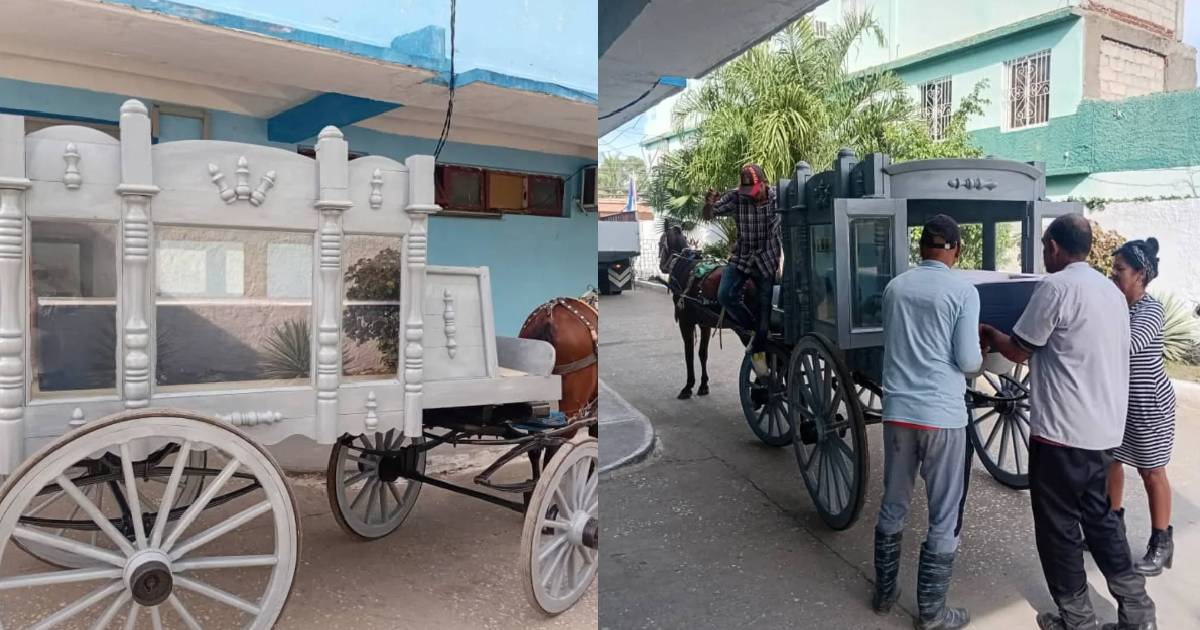
A cooperative in the city of Bayamo has started offering funeral transportation in a horse-drawn cart as an alternative due to the scarcity of fuel, which has sparked an intense debate on social media about whether it reflects creativity or the structural crisis that has plunged Cuba.
The agricultural production cooperative (CPA) Celia Sánchez Manduley, in the capital of the province of Granma, announced on social media the launch of a funeral service using a hearse, presented as an alternative due to the lack of fuel for transporting the deceased.
The initiative was also shared by the user Sucel Fajardo, who stated on her Facebook profile that the cooperative continues to “contribute through the search for creative solutions” to provide services to the community.
According to the cooperative itself on its page, the service was created in response to the fuel shortages affecting traditional funeral cars, a crisis that has worsened in recent years across the country.
The post sparked a heated debate among users. Some defended the initiative as a practical solution to the lack of resources and pointed out that horse-drawn hearses exist in other countries.
“At least there was creativity, and it is symbolic of the city,” commented an internet user, referring to the high number of horse-drawn cars, something that distinguishes the eastern Cuban city.
Others stated that it could even prove to be more dignified than the poorly maintained state vehicles.
However, many users reacted with indignation and felt that the measure reflects the regression and precariousness of the country.
"This is not creativity, this is misery, romanticization of poverty, and a lack of government capability," wrote a commentator. Others criticized the complacency toward what they consider a symbol of the deterioration of public services in Cuba.
The controversy occurs in the context of a deep crisis in the funeral system on the island. In recent months, multiple incidents have been reported related to the lack of funeral vehicles, fuel, and coffins.
Recently, the official broadcaster CMHS Radio Caibarién reported that in the municipality of Villa Clara artisanal production of coffins has begun to address the shortage affecting funeral services.
The announcement sparked similar reactions on social media, where some users mocked the official narrative that attributes these shortages to the U.S. embargo.
The crisis has led to increasingly frequent scenes of improvisation. In Velasco, Holguín, a family had to make a coffin out of cardboard and adhesive tape due to the complete lack of coffins at the local funeral home.
The deceased was taken to the cemetery on a tricycle by family members after the body had remained for hours in the home without electricity or funeral transport.
In parallel, several incidents involving deteriorated hearses have been documented in different provinces. In some cases, the coffins have fallen in the middle of the street during transport, leaving the bodies exposed to passersby.
Meanwhile, the Ministry of Transport announced at the end of 2025 the addition of 15 electric funeral vehicles for Havana, a project that the government claims will progressively expand to the rest of the country.
However, outside the capital, many families continue to face serious difficulties in transporting and burying their deceased loved ones, in a funeral system increasingly characterized by a lack of resources and improvisation.
Filed under: