
Related videos:
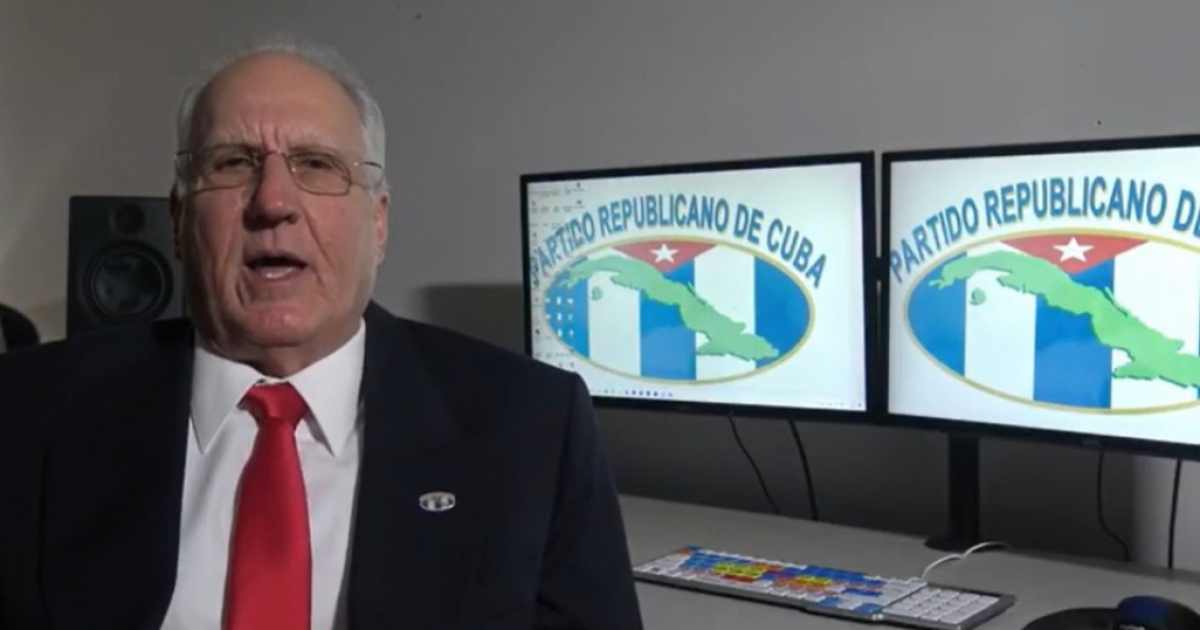
The president of the Cuban Republican Party (PRC), Ibrahim Bosch, made statements to CiberCuba in which he addressed issues related to the political situation on the Island, possible pathways to a system change, and the recent armed incident that occurred off the coast of Villa Clara, where a boat coming from Florida was intercepted by regime forces.
The conversation took place after it was revealed that one of the men who died during the incident was a member of the PRC. The Party, founded in 2003, defines itself as an opposing political organization whose mission is to work alongside Cuban society to put an end to the communist system and promote a democratic transition in the country.
During the interview, Bosch referred to reports about contacts between power sectors in Cuba and the administration of U.S. President Donald Trump.
The opposition leader considered that any movement that opens the door to changes on the Island generates expectations, although he also expressed reservations about a potential transition designed from abroad.
"A transition carried out by a country like the United States, I am glad it is happening, because the domino is moving. But an uprising of a people that sweeps away the beasts in power would have been something more authentic," he commented.
"But if it's managed by the U.S. administration, we have little to say, because they will do it their way. And perhaps, in some way, it will resolve and fulfill U.S. interests, not necessarily 100% of our interests," he noted.
Bosch acknowledged that, after more than six decades of failed attempts to achieve transformation in the country, many opponents view any potential scenario for change as an opportunity, even if it does not fully meet their aspirations.
"If we haven't been able to achieve this in the past 67 years, despite trying everything through every means, and the United States does it, well, what can we do? It may not be in the best way, but we hope that freedom arrives by any means. Our people deserve it; they need it," he stressed.
When discussing the strategies that could help bring an end to the regime, the leader of the PRC considered that the economic pressure policy of the Trump administration could be an effective tool.
"A good method is the one that this administration is using, suffocating," he stated.
Bosch also expressed skepticism about the possibility of reaching political agreements through negotiations with the regime. In his view, the Cuban authorities have not demonstrated a genuine willingness to engage in dialogue to resolve the country's crisis.
"There is no reliable type of negotiation with them; they simply do not want to negotiate," he pointed out.
In his view, the government remains entrenched in power, ignoring the difficulties faced by the population. "See their people living off garbage, they don't care," he stated.
In that same context, he questioned the official narrative that attributes the shortage of food and medicine to the U.S. embargo. Bosch recalled that the United States remains one of the main suppliers of agricultural products to Cuba.
"There is no blockade on food. And yet, in Cuba, there are neither medicines nor food. So, what blockade is being discussed? The whole world negotiates with them or is willing to negotiate. But they don't pay, they don't produce," he argued.
The interview also addressed the issue of annexationism, a stance that has gained visibility in certain sectors due to the prolonged economic and political crisis on the Island. Bosch rejected that possibility, although he expressed understanding for the reasons that lead some people to consider it.
"How can I be in favor of annexation while belonging to an organization with this name?" he replied.
In their opinion, the phenomenon arises from the frustration of generations that have grown up in precarious conditions and without prospects for development.
"A person who is 20 or 30 years old is born in a country of needs, is born into trash and leaves from trash. And they cannot imagine what we could be. (...) It saddens me that people with some level of authority show their community such a position of incapacity, as if we are incapable of governing ourselves," he lamented.
The political leader also criticized the U.S. authorization for the sale of Venezuelan oil to Cuba through small and medium-sized enterprises. In his opinion, this measure would ultimately benefit the state apparatus itself.
"It seems very negative to me, it's going to give them oxygen. They are not private companies," he asserted.
One of the topics of the interview was the incident that occurred in Cayo Falcones, Villa Clara, where a boat coming from Florida was intercepted by the Border Guards, resulting in a confrontation that left four crew members dead. One of them was Michel Ortega Casanova, a member of the PRC.
Bosch explained that the Republican Party of Cuba is a political organization and does not promote, direct, or organize armed actions against the Cuban government.
"It is not among our actions to prepare individuals to carry out these types of military incursions in Cuba," he assured.
It also clarified that, due to the size of the organization and its presence both inside and outside the Island, including the United States, the Party does not have control over the personal decisions of its members.
"Aside from that, no Cuban has to ask for permission to fight for freedom. We are a purely political organization, but members are free to act, and we respect the individual right of each person to proceed as they see fit," he stated.
After the incident, the PRC issued a statement distancing itself from the operation carried out by the group of 10 Cubans residing in Florida who were traveling on the vessel.
In the dialogue with CiberCuba, Bosch interpreted the episode as a sign of the level of desperation that Cubans experience after decades of repression and lack of freedoms.
"We are desperate, anxious. Our people have been pushed to the limit of oppression by this tyranny for 67 years," he denounced.
He recalled that the dictatorship has closed all civilized paths to resolve the issue. "And the people have the right to freedom, and if they are not allowed to resolve it in a civilized manner, the people have the right to rebellion," he stated.
The opposition figure avoided condemning those who participated in the incursion and asserted that they deserve respect, regardless of the circumstances.
Finally, when discussing the possibility that the group had been betrayed or that the Cuban authorities were aware of the operation beforehand, he stated that he does not rule out any scenario.
"Anything is possible. Just look at how diabolical, how criminal, and how terrorist they are. If they knew, the crime is even more heinous. If they knew, it's even more brutal that they didn't warn the United States," he reflected.
Filed under: