
Related videos:
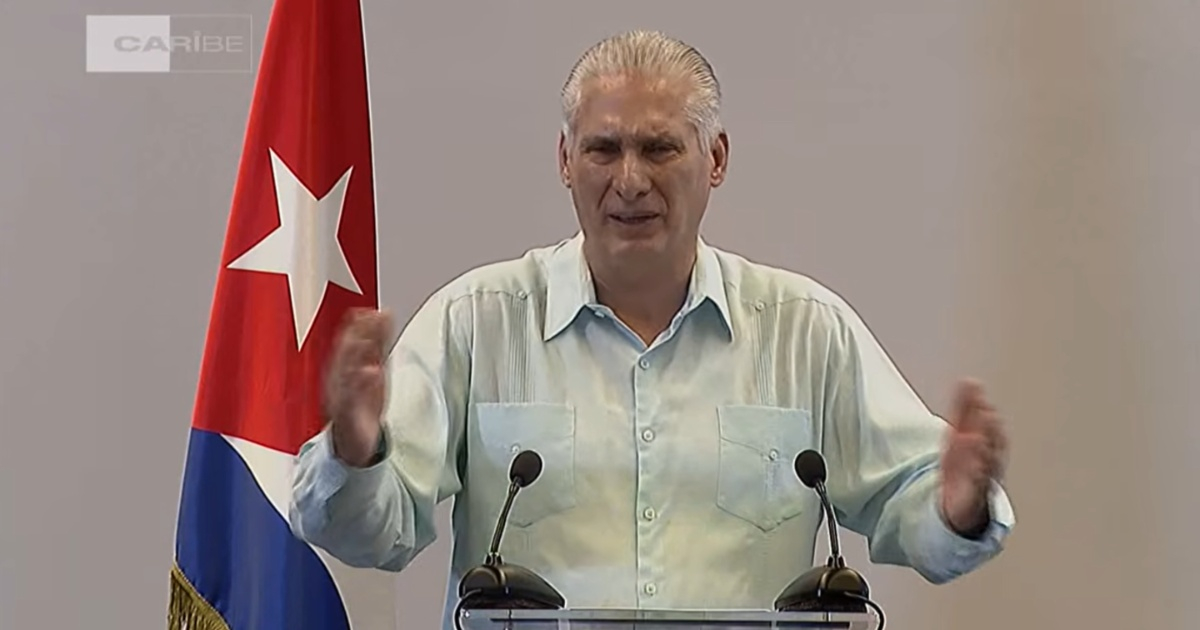
Miguel Díaz-Canel stated this Friday that “Cuba is working hard to move forward” amid the energy crisis affecting the country, and assured that the Government is implementing measures to confront a situation that, according to him, has been worsened by what he described as an “energy blockade.”
The ruler made this statement in a message posted on X, where he also mentioned that he had discussed with the Cuban press "that and other important topics for the nation," including the recent conversations between Cuban officials and representatives of the United States government.
In his message, Díaz-Canel directly linked the national situation to the energy scenario.
"Confronted with the colossal challenges posed by the energy blockade, Cuba is working hard to make progress," he wrote, before noting that in his remarks he had also spoken about recent discussions with Washington.
This formulation presented two central axes of his public discourse on the same level: the internal crisis caused by the blackouts and the existence of contacts with the U.S.
During the television appearance, the leader insisted that the government is already implementing solutions to address the crisis, although he admitted that its effects are not yet fully visible.
"There are solutions; the issue is that the magnitude of the problem is so great that they are not visible," he stated, defending the official response to the prolonged blackouts.
According to his explanation, the energy crisis is currently the issue generating the most "discomfort" and "distress" among the population. Díaz-Canel maintained that the recent worsening of power outages is due to the intensification of the so-called "energy blockade" and asserted that the country had previously prepared for this situation with "a whole set of proposed actions" and measures already in development.
He stated that no fuel has entered Cuba in the last three months.
He stated that, due to the lack of supplies, the country has had to rely on national crude oil, thermoelectric plants, and renewable sources to maintain electricity generation during the day, especially from solar parks, which contributed between 49 and 51 percent, depending on the sunlight and system conditions.
He added that at night, the generation relies on thermal power plants and the associated gas from the extraction of national crude oil.
In that context, he explained that until last week, there were still reserves of fuel oil and diesel being used in two key points of the electrical system: distributed generation engines in Moa and a system of engines in Mariel.
But he assured that, after three months without fuel supply, those resources were depleted, leading to the exit of "a considerable number of megawatts" from the system, especially during peak hours and at night.
The crisis is spreading
Díaz-Canel later described a series of technical consequences resulting from that loss of capacity. He noted that the shutdown of those plants caused fluctuations, the abrupt disconnection of the Antonio Guiteras thermoelectric plant, and subsequently a blackout.
He also justified that the recovery of the system required fuel, even in the generators of the islands, to generate initial signals that would allow thermal power plants to start up and synchronize photovoltaic parks.
The ruler tried to differentiate this stage of crisis from previous moments.
He said that in January and February, the government had managed to keep blackouts "not exceeding" those of December and that it had controlled the situation "effectively," although he acknowledged that extended outages were already occurring.
According to his account, the current difference lies in the loss of those additional capabilities for distributed generation, which has made the system much more fragile.
He also added that Cuba has over 1,400 megawatts of recovered distributed generation available, but it has been unable to use them due to a lack of fuel.
He argued that, if that resource were available, it would be possible to add that generation during the night, significantly reduce the deficit during peak hours, and lessen the electrical disruptions.
In his speech, Díaz-Canel acknowledged the significant social impact of the crisis.
He stated that there have been circuits and communities, both in Havana and in other provinces, experiencing over 30 hours of blackout. He admitted that this situation causes "excitability," "discomfort," and "anguish" among the population, and pointed out that the lack of electricity also affects water supply and pumping, productive services, communications, medical care, education, and transportation.
Despite this acknowledgment, he rejected the idea that the responsibility lies with the government, the revolution, or the Electric Union. "The blame is not on the government, the blame is not on the revolution," he stated.
Instead, he attributed the situation directly to the "energy blockade" and praised the workers in the electricity sector, whom he described as "titans" for enduring long hours of work while they and their families also suffer from the blackouts.
Filed under: