
Related videos:
The post by Miguel Díaz-Canel about the Baraguá Protest triggered a wave of reactions on Facebook that, at least in the reviewed sample, was predominantly marked by criticism, mockery, and political rejection of the Cuban leader, in a particularly sensitive context following the official acknowledgment of contacts with the United States.
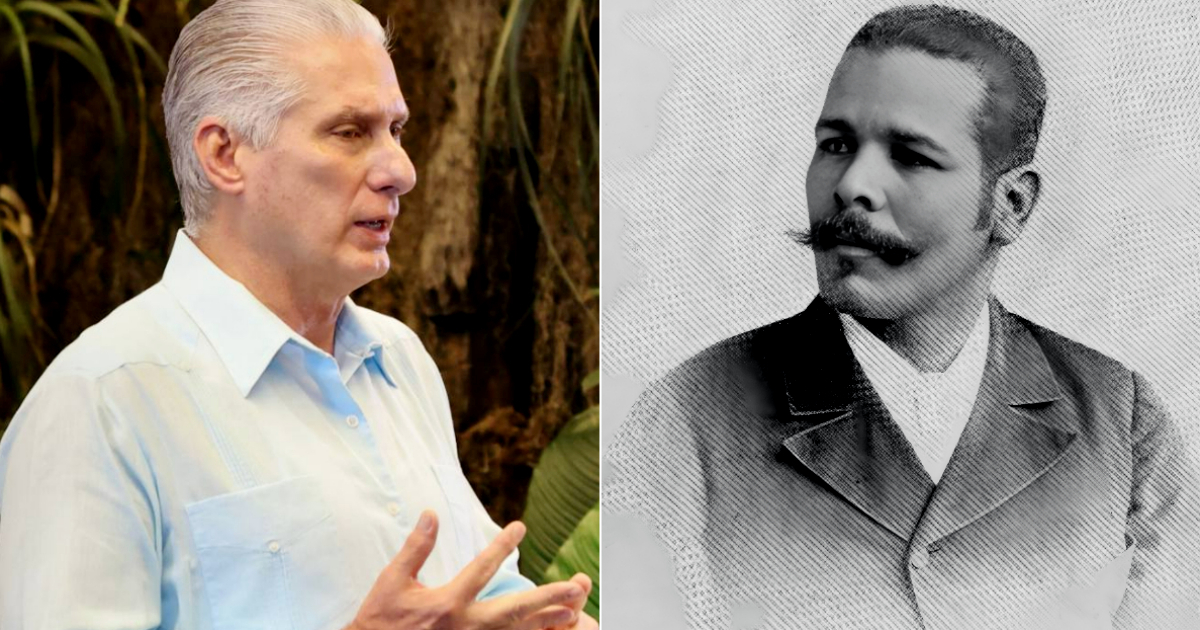
The leader appointed by Raúl Castro wrote on Facebook: “It is called Baraguá, and what strikes us from history is Antonio Maceo's intransigence against the Pact without independence: 'We do not understand each other,' he tells the Spanish counterpart and summons his troops to 'break the corojo' soon. We will always owe ourselves to that legacy of dignity.”
But the appeal to one of the symbols most used by official propaganda did not generate a supportive response. On the contrary: there were many comments that reinterpreted the legacy of Antonio Maceo against the regime itself, turning the phrase “We don’t understand each other” into a slogan directed from the citizenry to the power.
One of the most evident patterns was precisely that: the opposition's appropriation of the symbol of Baraguá. Several comments assert that Maceo did not fight to justify a system without freedoms, but rather to defend the independence and dignity of the Cuban people.
“Baraguá was to say NO to a pact without freedom. Today, millions of Cubans also say NO to living without rights, without a voice, and without a future”, wrote one person. Another summarized the same idea this way: “True dignity would mean that the Cuban people can live in freedom, prosper through their work, and not have to leave their country to seek a future”.
In the same vein, many messages reversed the historical analogy proposed by Díaz-Canel, casting the Cuban people in the role of Maceo, while presenting the regime as the counterpart to which one says, “We do not understand each other.”
“That is exactly what the people say to you and to everyone who walks with you: We do not understand each other”, stated a comment. Another insisted: “In this case, Maceo is the Cuban people and you are the invaders”.
A second significant block of reactions questioned the political use of history and accused the ruler of manipulating patriotic figures to uphold a narrative that clashes with the current reality.
"You manipulate history to your advantage", said a user. Another person found the comparison "almost disrespectful" and recalled that Baraguá occurred "in a wartime scenario," while a contemporary government should focus on "managing the economy, ensuring citizen welfare, and overseeing institutions."
There were also numerous comments rejecting any identification between Maceo and the current Cuban political system. "Maceo and communism have nothing to do with each other," wrote one user. Another was more direct: "The mambises were never communists."
In that same vein, several messages insisted that if Antonio Maceo were alive today, he would be on the side of the dissatisfied people and not the government. "If Maceo were alive right now…”, wrote one commentator, leaving an irony that was echoed in various forms. Another comment was even more explicit: "If Martí and Maceo were alive, they would be political prisoners of this system."
The opinions of internet users also revealed a third dominant theme: the weariness of the heroic narrative in the face of the country's material crisis. Many comments countered the official epic with concrete references to hunger, blackouts, shortages, and the deterioration of everyday life.
“With that legacy of dignity, we provide for our children, we have electricity, water, gas, food, medicine, and a decent life,” wrote a user in a clearly sarcastic tone. Another summed up the social fatigue with a blunt phrase: “The story is very beautiful, but these are different times and Cuba is dying.”
That tension between command and starvation appeared again and again. “No one lives on history. The people need food, electricity, medicine.”, a comment pointed out. Another noted: “Always with history and an empty belly, how much longer will this last?”.
In several messages, the criticism was not only political but also moral: the ruling elite was accused of invoking sacrifices that they do not share and demanding resilience from a position of privilege. "For you, it is very easy to continue living at the expense of a people who are dying of hunger and misery,” was read in one of the responses.
A fourth element was added to this: mockery as a means of delegitimization. The publication of "puesto a deo" collected a remarkable volume of sarcastic comments, verbal memes, references to his physical appearance, to his weariness, and to an alleged growing fear.
"You have little time left," "you just left," "pack your bags," or "nobody wants them in power" were phrases that were often repeated. Beyond the tone, all pointed to the same thing: the questioning of their authority and the perception of weakness in power.
Another group of responses linked the post to the current political moment and highlighted the contradiction between the rhetoric of Baraguá and the negotiations with Washington. "But you literally just admitted a few hours ago that you are finding common ground", one internet user reproached.
Another asked sarcastically: “Are there or are there not conversations with the USA?”. In several comments, the idea emerged that Díaz-Canel is trying to project toughness exactly when the regime is sending signals of retreat or seeking accommodation.
In general terms, the evocation of Baraguá did not manage to organize the debate surrounding the revolutionary epic; rather, it opened up a space for many Cubans to reinterpret that symbol as a break from power.
The phrase “We do not understand each other,” intended by Díaz-Canel as a tribute to the patriotic intransigence of Antonio Maceo, ended up being repurposed by numerous commentators as a declaration of divorce between the regime and a visible portion of the citizenry.
More than strengthening the official narrative, the post seemed to expose its main problem: the gap between the story invoked by the power and the concrete experience of a country exhausted by scarcity, emigration, repression, and a lack of horizons.
In that context, Baraguá ceased to be merely a worn-out symbol of the regime and returned, at least in commentary, to being a contested ground.
Filed under: