
Related videos:
On February 28, 2026, when the first U.S. and Israeli missiles struck the Iranian nuclear facilities in Natanz and Isfahan, most Cubans were in the dark. Literally: blackouts were already exceeding 15 hours daily in much of the country. But what followed that night would further increase the prices of what little was left in the agromarkets.
In less than three weeks, Brent rose from $67 to over $110 per barrel. The Strait of Hormuz —through which 20% of the world's oil passes— was effectively blocked. Global prices for wheat, corn, and soy reached levels not seen in years. And fertilizers, of which the Persian Gulf exports nearly one-third of the world's production, increased in price by between 20% and 77% in just a few days.
For any other country in the hemisphere, this clash would be serious. For Cuba, which reaches this moment without foreign oil since December 2025 and with a population where 89% lives in extreme poverty, it is a sentence.
Cuba before the shot: a patient on life support
To understand why the Gulf conflict impacts Cuba with an intensity that has no equivalent in any other country in the region, one must comprehend the state in which the island arrived by February 2026.
The Cuban peso was worth 24 to the dollar when the regime launched the so-called Tarea Ordenamiento in January 2021. Today, in the informal market — the only place where Cubans can truly buy foreign currency — it is worth 515 CUP per dollar. In five years, the currency has lost 95% of its real value. The official inflation rate for 2025 was 14%; independent economists estimate it to be around 70%. The basic basket for one person in Havana already exceeded 42,000 pesos per month before the Gulf war started. The average state salary hovered around 6,600 pesos. The arithmetic needs no explanation.
This must be added to the fact that Cuba entered 2026 without the two sources of oil that had sustained its electrical system for years. Venezuela stopped sending crude in January, when the Trump administration intervened militarily and captured Nicolás Maduro. Mexico suspended its deliveries under U.S. pressure. The island produces internally about 40,000 barrels a day—less than half of what it needs—and no tanker could find a port willing to receive it: Jamaica, Curaçao, and other Caribbean stops rejected Cuban vessels for fear of sanctions from Washington.
That was the starting point. On that foundation, the Gulf War arrived.
The Strait of Hormuz and the pound of chicken in Havana
The connection between a strait in the Persian Gulf and food prices in a Havana agromarket is not abstract. It is direct and operates through three simultaneous channels.
The first is oil. With Brent prices at $110-120, any supplier Cuba might find on the black market—bypassing Trump’s sanctions that penalize anyone selling fuel to the island—now demands prohibitive prices. Economist Jorge Piñón from the Energy Institute at the University of Texas warned in January that if Cuba didn't receive oil within six to eight weeks, it would face a serious crisis. That deadline expired before the conflict began. With crude oil at levels not seen since 2014, the possibility of alternative supplies becomes mathematically impossible for an economy whose real GDP, measured at the informal exchange rate, barely exceeds $1.2 billion.
Without oil, there is no transportation. Without transportation, food does not reach the market. The regime rationed fuel in February: 20 liters per vehicle, paid in foreign currency. The visible result is immediate: fewer trucks, less supply, more scarcity, higher prices.
The second channel is fertilizers. Cuba does not produce them; it imports them. Its Latin American suppliers—Argentina, Brazil, Mexico—partly purchase them from the Persian Gulf, which accounts for nearly a third of global nitrogen production. With urea prices soaring from 470 to over 530 dollars per ton in just a few days —and with projections of an additional 80-120 dollars if the blockage continues—, the Latin American farmers supplying Cuba will raise their export prices. What becomes more expensive in Buenos Aires or Mexico City arrives at a higher cost in Havana, in the few shipments that still come in.
The third, and most direct, factor is imported food. Cuba spent 355 million dollars on food from the United States just between January and September 2025. Chicken, pork, powdered milk, rice, wheat flour: the basic diet of Cubans relies on over 80% on imports. Each of these products has now become more expensive at the source: wheat reached 230 dollars per ton, corn 180, and soybeans 440. Shipping costs have skyrocketed because shipping companies are avoiding the Strait of Hormuz and the Suez Canal, going around Africa, adding ten to twenty days —and the equivalent cost— to each delivery.
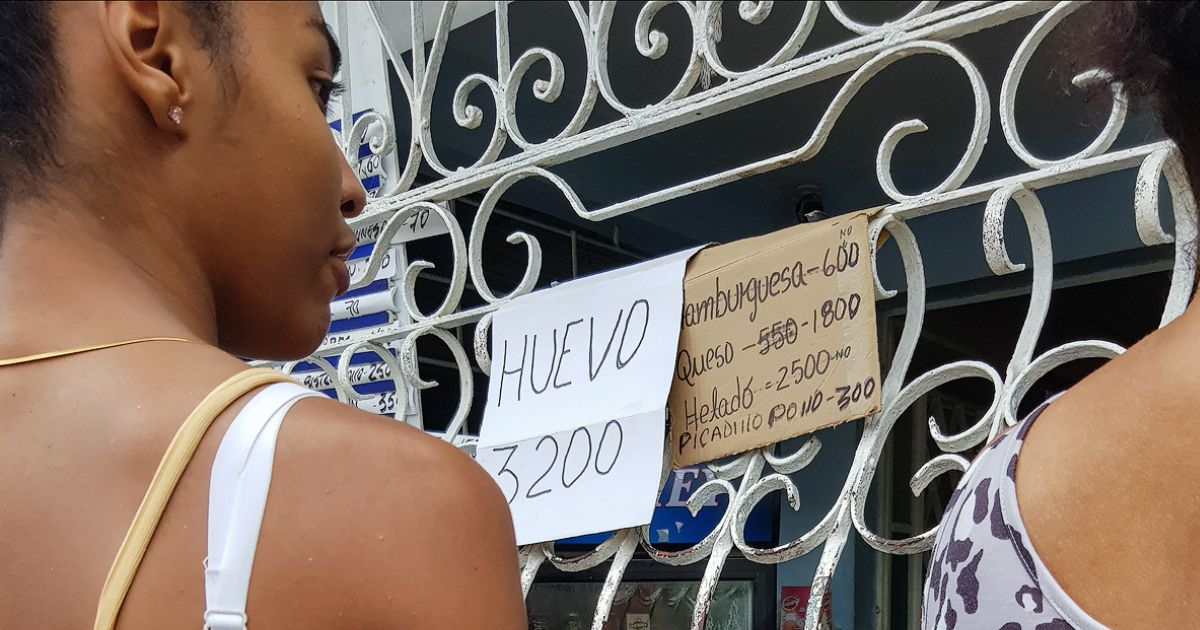
All of that reaches the Cuban like a number on the agromarket's board.
The cost of things: before and after
Before the Gulf War, prices in the informal markets of Havana were already devastating for anyone earning in state pesos. A carton of 30 eggs cost between 3,000 and 3,500 CUP —representing 45% to 53% of the average monthly salary for just one product—. A pound of pork was priced at 1,000-1,300 pesos. A liter of oil ranged from 700 to 1,000 pesos.
These prices corresponded to an informal rate of around 430-450 CUP per dollar. With the dollar already at 515 CUP in March 2026—and the shock from commodities still not fully transmitted through the distribution chain—the rule is simple: every imported product or product that relies on imported inputs increases in proportion to the devaluation of the peso and the rising costs of origin. A pound of chicken that previously cost the equivalent of one dollar now costs the equivalent of 1.20-1.40 dollars, but when measured in CUP, the increase is even greater because the peso is worth less.
The economist Omar Everleny calculated that the food basket for two people had risen to 41,735 pesos in August 2025. With the additional devaluation in December and the impact of the Gulf War reflected in prices during March and April, this figure is expected to exceed 55,000-60,000 pesos before the end of the first semester. This is in contrast to an average salary of 6,600 pesos.
The gap is no longer an economic problem that can be managed with monetary policy. It is hunger.
The projection: three-digit inflation in 2026
No international organization has yet published an inflation forecast for Cuba in 2026 that incorporates the three simultaneous shocks —total energy cut, Gulf war, recurrent electrical collapse—. The war against Iran could trigger a global food crisis that would impact all net importing countries, but none as intensely as Cuba.
What historical analysis does allow is to establish a frame of reference. In 2021, when the only shock was the monetary reform of the Tarea Ordenamiento, real inflation ranged between 174% and 700% depending on the source and methodology used. By 2026, the shock is simultaneously energy, food, and exchange-related, impacting an economy with even more deteriorated productive capacity than in 2021.
The most optimistic scenario —Strait of Hormuz reopened in April after Trump’s ultimatum, oil around 90 dollars— points to a real annual inflation of 100-120%. The more likely scenario based on first quarter data —prolonged blockade, Brent between 110 and 120 dollars— implies an inflation rate between 150% and 200%. The collapse scenario, if the 22 countries demanding the reopening of Hormuz do not exert enough pressure and Cuba does not receive oil until September, exceeds 250-300%.
In any of the three cases, we are talking about hyperinflation by any technical definition of the term.
Without a safety valve
What differentiates the current crisis from the Special Period of the 1990s—when Cuba also abruptly lost its Soviet energy supply and GDP fell by 35%—is not only the magnitude of the shock. It is the lack of exits.
In the 1990s, the regime launched the reforms of 1993-1994: it legalized the dollar, opened agricultural markets, and activated tourism. These measures were insufficient, but they cushioned the blow. And it found a new patron in Venezuela, which between 1999 and 2025 transferred to Cuba energy resources valued at 63.8 billion dollars.
That pattern no longer exists. Venezuela is under Washington's control following Maduro's capture. Mexico has cut off shipments. Russia, which could be an alternative, is sanctioned and occupied in Ukraine. And the Díaz-Canel regime has shown, over five years of crisis, that it prefers political control to reforms that could destabilize it. Wood and mules have returned to Cuba as means of transport and cooking — the most brutal image of how far the dictatorship has come.
Meanwhile, between 1.4 and 2.7 million Cubans have emigrated since 2019. Those who remain — those who cannot or do not want to leave — look at the prices on the agromarket board and do the same calculation that has been yielding the same result for years: it is not enough.
The war in the Persian Gulf did not create that account. It only made it even more impossible to close.
Analysis conducted with data from ONEI, CEPAL, elTOQUE, the Energy Institute of the University of Texas, and verified sources cited in the text.
Filed under:
Opinion article: Las declaraciones y opiniones expresadas en este artículo son de exclusiva responsabilidad de su autor y no representan necesariamente el punto de vista de CiberCuba.