
Related videos:
The Cuban leader Miguel Díaz-Canel shared a message on Tuesday via the social media platform X, expressing his "excitement" about the arrival in Havana of a vessel named "Granma 2.0," part of the so-called Convoy Nuestra América, a initiative by international leftist activists that transported humanitarian aid from Mexico to Cuba.
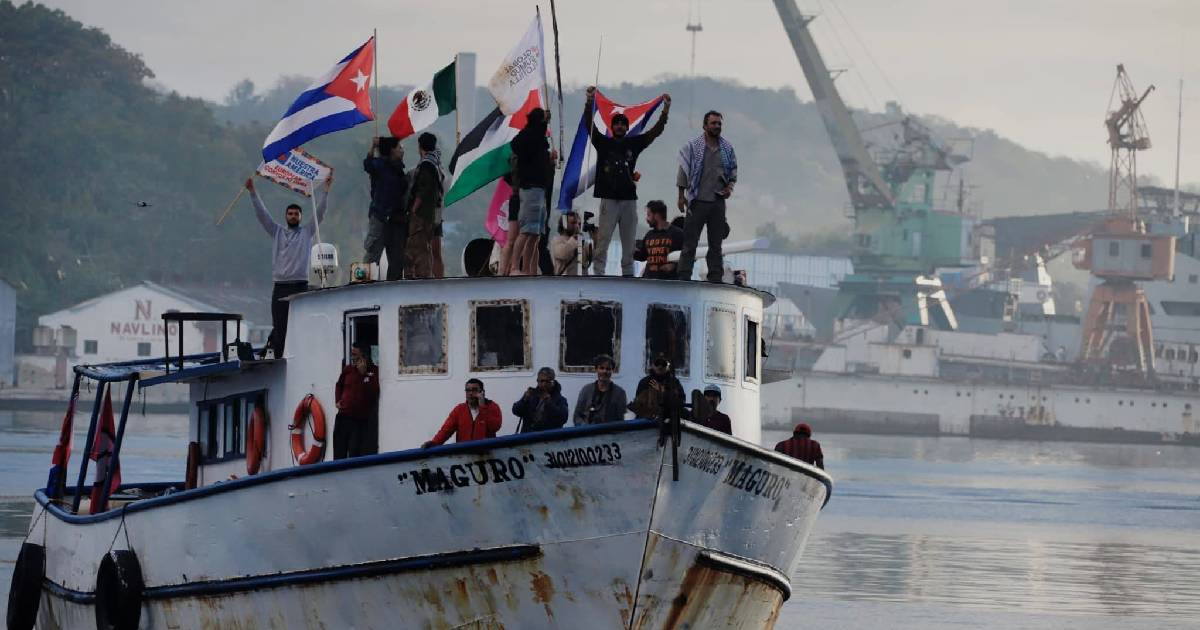
The ship, officially named "Maguro" — visible on the hull with registration number 31012100233 — departed from the port of Chelem, Yucatán, between March 20 and 21, carrying between 25 and 40 activists from over 30 countries on board, transporting between 20 and 30 tons of food, medicine, solar panels, and technological equipment.
In his post, Díaz-Canel wrote: "On the Island, we welcome them with deep gratitude, the kind that grows in the presence of thirty brothers from eleven nations who, from Mexico, have arrived in Havana to join the #ConvoyNuestraAmérica. It is moving that the vessel has been named 'Granma 2.0'. Thank you."
The name evokes the original Granma yacht, with which Fidel Castro and 81 expeditionaries clandestinely left from Tuxpan, Mexico, on November 25, 1956, to begin the guerrilla movement that culminated in the revolutionary triumph on January 1, 1959. On board were figures such as Che Guevara, Raúl Castro, and Camilo Cienfuegos.
Leticia Martínez, head of press for Díaz-Canel, also celebrated the event on social media, calling it "the most beautiful thing we will see today" and describing the arrival as that of "the Our America flotilla with humanitarian aid."
However, the image shared showed only one vessel, and the visible name on the hull was "Maguro," not "Granma 2.0." Cuban users quickly pointed out the contradiction: "What about the flotilla? A flotilla by definition is a fleet composed of ships, and here we see just one little boat," wrote one of them.
The convoy coordinator, Brazilian activist Thiago Ávila —known for having been detained by Israel on two occasions during flotillas to Gaza alongside Greta Thunberg— described the action as "an act of historical retribution" and shouted slogans like "Whatever it takes, Fidel" upon arrival. The governor of Havana, Yanet Hernández, welcomed the expedition members.
The initiative faced strong backlash from analysts and Cubans on social media. The Egyptian filmmaker Basel Ramsis Labib, who participated in the flotilla to Gaza, was blunt: "Naming one of the boats 'Granma 2.0' is not a tribute to Cubans", but rather a childish fantasy to show that they are akin to those who were part of the original Granma, who were indeed brave and revolutionary.
The researcher Elaine Acosta from the Cuban Research Institute at Florida International University described the convoy as a "political maneuver" and warned about the risk of the aid being diverted to dollar stores, given that it will be distributed by the Cuban Institute of Friendship with the Peoples (ICAP), an organization linked to the regime.
Cuban users on social media were more direct: "They go on revolutionary tourism in a little boat" and "These pathetic ones called this boat Granma 2.0 with four things to continue maintaining the misery of the Cuban people."
The convoy arrives as Cuba is experiencing its worst energy crisis in decades, with electrical deficits exceeding 1,800 MW, blackouts lasting between 8 and 20 hours daily, and an accumulated economic contraction of 23% since 2019. In fact, the very expedition members experienced the Cuban reality firsthand when a general blackout caught them during their ideological tour.
The Mexican president Claudia Sheinbaum announced a new shipment of humanitarian aid to the Island, stating: "We will send all the humanitarian aid that is necessary." With this, Mexico has now sent at least five ships and over 2,000 tons of supplies since February 2026.
Filed under: