
Related videos:
The United States has sent approximately 30,000 barrels of fuel to the Cuban private sector since early February 2026, according to documents and shipping data analyzed by Reuters.
The decision falls within the deliberate policy of the Trump administration to favor private entrepreneurs on the island while maintaining the energy blockade against the government of Miguel Díaz-Canel.
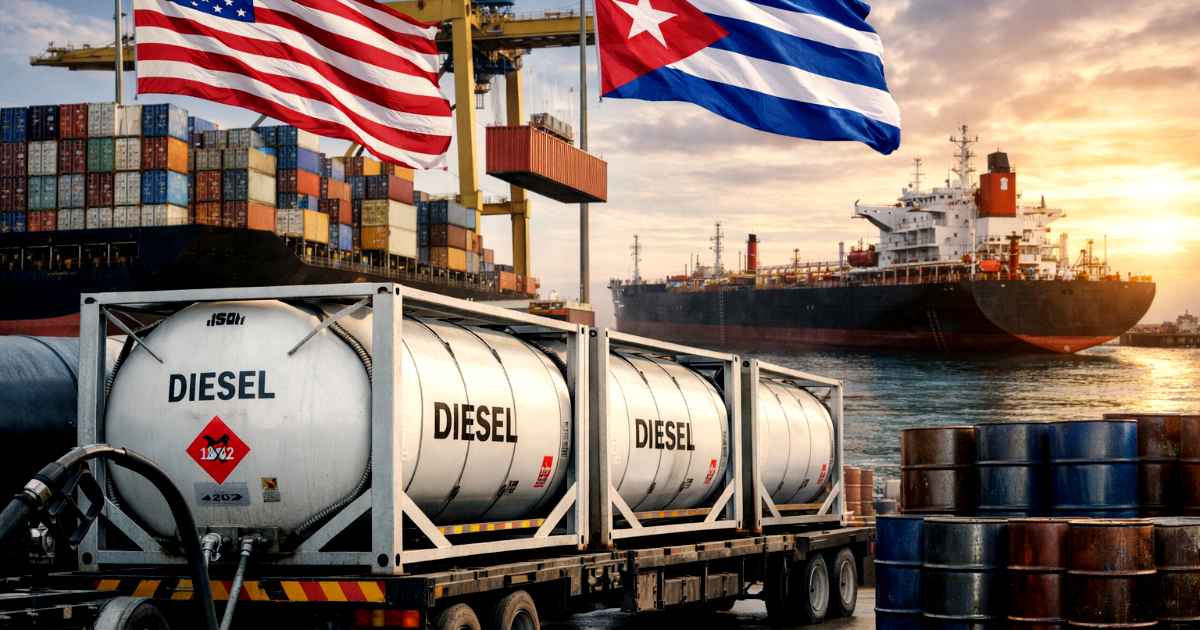
Shipments primarily arrive in ISO tanks of approximately 21,600 liters transported on container ships, and 99% of the fuel is diesel.
Since January 2026, 61 container ships carrying products imported by private companies have docked in Cuba, primarily at the port of Mariel, west of Havana. A total of around 200 isotank containers have been unloaded.
The 30,000 barrels amount to just over one-tenth of the capacity of a medium-sized tanker, a minimal fraction compared to the 100,000 barrels daily that Cuba historically required to fuel its power plants and meet regular demand. However, the figure represents a concrete advance in the Washington strategy against the Cuban regime.
The Secretary of State Marco Rubio has been explicit about the goal of the policy. The strategy is "entirely designed to place the private sector and private Cubans —not affiliated with the government, not affiliated with the military— in a privileged position," he stated in February. Rubio also warned that licenses will be revoked if it is detected that fuel is diverted to the regime or the military.
The Department of Commerce published a guide in February authorizing the export and re-export of gas and petroleum products to eligible private Cuban entities. The OFAC spokesperson, Emily Mendrala, specified that "these exports support private entrepreneurs in Cuba without benefiting entities linked to the military."
Among the identified beneficiaries are private bakeries, wholesalers that supply small urban markets, and online stores. The owner of Pan Habana, María López, stated that "American diesel has been a radical change for our bakery operations. It runs cleaner and more efficiently than what we obtain locally."
The online store Supermarket23, which had suspended orders in February due to the fuel crisis, resumed them after importing diesel like private Cuban SMEs.
The Cuban government authorized MIPYMES to import fuel on February 7, but with mandatory state mediation through importers such as QUIMIMPORT or MAPRINTER, at a CUPET rate of $0.12 per liter and an estimated final cost exceeding $2.50 per liter. The energy crisis is impacting 96.4% of the 8,904 registered MIPYMES in Cuba.
The context is one of energy collapse for the Cuban state: Venezuela stopped its shipments of between 26,000 and 35,000 barrels daily following the capture of Nicolás Maduro in January; Mexico suspended its shipments on January 27 in response to tariff threats from Washington; and the OFAC prohibited the shipment of Russian oil to Cuba.
Díaz-Canel himself stated last week that the island had not received fuel for three months, without mentioning supplies to the private sector. Cuba experienced its sixth nationwide blackout on March 16, with only 1,140 MW available compared to 2,347 MW demanded.
Congresswoman María Elvira Salazar (R-Fla.) opposes the policy and criticizes the use of MIPYMES to import fuel, warning that "supplying fuel to the Cuban private sector indirectly supports the regime," and arguing that the fuel ultimately benefits the ruling elite through frontmen in the MIPYMES and that "nothing enters Cuba without the dictatorship taking its cut."
Filed under: