
Related videos:
During years, the idea of promoting regime change from Washington became associated with the failures in Iraq and Afghanistan. The term disappeared from official discourse and became almost a taboo in U.S. foreign policy.
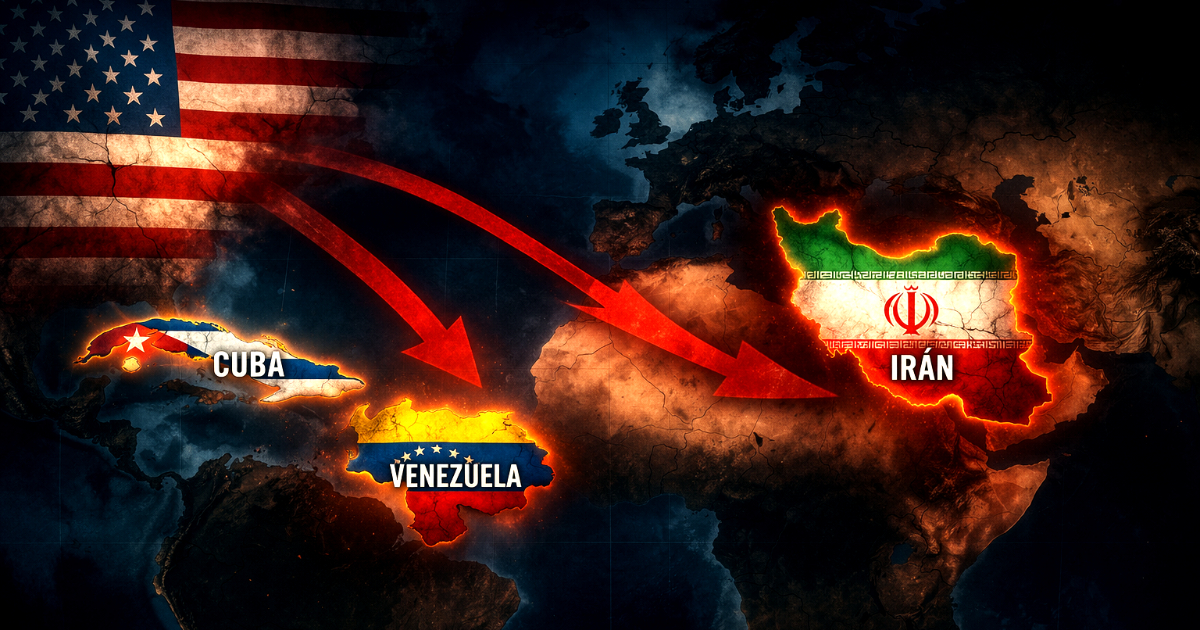
However, recent events in Cuba, Venezuela, and Iran suggest that this logic not only remains relevant but has been reformulated under a more discreet strategy in its approach, yet equally ambitious.
The fundamental difference lies not in the objective, but in the method. At the beginning of the 21st century, regime change involved direct military interventions, prolonged occupations, and state reconstruction processes.
Today, in contrast, the administration of Donald Trump relies on a more pragmatic and cost-effective version: a combination of economic pressure, international isolation, and taking advantage of internal crises to force political transformations without deploying large military contingents.
In this new approach, Venezuela occupies a central place. For years, the United States attempted to weaken chavismo through sanctions and diplomatic pressure, but recent events have marked a turning point.
The exit of Nicolás Maduro from power following a U.S.-led intervention has transformed what was a strategic objective into a fait accompli. The country now enters an uncertain phase: the question is no longer whether the regime can fall, but what type of system will emerge and whether it will be able to stabilize.
Cuba represents a different, yet crucial, scenario for understanding this strategy. The island is experiencing one of the deepest crises in its recent history, resulting from decades of poor economic management, state control, and lack of freedoms, amid increasing international pressure.
Washington has intensified the isolation of the regime, particularly in the energy sector, while exploring contacts with actors within the Cuban system to open possible negotiation avenues.
The logic seems clear: increase the pressure until forcing changes, while avoiding an uncontrolled collapse that leads to greater instability. More than a sudden drop, what is sought is a progressive transformation from within with openness to the participation of the exile community and international capital.
The case of Iran introduces a strategic nuance. Unlike Cuba and Venezuela, the United States does not explicitly demand an immediate regime change. The priority remains to contain Iran's nuclear program and limit its influence in the Middle East.
Nevertheless, the intensity of economic pressure and indirect confrontation suggest that the weakening of the system is part of the strategy. In this context, a potential political change is not the stated objective, but rather a latent possibility.
Far from being isolated cases, these three examples reflect a similar view of the international environment.
The Trump administration seems to assume that the world has entered a stage of open competition among powers, where stability is no longer the main focus and geopolitical influence takes center stage.
In this context, regimes deemed adversarial are not managed: they are pressured, weakened, and, if conditions permit, transformed.
What emerges is not a return to classic interventionism, but the adaptation of an old strategy to new circumstances.
The regime change remains a tool of U.S. foreign policy, but it is now applied using more indirect, selective, and seemingly more effective methods. Fewer invasions, more pressure; less ideological rhetoric, more strategic calculation.
Cuba, Venezuela, and Iran are not just three distinct crises. Together, they represent the expression of the same trend: the silent return of a policy that never vanished, but is now regaining a central place, albeit with a different face.
Filed under: