
Related videos:
When one imagines that the overflowing sweetness of words and the fervent linguistic endearments can’t generate more “sting” in the speeches of Cuban bureaucracy, the national first secretary of the Union of Young Communists (UJC), Meyvis Estévez, breaks her own records.
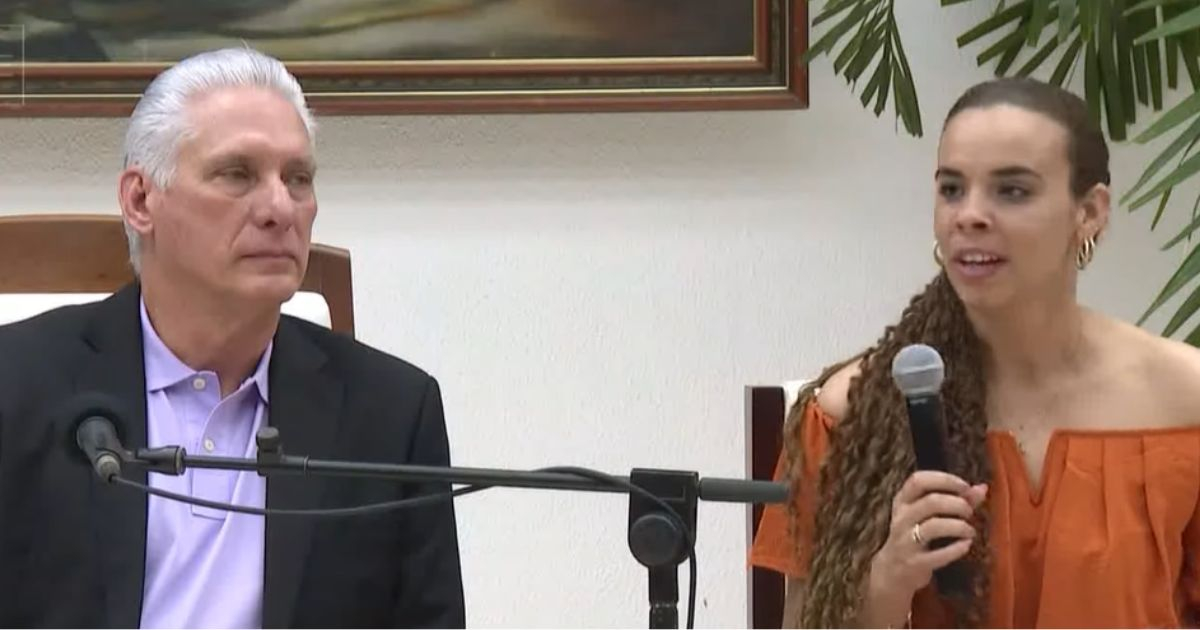
This time, he narrated on his Facebook profile about “a meeting that stirs the soul,” where President Miguel Díaz-Canel met with young people who, “with voices trembling with emotion,” confirmed to him that “history does not stop,” akin to saying that after Monday, Tuesday typically follows.
Estévez recounted, with cardiological precision, that "in every word, in each tale of sacrifice and dedication, the same heart that has known how to defend the most sacred was beating," although he did not clarify what that precious thing would be, whether the air conditioning of the Palace of the Revolution or the gas-filled tank of the "leaders" at the central level.
His post skillfully moves from the tribune to the sentimental, when he states that "it was an intimate dialogue, where sensitivity and firmness shook hands to show us that the continuity of the Revolution is not a certainty, but something that is built every day with sweat, science, and love."
The spiritual geological exploration of the leader continues as she describes that, in response to the calls from President Díaz-Canel, a deep feeling emerges in the youth: "commitment."
And of course, it couldn't be any other way, because the first secretary of the PCC “spoke to us with the warmth of a guide, a father... and the passion of another Cuban,” he said.
Of course, the "trust placed in us" should emerge at some point in the narrative, as "the greatest of honors." This is immediately associated with "the commitment to not falter, to live up to every task, to be that young force that the Revolution will always have by its side."
The leader, who tasked the youth with keeping the ideas of Commander in Chief Fidel Castro alive—of course—on his centenary, shared with them “his ideas, those projects that we can lead from workplaces, classrooms, or communities,” Estévez charmingly noted.
In the meeting, an official ceremony for the awarding of state decorations “to those who hold exceptional merits,” according to the report from the official Presidency website, Díaz-Canel emphasized the importance of young people “continuing the legacy” and expressed his faith that “we will also overcome these times, and for you, they will be experiences of strengthening, reinforcing convictions, and also of growth as revolutionaries.”
Such "growth" does not seem to be closely related to the economic and social parameters of Cuban society, where almost all indicators tend to decline, except for inflation, poverty, the emigration of young people and the general discontent of citizens with the system that oppresses them.
Díaz-Canel also referred to "the communication battle; the popular mobilization; ideological training; […] cultural creativity and the battle of symbols," indicated the presidential press, echoing the refrain of terms that Cuban official propaganda repeatedly articulates and rearticulates.
Almost concluding his "chronicle" of the meeting, Estévez remarked that they carried in their hearts “the nostalgia for the times we live in, but the immense joy of feeling part of something greater than ourselves.”
And here is when, delicately, tenderly, the "youth leader" summarized what triggers the structural crisis, widespread across the country, with a slight hint of "nostalgia." Never sadness, weariness, despair, like that felt by the young people who take to the streets demanding change. Never mockery, irony, parody, like that which other young people create to signify that the country is in prehistoric conditions. Never exhaustion, agony, despair, like that of the mothers who cry out for their political prisoners…
No, man, no. None of that is in the approved feelings catalog of a young Cuban communist. "Immense joy," and that’s all there is to it.
Filed under: