
Related videos:
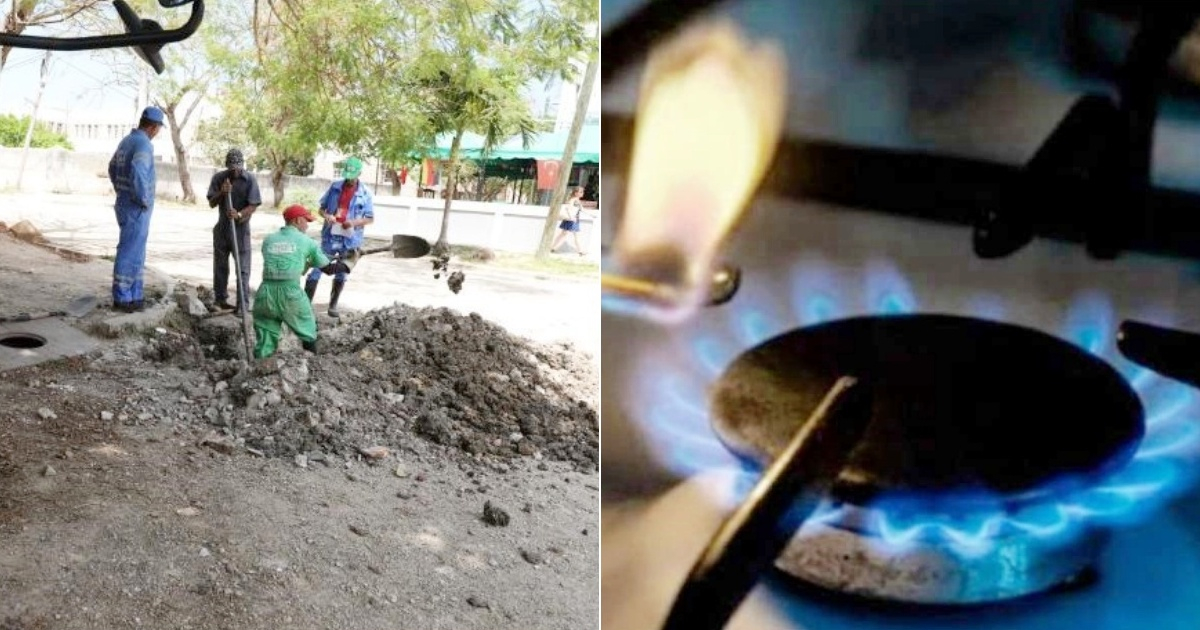
As power outages continue to affect daily life in Cuba and the shortage of liquefied petroleum gas (LPG) impacts thousands of households, the government has resumed the expansion of the so-called "street gas" in Havana, presented as an energy solution in the face of the crisis.
An article published in the newspaper Granma this Monday stated that the plan aims to reach up to 25,000 clients in the capital this year, although the actual number currently falls far short of that target: only 735 homes have been connected.
Cooking in the early hours to avoid going without food
The relaunch of the service is supported by stories like that of Mayda Fraguela Rodríguez, a resident of Plaza de la Revolución, who describes the direct impact of the energy crisis on her daily life.
"Keep in mind that I only have that little electric stove. I had to do everything quickly: heat the water, cook. There were times when we went without eating," she recounted.
Like her, many families have had to adapt to cooking in the early morning or resort to alternatives such as charcoal or firewood, amid prolonged blackouts and a lack of LPG.
Their recent connection to manufactured gas —after years of waiting— is presented as a relief, but it also highlights that access remains limited.
A recycled solution after years of neglect
The program revives an infrastructure that was practically abandoned between 2007 and 2010, when the government opted for a different energy matrix and put the expansion of manufactured gas on hold.
Now, amid the crisis, the authorities present it as a "state policy," emphasizing that its raw material is sourced domestically, unlike LPG, which relies on increasingly difficult-to-sustain imports.
According to the director of the Manufactured Gas Company, Daina Álvarez, the priority will be to connect those who already had incomplete installations.
"Those who have the piping reaching the doors of their homes, but without the service, as well as those requests that represent the concerns of the population," he stated.
However, the scope of the system remains limited.
In Havana, only about 284,000 people -around 16% of the population- have potential access to this network.
Less electric consumption, but with limitations
From the official discourse, the main benefit of manufactured gas is to relieve the pressure on the national electrical system.
“Each gasified home reduces the demand for electricity during peak hours... and families have the assurance of being able to cook at any time, even when there are power outages”, stated Lázaro Rafael Campos Recio, a worker in the sector.
The system relies on natural gas extracted from the Jaruco fields, which is then processed at the Melones plant to produce what is technically known as "methane air."
From there, about 40,000 cubic meters per hour are distributed to various municipalities in Havana.
Part of the network has the advantage of operating without electricity, making it more stable during blackouts.
But not the entire system shares that advantage.
In areas like Playa and Marianao, the service relies on electric pumping, making it vulnerable to failures. In fact, recent power outages have caused prolonged interruptions in those municipalities.
Costs, scarce materials, and informal market
Access to the service is not free either. Users must pay for both installation and materials, which creates an economic barrier in a time of crisis.
Although the official rate is 65 pesos per hour of work, the real issue lies in the materials, which are often scarce and only available in the informal market at much higher prices.
This leaves many families outside the system, even when they have the network close to their homes.
Dependent technology and structural scarcity
Despite being presented as a "national" alternative, the system is not free from external limitations. The technology used depends on imported components and supplies that are not always available.
One of the most revealing examples is the substance used to detect gas leaks:
“It had to be replaced with a European odorant because there was no longer a way to acquire it,” acknowledged an executive from the sector.
Between the official discourse and reality
The government promotes manufactured gas as a step towards "energy sovereignty," but its real impact remains limited in light of the magnitude of the crisis.
The official narrative itself acknowledges that the expansion will be gradual and will depend on resource availability, while thousands of families continue to face daily blackouts and a lack of fuel for cooking.
In that context, the rise in "street gas" seems more like a partial measure than a structural solution in a country where energy remains one of the main factors of precariousness in daily life.
Filed under: