
Related videos:
The Cuban regime once again blamed the United States for the food crisis on the Island, following the approval in the UN Human Rights Council of a resolution presented by Havana defending the right to food.
During the session held in Geneva, representatives of the Cuban government denounced the supposed "inhumane and illegal" nature of the U.S. embargo, which they blame for the deterioration of the country’s food security. However, the figures for bilateral trade reveal a very different reality.
Since the implementation of the Trade Sanctions Reform and Export Enhancement Act (TSREEA) in 2000, the United States allows the export of food and agricultural products to Cuba, under conditions such as payment in cash in advance. This means that there is not a total ban on food trade, but rather a restrictive yet operational regime.
In fact, Cuba has consistently imported food from the U.S. for over two decades. Between 2001 and 2025, cumulative purchases exceed 7.8 billion dollars, confirming that the supply from that country is not only possible but structural.
In just 2025, between January and May, food imports from the United States reached approximately 204.9 million dollars. Frozen chicken overwhelmingly dominates these purchases, accounting for more than 40% of the total in some months, and solidifying its position as one of the main sources of protein for the Cuban population.
If this pace continues, annual imports could exceed 400 million dollars, one of the highest levels recorded in the last decade.
This constant flow of food dismantles the argument of a supposed complete stranglehold. Cuba imports about 80% of the food it consumes, a dependence that mainly stems from low domestic agricultural productivity, a lack of incentives, and the inefficiencies of the state economic model.
Despite this, the official discourse insists on attributing the scarcity to the embargo. The reality is more complex: although there are financial limitations—such as the inability to access credit and difficulties in making international payments—the trade of food with the United States continues to operate and has grown during times of greater internal crisis.
The paradox is evident. While the regime denounces in international forums the use of food as a tool of political pressure, it largely depends on imports from the very country it accuses.
Additionally, there are determining internal factors: a declining agriculture, economic decisions that have prioritized sectors such as tourism over food production, and a chronic lack of foreign currency.
Even the recent measures to ease private imports and eliminate tariffs on certain products reflect an implicit recognition that the state system fails to ensure supply.
In this context, blaming only external factors is not only insufficient but also hides the structural causes of a food crisis that the economic model itself has helped to exacerbate.
Dollarization, inequality, and internal control
This contradiction is compounded by "the partial dollarization policy of the economy" driven by the regime itself in recent years.
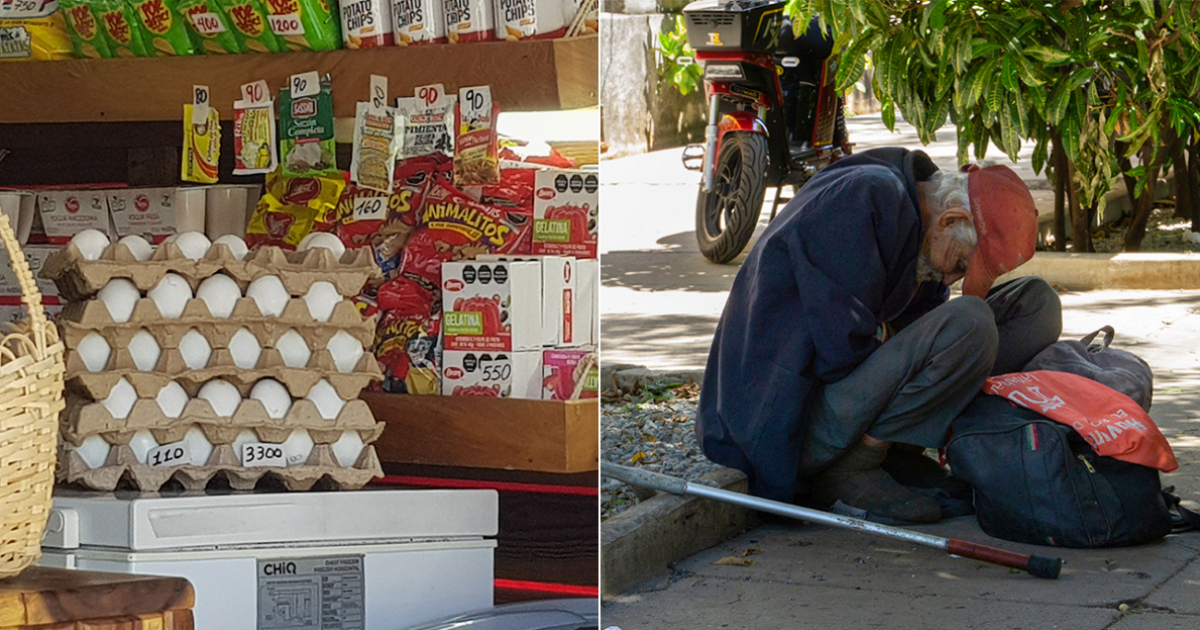
A significant portion of imported food —including those purchased from the United States— is sold in foreign currency stores at prices that can triple those of the original market, excluding those who do not have access to dollars.
This model not only exacerbates social inequality, but also channels income to the military conglomerate GAESA and the elites connected to power, who control a significant portion of trade in hard currency.
At the same time, Mipymes and private actors depend on these imports and the channels controlled by the State to operate, which reinforces their subordination to the system.
In contrast, most Cubans, without access to foreign currency, are relegated to an increasingly weakened rationing system, with a supply booklet on the verge of disappearing.
In practice, the State not only acknowledges its inability to produce sufficient food, but also manages its scarcity through a system that prioritizes the capture of foreign currency over equitable access to basic goods.
Filed under: