
Related videos:
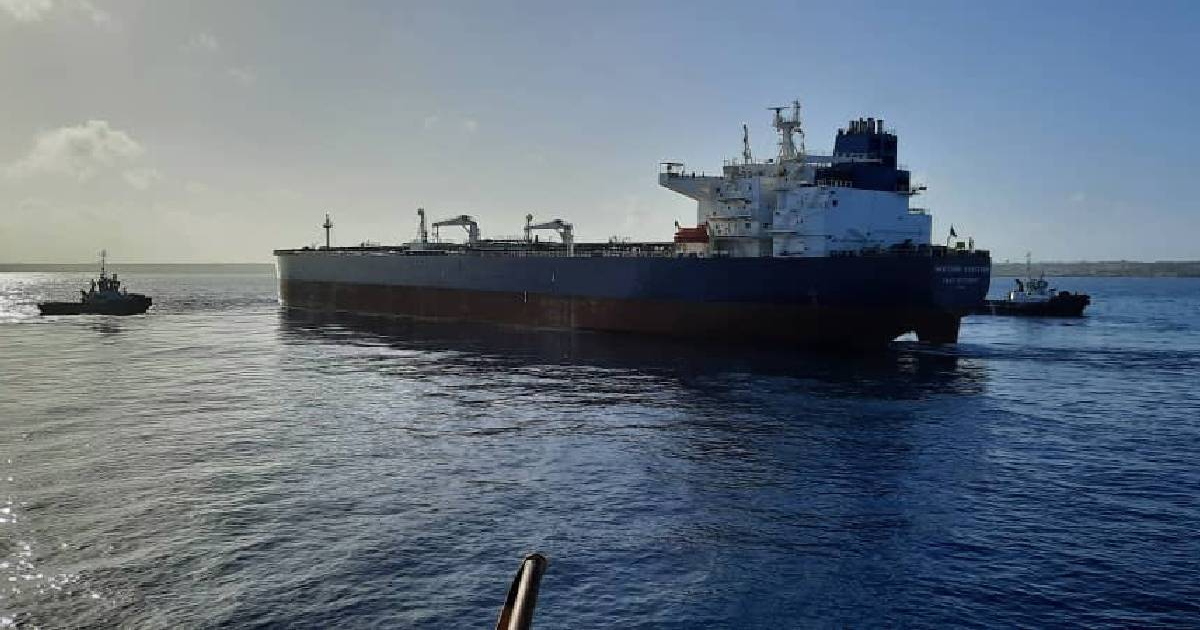
The Cuban state company CUPET announced this Saturday that the unloading has been successfully completed on time of the tanker Anatoly Kolodkin at the port of Matanzas, carrying 100,000 metric tons of crude oil labeled by the regime as "solidarity aid from Russia."
The vessel, registered in St. Petersburg and owned by Sovcomflot — a Russian state shipping company sanctioned since 2024 by the United States, the European Union, and the United Kingdom — set sail from the Russian port of Primorsk on March 8 and docked at the Matanzas Supertanker Base on March 31, becoming the first significant oil supply received by Cuba in almost three months.
According to Irenaldo Pérez Cardoso, deputy director of CUPET, the unloading process took approximately 96 hours.
CUPET reported that in the coming days, the process of refining crude oil will begin to produce liquefied petroleum gas, gasoline, diesel, and fuel oil, with the first scheduled derivative products to be distributed in the second half of April.
However, the 100,000 tons received —equivalent to between 730,000 and 740,000 barrels— would barely be enough to keep the National Electric System operational for between seven and 14 days, which led many Cubans to ironically refer to the shipment as a "handout."
The shipment arrives amidst the worst energy crisis the island has faced since January 2026, with generation deficits exceeding 1,900 MW and blackouts lasting up to 24 hours.
The National Electric System completely collapsed on at least two occasions: on March 16, for 29 hours and 29 minutes, and again on March 22.
The arrival of the Anatoly Kolodkin was not without geopolitical tension. The United States Southern Command positioned Coast Guard cutters near Cuba during the vessel's approach, and its entry required an implicit authorization from the Trump administration on March 30, following negotiations in which Havana provided fuel to the U.S. embassy in Havana.
Despite this, both the Cuban regime and Moscow presented the event as a victory. Cuban state television broadcast it as a breach of the embargo, omitting Washington's authorization.
Miguel Díaz-Canel expressed gratitude for the shipment on April 1st, and Prime Minister Manuel Marrero presented it the following day as a success before the United States.
Russia, for its part, took advantage of the episode for geopolitical propaganda. Dmitry Birichevsky, the director of the Department of Economic Cooperation at the Russian Ministry of Foreign Affairs, stated this Saturday that Russia does not intend to seek permission from other countries to supply its oil.
Filed under: