
Related videos:
Cuban regime officials claimed that the transition to renewable energy is "a condition for development" capable of transforming the island's economy, during a televised debate broadcast by the state program Cuadrando la Caja.
The debate brought together three officials: Adriano García Hernández, an expert in economic policy from the Ministry of Economy and Planning; Rosell Guerra Campaña, director of Renewable Energies at the Ministry of Energy and Mines; and Edel Gómez Gómez, general director of the Comandante Camilo Cienfuegos Electronics Industry Company.
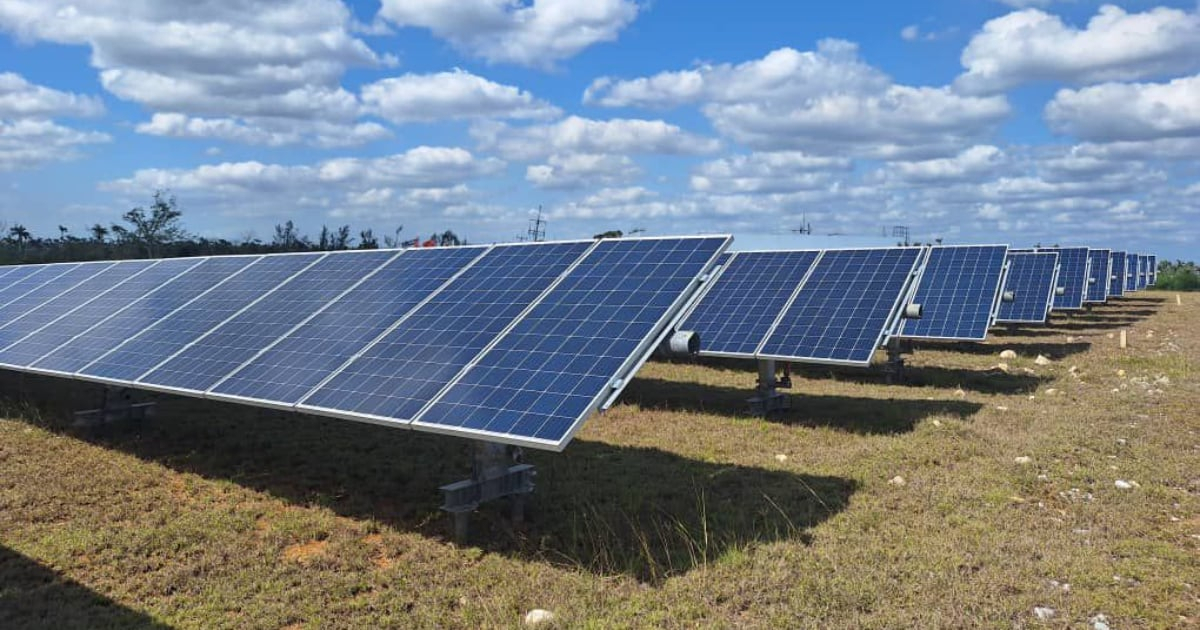
According to Guerra Campaña, there were advancements in renewable energy in 2025 compared to 2024: "Last year, we managed to produce 10% of the energy consumed in the country from renewable sources, up from 3%," the official stated, attributing the progress to the installation of more than 1,000 MW of additional photovoltaic solar capacity on a base of 300 MW that existed in 2024.
By 2026, the government plans to add more than 500 MW and achieve 15% renewable generation. "This year we expect to add over 500 MW. This means we are certain, as we have secured resources, that this year we will surpass 15%," said Guerra Campaña. The official goal of the regime is to reach 24% by 2030.
The central economic argument of the debate was the cost of generation. According to the official, while energy produced from fossil fuels exceeds 20 cents per kWh, solar photovoltaic energy costs between six and seven cents. "You notice that there's a difference of just 6 or 7 cents per kWh compared to over 20. Now, that's for one kilowatt, but when you talk about millions of kilowatts, the savings amount is significant," he noted.
It was also mentioned in the program the installation of more than 10,000 photovoltaic systems in homes —4,000 for public health workers, 3,000 for education and 3,000 for higher education—, as well as 160 systems of 2,000 W in vital centers such as hospitals, polyclinics, banks, and nursing homes.
Officials acknowledged that the main obstacle in the process is financial, although they attributed it to the U.S. embargo. Adriano García Hernández admitted that "the greatest innovation left to us is not technological; it is precisely the financial innovation in managing business models."
What officials did not mention is that the energy crisis has structural roots, decades of lack of investment and lack of maintenance in the thermal power plants, whose obsolescence predates and is unrelated to the embargo. While the regime presents renewable transition as a future solution, millions of Cubans continue to endure blackouts of more than 18 hours daily.
In March 2026, Cuba experienced two total collapses of the National Electric System, causing the entire country to be plunged into darkness for hours.
Filed under: