
Related videos:
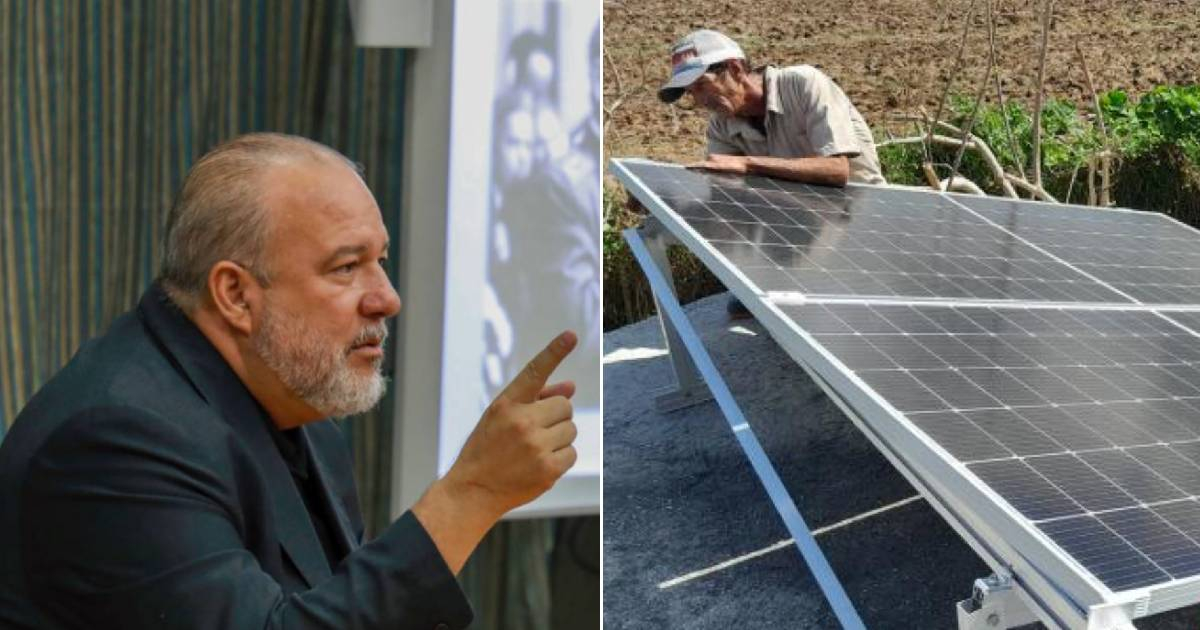
The Cuban Prime Minister Manuel Marrero Cruz announced on his X account that the installation of more than 10,250 photovoltaic solar systems will be completed in March for teachers, doctors, and Heroes of Labor, and that the placement of an additional 5,000 modules in isolated communities and vital centers of the country should also be finished this month.
In two messages shared with the hashtags #GovernmentProgram and #CubaWillOvercome, Marrero framed the announcements as evidence of the regime's strength in the face of the worst energy crisis in recent history on the island. "Continuing the energy transition amid adverse circumstances not only demonstrates our capacity to endure but also to develop," wrote the Prime Minister.
Regarding the first program, Marrero pointed out that it is advancing "towards the recovery of the National Electroenergetic System, promoting its sovereignty." As of February 2026, out of the 10,200 systems planned for that group of beneficiaries, 7,719 have been installed, achieving 87.4% completion. The company Copextel is responsible for the installations, and each kit includes an 800 W panel, connections, and a 1,200 W battery. The cost per system is 75,200 Cuban pesos, which is equivalent to more than 20 average state salaries, with payment facilities.
Regarding the 5,000 modules for isolated communities, provincial reports document 686 installations in Santiago de Cuba —171 in vital centers and 515 in homes across 31 communities of the Turquino Plan— and over 1,100 systems in isolated areas of Granma. The panels are part of a Chinese donation valued at over 114 million dollars.
Marrero's announcements stand in stark contrast to the scale of the crisis facing Cuba. The electricity deficit is nearing 1,800 megawatts, blackouts affect up to 64% of the country and can last between 20 and 25 hours a day. Some 102 generating plants remain idle due to a lack of fuel, a situation that has worsened since December 2025 with the disruption of Venezuelan oil supplies, on which Cuba relies for about 25,000 to 30,000 barrels daily.
The government has embraced solar energy as the cornerstone of its so-called energy transition. Cuba currently has 49 solar parks connected to the National Electric System, with a capacity of between 900 and 1,000 megawatts, and plans to reach 92 parks — about 2,000 megawatts — by 2028, largely thanks to Chinese support.
Independent experts, however, warn that solar panels do not address the underlying problem. Without nighttime storage batteries, photovoltaic parks cannot meet demand during peak consumption hours.
The energy expert Jorge Piñón has warned that Cuba would need between 3 and 5 years and investments of between 8,000 and 10,000 million dollars to begin a real recovery, while the Energy Minister himself, Vicente de la O Levy, acknowledged in December 2025 that "2026 will be difficult although slightly better than 2025."
Filed under: