
Related videos:
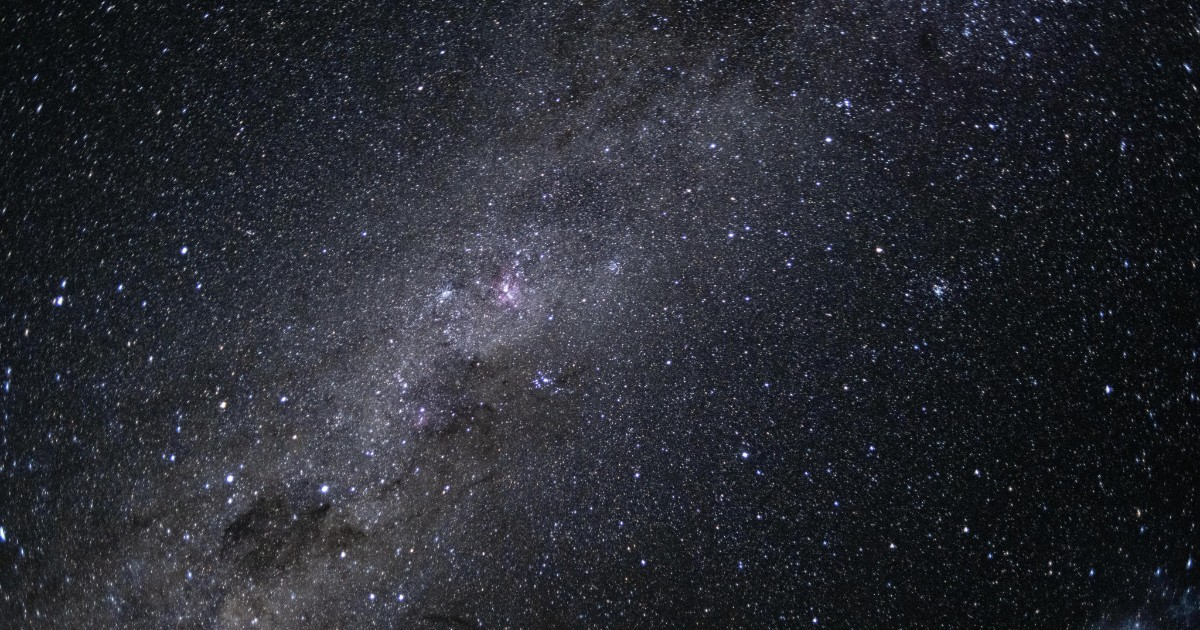
The astronauts of the NASA Artemis II mission photographed our galaxy, the Milky Way, from deep space yesterday, in an image that the space agency described as stunning following the successful lunar flyby completed this past Sunday.
The photograph was taken on April 7 during the seventh day of flight, when the Orion spacecraft —named "Integrity" by the crew— was about 236,000 miles from Earth on its return trajectory, in total darkness and with no light pollution.
The image, captured using long exposure technique, shows the central band of the galaxy crossing the frame diagonally, pink and purple nebulae that may correspond to the region of the Keel Nebula, dark clouds of interstellar dust, and what appears to be the Magellanic Clouds in the lower right corner.
NASA shared the photograph earlier this morning on its X account with the message: "A sky full of stars. Following a successful lunar flyby, the astronauts of Artemis II captured this stunning photo of our galaxy, the Milky Way, on April 7, 2026."
The mission, launched on April 1 from launch pad 39B of the Kennedy Space Center aboard the SLS rocket, is the first crewed flight beyond low Earth orbit since Apollo 17 in December 1972, over 53 years ago.
The crew is made up of commander Reid Wiseman, pilot Victor Glover, mission specialist Christina Koch —all three from NASA— and specialist Jeremy Hansen from the Canadian Space Agency.
Last Sunday, during the lunar flyby, the mission achieved several historic milestones: the spacecraft reached a maximum distance of 252,752 miles from Earth, surpassing the record held by Apollo 13 since 1970 by about 4,102 miles.
Victor Glover became the first person of African descent to travel near the Moon, Christina Koch the first woman on a crewed lunar mission, and Jeremy Hansen the first Canadian citizen to reach the Moon.
During the flyover, the crew also witnessed a total solar eclipse from lunar orbit that lasted between 50 and 60 minutes —about seven times longer than from Earth— and documented six flashes caused by meteoroids impacting the lunar surface.
The astronauts also photographed for the first time in its entirety the Orientale Basin, a formation 930 kilometers in diameter that had never before been completely seen by human eyes, as well as the "Earthset" and "Earthrise" from lunar orbit.
Artemis II does not include a lunar landing: it is a test mission of the SLS/Orion system with a crew in deep space that lays the groundwork for Artemis III, the mission that aims to return humans to the lunar surface for the first time since 1972.
The landing is scheduled for April 10 off the coast of San Diego, California, at 8:07 p.m. Eastern Time.
Filed under: