
Related videos:
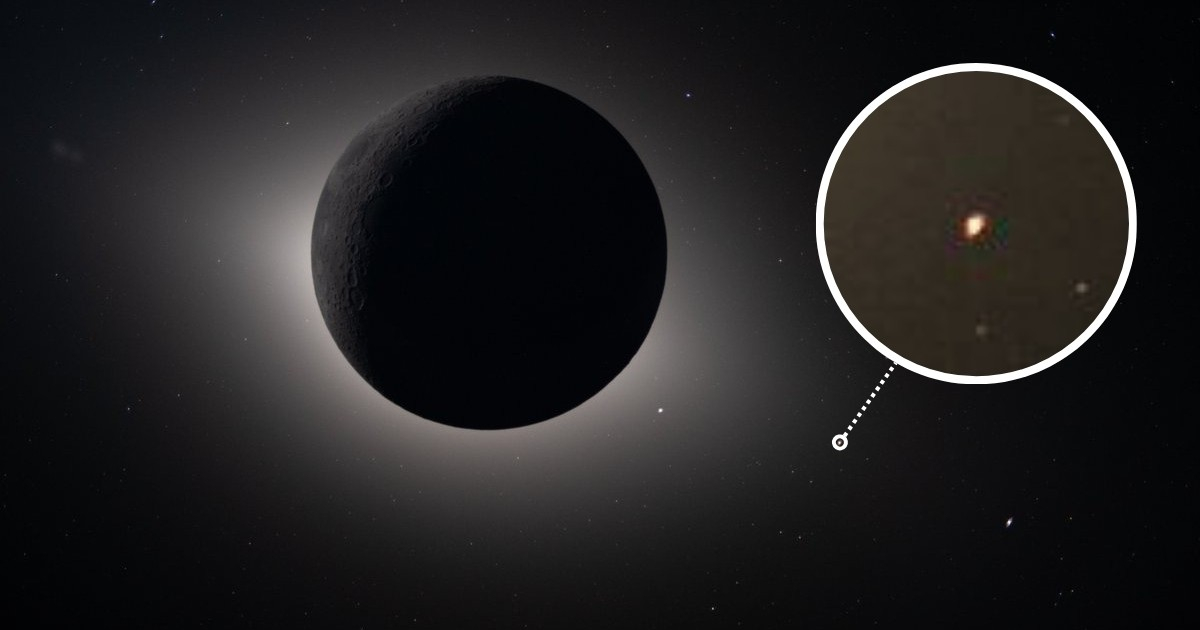
The crew of the NASA Artemis II mission photographed a total solar eclipse from the Orion spacecraft last Monday during its flyby of the far side of the Moon, and in the image, Mars can be seen alongside two other planets that appear as stars to the naked eye.
The official account of NASA Mars shared the photograph yesterday on the social network X with a clarification that surprised thousands of followers: "The Artemis crew captured this view of the Moon eclipsing the Sun. The three 'celestial bodies' in the lower right corner of the Moon are actually planets. The one in the center has a slight reddish tint. That is Mars."
Next to Mars, identifiable by its characteristic reddish color, Saturn and Venus are also visible in the lower right quadrant of the image, with the Moon completely blocking the Sun and the solar corona radiating white light around it.
The eclipse was observed from the Orion spacecraft, named "Integrity," between 8:35 p.m. and 9:32 p.m. EDT last Monday, with a totality of approximately 54 minutes, about seven times longer than the maximum observable from Earth. From the lunar orbital perspective, the Moon appears five times larger than the Sun, which ensured a perfect and uninterrupted totality.
The astronaut Victor Glover described the spectacle as "unreal": a black orb surrounded by a shining solar corona, with Earth reflecting light faintly in the background and planets visible to the naked eye. During the eclipse, the crew also reported six flashes produced by meteoroids impacting the lunar surface, a rarely observed phenomenon that is only visible in the unlit portion during eclipse conditions.
The Orion spacecraft is equipped with 32 cameras, and the crew took thousands of photographs during the seven hours of the lunar flyby. The official images were sent to Earth yesterday and represent the first official photos of the mission from the Moon. The European Space Agency also shared images of the eclipse, describing them as a view that few humans have ever witnessed.
Artemis II, launched on April 1 from Launch Complex 39B at Kennedy Space Center aboard the SLS rocket, is composed of Reid Wiseman as commander, Victor Glover as pilot, and Christina Koch and Jeremy Hansen as mission specialists. Glover is the first African American astronaut to participate in a crewed lunar mission; Koch is the first woman to fly to the Moon on a crewed mission; and Hansen is the first Canadian on a crewed lunar mission.
Last Monday, the spacecraft reached a maximum distance of 252,752 miles (406,773 km) from Earth, surpassing the historic record held by the Apollo 13 crew since April 1970. It is also the first crewed mission near the Moon since Apollo 17 in December 1972, over 53 years ago.
The landing of Artemis II is scheduled for April 10 off the coast of San Diego, California, with recovery conducted by the USS John P. Murtha ship. The mission validates the systems of the Orion capsule in preparation for Artemis III, which plans a lunar landing at the south pole in 2027.
Filed under: