
Related videos:
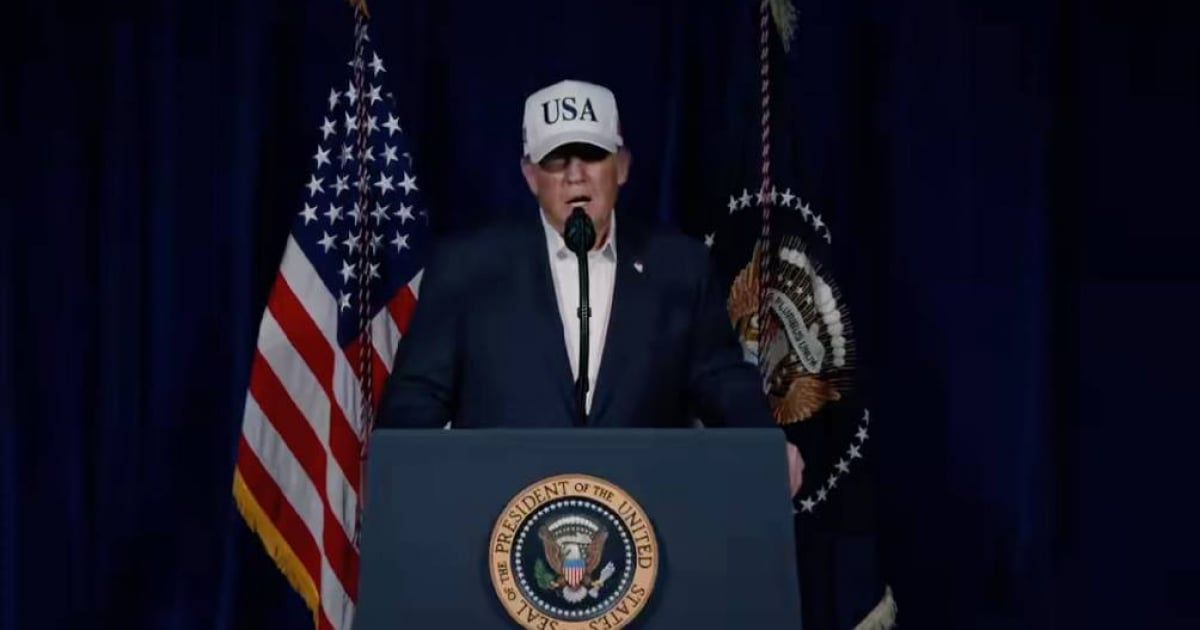
President Donald Trump stated this Wednesday on Truth Social that Iran has undergone a very productive regime change and that the United States is actively negotiating with the Persian country to reduce tariffs and sanctions.
In his post, Trump noted that "many of the 15 points have already been agreed upon" and that there will be no uranium enrichment in Iran, as part of a two-week bilateral ceasefire announced on the same day following weeks of extreme military escalation.
"The United States will work closely with Iran, a country that we have observed has undergone a highly productive regime change. There will be no uranium enrichment, and the United States, in collaboration with Iran, will excavate and eliminate all deeply buried nuclear remnants (from B-2 bombers)," wrote Trump.
The leader added that these nuclear remnants "are, and have been, under strict satellite surveillance (Space Force)" and that "nothing has been touched since the attack."
The context of the message is that of a fragile truce achieved through the mediation of Pakistan, whose Prime Minister Shehbaz Sharif and military chief Asim Munir facilitated the agreement that includes the reopening of the Strait of Hormuz.
The escalation that preceded the ceasefire was of unprecedented intensity. The Epic Fury Operation, launched on February 28 jointly by the U.S. and Israel, destroyed 90% of Iran's missile capability, 95% of its drones, and more than 5,000 targets, including nuclear facilities in Natanz, Isfahan, and Fordow.
In that attack, the supreme leader Ali Khamenei died, and on March 9, the Assembly of Experts elected Mojtaba Khamenei as the new supreme leader with 59 out of 88 votes, preserving the theocratic system.
Analysts indicate that, although Trump speaks of "regime change," the Iranian theocratic system remained intact with the arrival of Mojtaba Khamenei, without any formal political transformation.
Iran closed the Strait of Hormuz on March 4, blocking 20% of the world's oil, stranding 2,000 ships and pushing the price of Brent crude above 115 dollars per barrel.
Trump issued four ultimatums since March 21 demanding the reopening of the strait. On April 7, he escalated the pressure by warning that "a whole civilization will die tonight" if Iran did not comply.
Israel supported the suspension of attacks against Iran for two weeks on Wednesday, although it clarified that the ceasefire does not apply to Lebanon.
Formal negotiations between the U.S. and Iran will commence on April 10 in Islamabad, Pakistan, where both parties will need to address the outstanding differences of the 15-point U.S. plan, which demands the complete dismantling of Iran's nuclear program, the cessation of support to proxy groups, and a rollback of the missile program.
Filed under: