
Related videos:
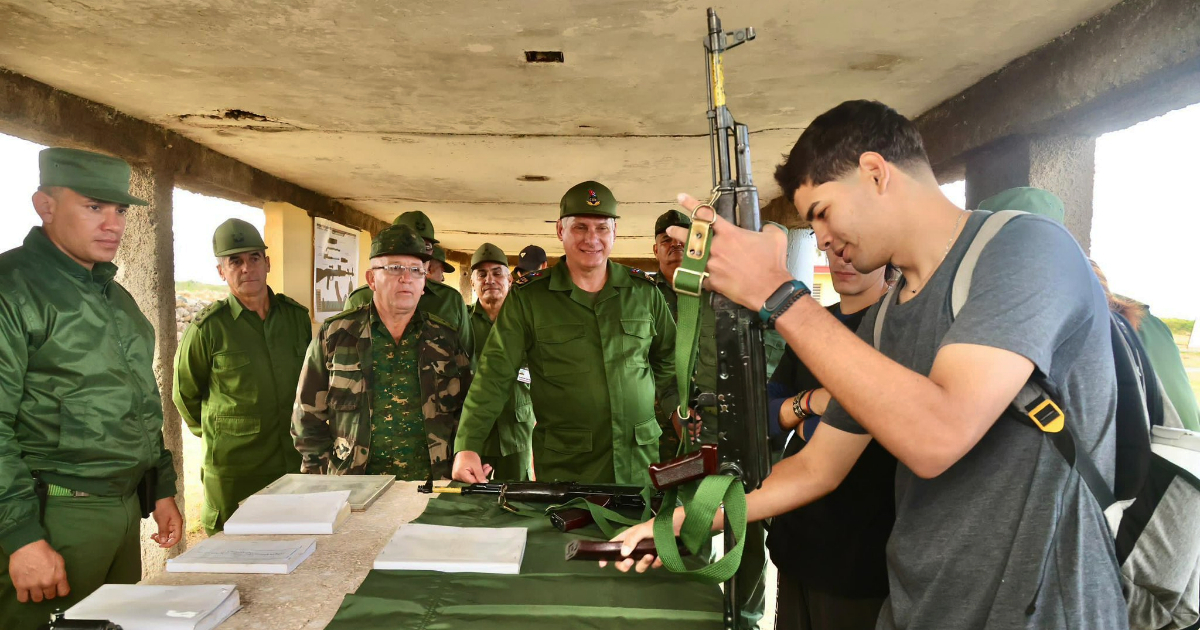
The post by CiberCuba on Facebook regarding the statements from Miguel Díaz-Canel, who warned that there would be a "guerrilla war" in Cuba if the United States attacks the island, immediately sparked a strong reaction among the outlet's followers.
Far from garnering support, the words of the Cuban ruler were received by many readers as a sign of disconnection from the reality of the country, with a wealth of comments largely characterized by mockery, indignation, and discredit.
Among the nearly 3,000 comments received in less than 24 hours, expressions of disbelief, local sarcasm, and direct criticisms of a speech that, for many, sounds outdated, propagandistic, and disconnected from the everyday struggles of the average Cuban were strongly reiterated.
From the very first minutes, the post collected responses filled with terms like "meme," "joke," and "ridiculous".
A commentator summarized that reaction with a phrase that was repeated in various tones throughout the thread: “Talking about guerrilla warfare in the 21st century is not just anachronistic, it's downright ridiculous.” Another wrote: “This must be a meme,” while a third remarked: “Not even in the Russian cartoons.”
A significant portion of the responses focused on the idea that the regime continues to rely on a narrative from the sixties to try to project strength at a time of extreme internal fragility.
“Wars today are not guerrilla wars,” stated a reader. Another was more graphic: “Now all wars involve technology, and you are far from having it.”
In the same vein, several comments emphasized that a modern conflict is not fought "with old slogans" or "with rusty rifles," but with means far superior to what Cuba could sustain.
But beyond the military mockery, what dominated was the contrast between that confrontational language and the hardships faced by the population. Time and again, readers brought the discussion back to the realm of the national crisis.
“What food?” one asked sarcastically. Another left a statement that summed up the general sentiment: “People with empty stomachs and he’s thinking about this.” There was also someone who wrote: “But if I’m hungry, what do I do?” and another added: “A starving people do not fight.”
In the discussion, a strong idea emerged, repeated in dozens of ways: if there is a war in Cuba today, it is not against a foreign enemy, but against daily survival.
The war we are facing is one of hunger, wrote a user. Another commented: We have been waging a guerrilla war for a while now to survive everything we are going through. And one more summarized social exhaustion with this statement: Without power and without food.
Power outages, the lack of medications, scarcity, and the general deterioration of the country were consistently mentioned by those who reacted to the CiberCuba publication.
"Better worry about electricity," a reader complained. Another wrote, "That can be solved by replacing weapons and bullets with food and basic necessities."
There were also more direct calls to abandon the warlike rhetoric and focus on real issues: “What needs to be sought is peace and to try to improve the country.”
One of the points that generated the most rejection was Díaz-Canel's insistence on speak on behalf of the "people". Dozens of commentators questioned the leader's claim to a representation that, as many responses reflect, they do not feel he possesses.
"I don't know what town this one has," wrote one user. Another commented, "Don't count on me." A reader was even more direct: "He can't speak for a town."
The idea that eventual resistance would not come from the people alongside the regime, but rather from the people against the regime, emerged repeatedly.
This guerrilla war would be the people against yourselves, noted a commentator. In another message, it read: “The war of the government, not of the people.” And another one stated: “The people are the ones who will be against you.”
There were also comments that interpreted the leader's words as a sign of fear or political desperation. "Díaz-Canel is scared," one wrote. Another offered this interpretation: "A threat is because you're crapping yourself."
In several messages, it was stated that the discourse aims to prepare a narrative to maintain power or to portray itself as a victim in the face of a potential escalation. "Now they are afraid, very afraid of losing everything, and they want to use the people they have humiliated so much as a saving shield," wrote a reader.
In the midst of that avalanche of reactions, several comments pointed out that the regime is attempting to turn the population into human shields. "He refers to forcing the people to die, and he will use them as shields to defend himself," warned a user.
Another person commented: “The loss of human lives is already known to be the young people in military service.” That fear that those at the bottom will bear the cost of a confrontation was one of the most visible subtexts of the debate.
There were also those who urged to avoid war at all costs. Although there were fewer of them compared to mocking or dismissive comments, there were indeed voices calling for reason. "No to war," wrote one reader.
Another person remarked, "What is at stake is to avoid a confrontation so that this people does not suffer more." In that vein, several insisted that any solution must be peaceful, because war would only worsen the suffering of an already exhausted society.
The magnitude of the interaction made it clear that the post struck a chord with the followers of CiberCuba. The abundance of comments, the chain responses, and the agreement on many of the arguments revealed something more than just a fleeting reaction: they reflected a deep discontent with the official discourse and a growing gap between the propaganda of power and the reality on the streets.
In the end, Díaz-Canel's threat did not evoke an image of firmness but rather a wave of skepticism. In the discussion opened by CiberCuba, a devastating perception prevailed: while the leader speaks of a "war of the entire people," many Cubans respond that they are already overwhelmed by surviving the daily war of hunger, blackouts, and misery.
Filed under: