
Related videos:
An article published on April 9 by the magazine El Estornudo traces the symbolic arc that connects two Cuban figures separated by time, yet united by hunger: Juan Carlos González, known as Pánfilo, who shouted in a Havana street that food was needed, and Luis Manuel Otero Alcántara, the artist and activist who has turned fasting into a weapon of resistance from prison.
Pánfilo became famous in April 2009 when he burst into a street recording and shouted, "Jama! What we need here is jama… we're on fire." His outcry was spontaneous, devoid of political calculation, but the regime responded with the only language it knows: repression.
He was admitted to a psychiatric hospital without medical justification. El Estornudo describes this practice as turning "dissent into pathology, medicalizing it, isolating it. Turning hunger into madness and those who speak of it into patients or prisoners."
Pánfilo left the hospital, but hunger remained. In September 2023, an activist reported him living on the street, sick and without medical care, near Carmelo in Vedado. He passed away in Havana on March 26, 2026. His sister Daisy Ortega confirmed it.
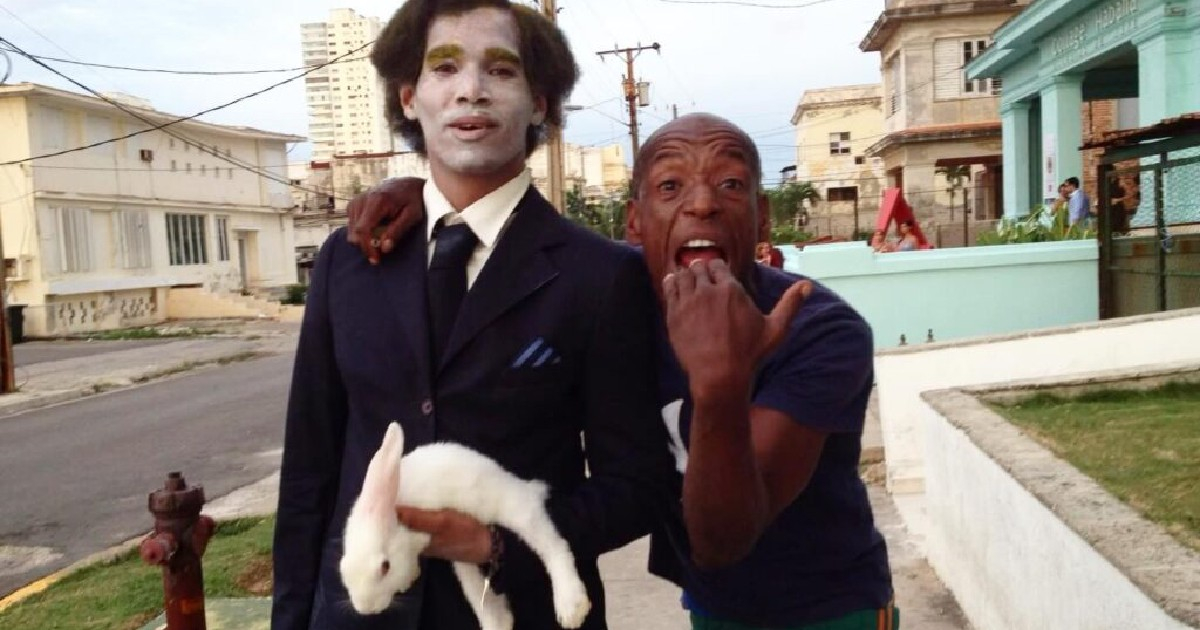
After his death, an image circulated showing him alongside Luis Manuel Otero Alcántara during the performance "Super Pijo," near the Collage Habana gallery. Pánfilo makes his viral gesture of asking for food; Otero holds a white rabbit, his face altered, giving a half-smile directly at the camera.
Otero Alcántara, leader of the San Isidro Movement and a prisoner of conscience recognized by Amnesty International, has been imprisoned since July 11, 2021, when he was arrested while attempting to join the protests on that now-historic day. He was sentenced to five years for offending national symbols, contempt, and public disorder.
On March 28, 2026, agents from Department 21 of State Security threatened to kill him during an inspection at the Guanajay prison in Artemisa: "We are going to kill you here".
Two days earlier, on March 26, he began a partial fast of 12 hours each day in protest of the threats and fear of an extension of his sentence. On March 30, he escalated to a total hunger strike, consuming only water. The strike lasted eight days and ended on April 6.
The activist Anamely Ramos confirmed the end of the hunger strike, stating that Otero Alcántara had regained inner strength and peace.
The context in which all this takes place is devastating. According to the Food Monitor Program, 96.91% of Cubans have lost adequate access to food due to inflation and falling purchasing power. 25% go to bed without dinner; 29% of families have eliminated one of their three daily meals. Deaths from malnutrition increased by 74.42% between 2022 and 2023, rising from 43 to 75 fatalities according to the National Office of Statistics and Information.
80% of Cubans believe the current crisis is worse than the Special Period of the 1990s, a direct consequence of 67 years of dictatorship that has destroyed the country's productive capacity and made it dependent on imports for between 70% and 80% of the food it consumes.
In that context, the regime announced on April 2 a pardon for 2,010 prisoners that explicitly excluded political prisoners, including those convicted for contempt or public disorder. The organization Justicia 11J documents at least 760 political prisoners in Cuba, 112 of whom are in vulnerable situations due to health or age.
Otero Alcántara is not the only one who has resorted to fasting as a form of protest: Roilán Álvarez Rensoler completed 45 days on hunger strike by March 2026, and Yosvany Rosell García conducted one lasting 39 days until November 2025. In a Cuba where hunger is systemic, political prisoners have learned to turn the very deprivation that crushes the people into the only tool of protest that the regime cannot confiscate from them.
Filed under: