
Related videos:
The official newspaper Sierra Maestra, from Santiago de Cuba, published an opinion piece authored by Yamilé Mateo Arañó that starkly depicts the failure of the banking process promoted by the Cuban regime since August 2023, with the most striking phrase coming from a private seller: "the transfer is the ruin of the business".
The text is notable for coming from a state media outlet that openly criticizes a government policy, describing banking as "a well-thought-out mechanism that, most of the time, does not work as envisioned".
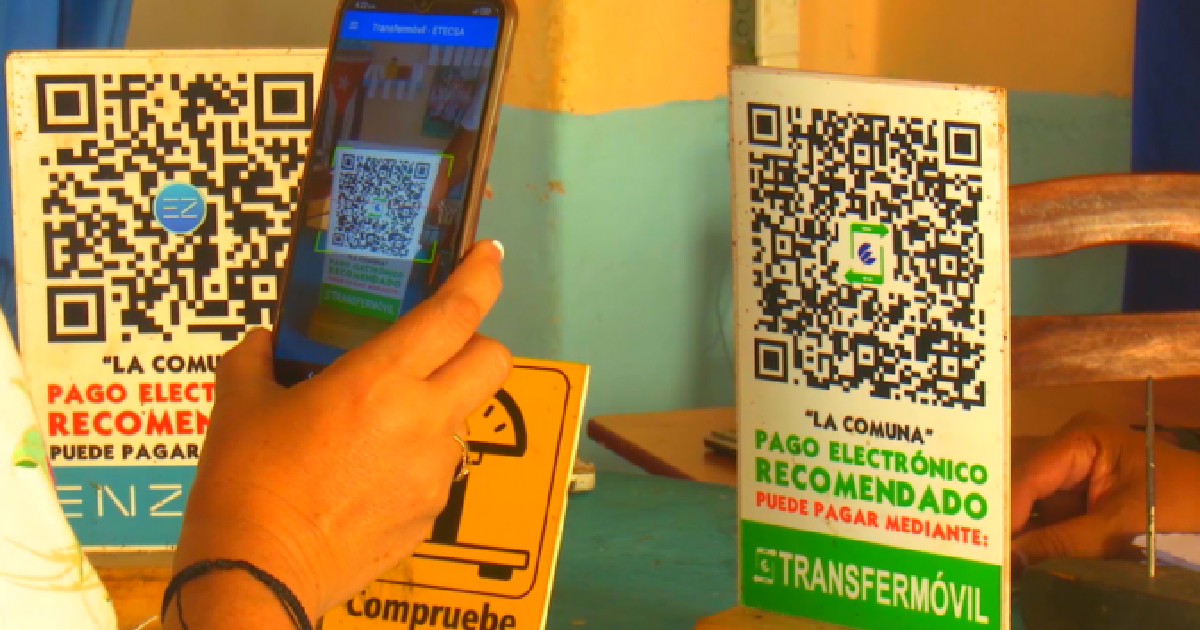
The author documents a catalog of excuses that private businesses use to avoid accepting digital payments through platforms like Transfermóvil and EnZona: "it's only for one product," "half cash and half transfer," "there's no power and therefore no connection," "the owner isn't here," or "we've already reached today's limit," even when it is only nine in the morning.
The underlying structural reason for this resistance is that private businesses need cash to purchase goods and import supplies, as their suppliers also do not accept transfers, and because cash leaves no fiscal trace, making it easier to evade taxes in a high-tax pressure environment.
The resistance of the private sector is compounded by the collapse of the banking infrastructure: ATMs are frequently out of order, cashless or shut down due to power outages, rendering them useless even for paying basic services.
Those who suffer the most from this situation are the elderly, many of whom lack mobile phones and must stand in long lines at banks to collect their pensions, with no guarantee of receiving the full amount due to the scarcity of cash in the institutions.
This void is filled by informal operators who exchange digital money for cash with commissions of up to 30%, and as the author describes, they organize themselves to hold spots in the lines and attend to their "clients" —primarily the elderly— until they are left with just enough to get by for the month.
The government has responded with coercive measures: in April 2024, it closed 476 establishments for failing to comply with electronic payment, and in September of that same year, it closed 58 more businesses for the same reason.
It also enabled phone numbers for reporting those who refuse transfers, but the author herself acknowledges the public skepticism: "They may come, but I've seen how they impose fines and people still don’t receive transfers when the inspectors leave," a neighbor told her.
That failure was acknowledged even by the Prime Minister Manuel Marrero Cruz on April 6, 2024, during the assessment meeting of the Central Bank of Cuba, and the general director of operations of that institution described it as one of the "primary disappointments" of the bank.
The macroeconomic context worsens the situation: severe inflation, shortages in state-run stores, and a partial dollarization of the economy that sets the prices of food and cleaning products in foreign currency, while the Cuban peso continues to depreciate unchecked in the informal market.
Mateo Arañó concludes that what was once envisioned as modernization "today has turned into a nightmare", and finding a real solution is the "task of very capable economists" under circumstances that, for now, only undermine the faith of Cubans in the process.
Filed under: