
Related videos:
Mark Kuster, a Swiss citizen and director of the NGO Camaquito, published a call this week on Facebook for transforming the training and job opportunities for young Cubans, demanding fewer state barriers and an education more focused on entrepreneurship and the real market.
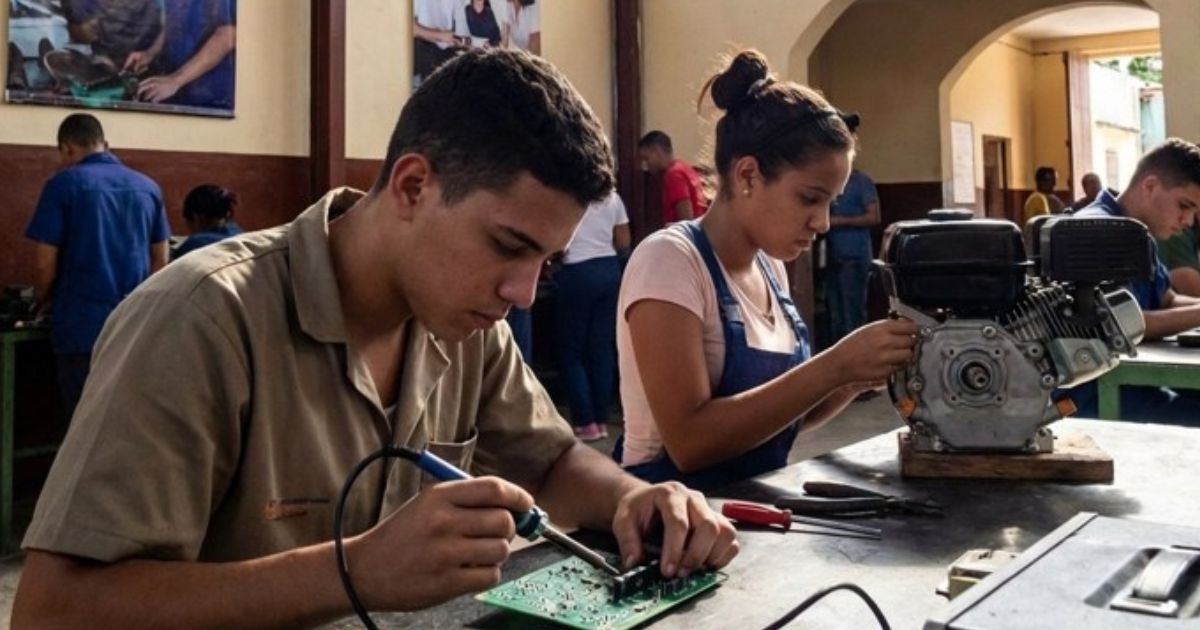
"Giving perspectives to young people in Cuba means, above all, preparing them for real life and for the real job market," wrote Kuster, accompanying his text with an image of the Center for Trades and Entrepreneurship of Santiago de Cuba, where students can be seen working with electric welders and engines under signs that read "Practical Training" and "Your Future, Your Business."
The director of Camaquito outlined three concrete proposals.
The first focuses on a pragmatic education that encourages personal responsibility, creativity, and an entrepreneurial spirit. "Young people need not only theory but also concrete skills that allow them to build something for themselves and secure their livelihood," he noted.
The second proposal directly questions the role of the state in the private economy: "The future of self-employment, small and medium-sized enterprises, or Local Development Projects should not primarily depend on state approvals. Rather, it should be quality, commitment, and usefulness that determine who can remain in the market."
The third one proposes to review the mandatory Social Service. "We must honestly ask ourselves if the Social Service, in its current form, is still suitable for the times," Kuster wrote, noting that "many young people today want to directly join the workforce, gain practical experience, and earn their own money from the outset."
The proposal is not isolated. The very draft of the new acknowledged that the three-year period for Social Service is lengthy and does not align with what is stipulated in other regulations, indirectly validating part of Kuster's criticism.
The context surrounding this call is urgent. Since 2021, over a million people have left Cuba, mostly young people of working age, reducing the population from 11.3 million to between 8.6 and 8.8 million by 2025.
The Cuban private sector, although officially expanded with more than 2,000 permitted activities for self-employment, remains subject to increasing bureaucratic restrictions, including Agreement 10216 from February 2026, which adds new layers of state control to e-commerce. The fuel crisis affects 96% of small and medium-sized enterprises.
Kuster has been connected to Cuba for over two decades through Camaquito, founded in 2001 and celebrating its 25th anniversary this year. In Santiago de Cuba, the NGO promotes the Local Development Project ZUTURO, which has benefited more than 600 entrepreneurs, and ZUTURO Junior, aimed at youth aged 15 to 18 from polytechnic institutes to turn ideas into sustainable projects.
His critical stance toward the regime's bureaucracy is not new: in November 2025, he allocated 50,000 dollars of his own and friends' funds to repair homes affected by Hurricane Melissa in Santiago de Cuba, explicitly without intermediaries and without bureaucracy.
"If we want to give a future to Cuba, then we must trust the young people, open up opportunities for them, and allow them to take on responsibilities," Kuster concluded.
Filed under: