
Related videos:
"I am waiting for my son to wake up so that with the little bit of water I collected from rinsing the rice last night and the water that drips from the refrigerator during the times it defrosts (due to the power outages), I can flush the toilet, which I have forbidden him to flush since yesterday because the little bit of clean water we have left is for bathing today, maybe tomorrow we will clean ourselves with wet wipes."
The testimony of this Cuban mother, residing in Old Havana and whose Facebook profile identifies her as LaSai Dela Vida, starkly summarizes the daily odyssey faced by millions of the island's residents.
"There is no institution in this country that serves the interests of the people; therefore, the people do not know, nor will they ever know, nor do they have any information about what is happening with water, and when we talk about water, we mean absolutely everything," laments the writer and visual artist.
In his opinion, the U.S. "blockade," the oft-repeated refrain by the Cuban government to justify the problems plaguing the nation, is not the cause of the dire situation: "The problem is that the leaders have long blocked the willingness to listen and truly serve their people [...]. There cannot be a country that advances where there is a constant attempt to cover the sun with a finger."
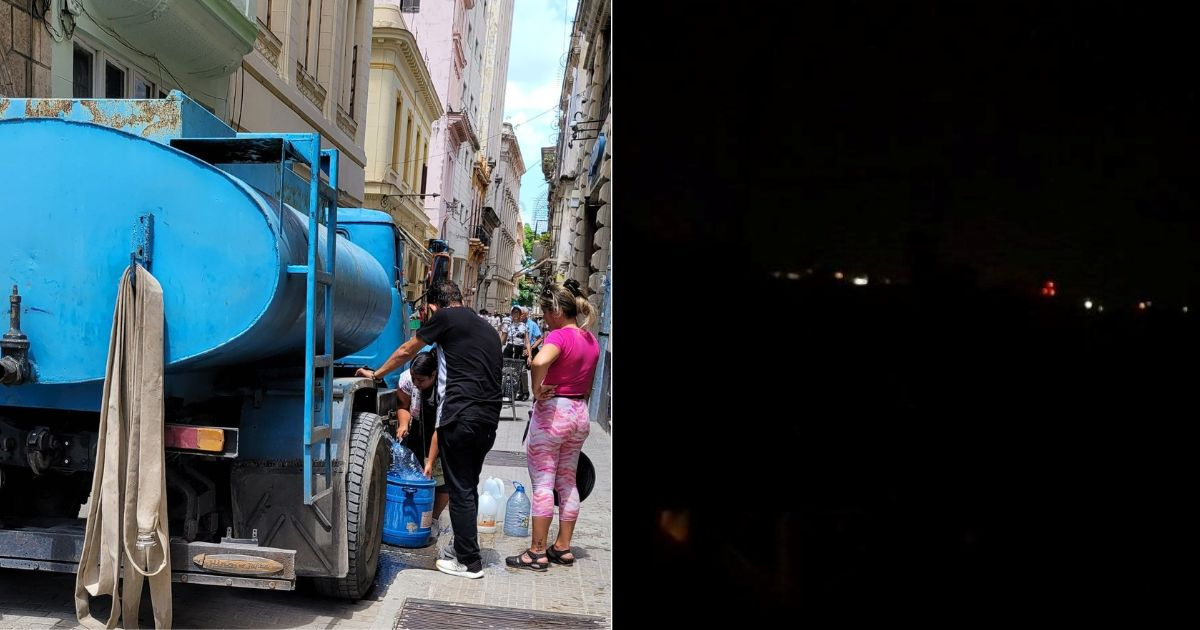
The situation is not an isolated case. The water crisis in Cuba —which has been ongoing for a long time— has now reached alarming levels due to the electrical collapse: the supply system relies on pumps that do not operate without electricity, and only 135 of its 480 essential stations are on protected circuits, leaving most pumping facilities at the mercy of power outages.
Power outages, far from easing, have worsened in recent weeks. Following the breakdown that took the Antonio Guiteras thermoelectric plant out of service, the national electrical system entered a deterioration spiral that has pushed the outages to unsustainable levels. The projected deficit on Wednesday of this week, for example, was 1,850 MW, a figure that illustrates the magnitude of the energy disaster.
The consequences on water supply are devastating across the country. In Ciego de Ávila, an area went 36 days without water, a figure that would have seemed unbelievable just a few years ago and has now become a normalized reality for its residents.
In Matanzas, the situation is no less dramatic: the power cycles reach two hours of electricity for 36 without supply, a ratio that makes it virtually impossible to maintain any daily activities normally, including access to drinking water.
In the face of the government's inaction, Cubans are turning to desperate measures. In Pinar del Río, families are paying 4,000 pesos for a water truck, an expense that is unaffordable for most of the population in a context of hyperinflation and meager salaries.
The international community has begun to recognize the seriousness of the crisis. The United Nations launched a $94.1 million action plan to sustain essential services in Cuba, indicating that the deterioration has reached a humanitarian dimension that can no longer be ignored from the outside.
Filed under: