
Related videos:
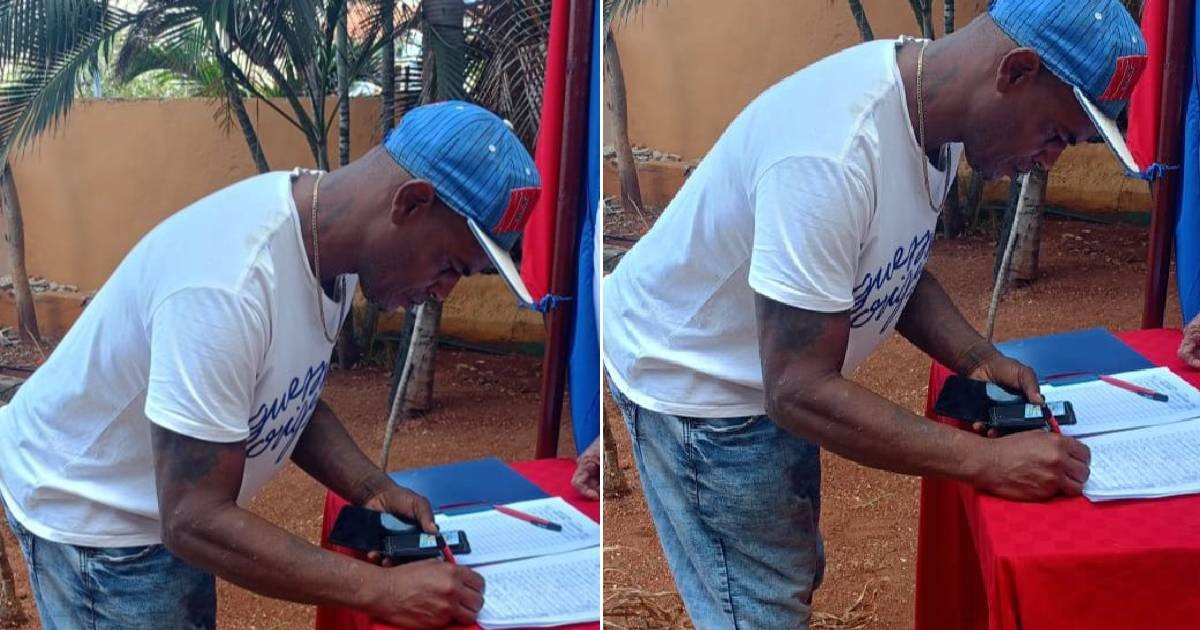
The former Cuban spy Gerardo Hernández Nordelo, national coordinator of the Committees for the Defense of the Revolution (CDR), posted an image of a man signing at a CDR table during the "My Signature for the Homeland" campaign, presenting it as evidence of popular support for the regime's initiative.
In the post, the man identifies himself as a "repatriated" person who lived three decades in the United States and justifies his participation with these words: "My ideology is not what matters. What matters is that I don't want bombs for my people; I ask for peace. I don't want any more blockades; we have suffered enough. That's why I sign."
The image shows a young man leaning over a table with a red tablecloth, signing documents next to what appears to be an official seal, with a Cuban flag in the background and palm trees in an outdoor setting of reddish soil.
The use of this figure has an evident propagandistic objective: to show that even those who lived in the United States support the revolution. However, the publication reveals more than it intends to hide, as it exposes the artificiality of a campaign that the regime presents as a spontaneous movement of civil society.
The campaign "My Signature for the Homeland" was launched on April 19 by the Communist Party of Cuba (PCC) to support the declaration "Girón is today and always," issued on April 17 to commemorate the 65th anniversary of the proclamation of the socialist nature of the revolution.
The initiative was organized by the Ideological Department of the Central Committee and announced by its head, Yuniasky Crespo Baquero, who framed it as a constitutional obligation: "Defending ourselves is not just a right; it is, as we affirm in our Constitution, the greatest honor and the supreme duty of every Cuban."
The guestbooks were opened in communities, workplaces, and educational centers across the country, amid a severe energy crisis characterized by widespread blackouts and general scarcity.
Even Díaz-Canel himself acknowledged during an event on April 16 that "there is absolutely no fuel for almost anything", which contrasts with the image of unity and support that the regime tries to project with the campaign.
Critics point out that these mobilizations serve as mechanisms of social control and coercion, as non-participation carries the risks of political labeling and labor or academic sanctions.
This is not the first time the regime has resorted to this mechanism. In September 2025, an identical campaign to support Nicolás Maduro was executed, in which the Ministry of Education mobilized students and demanded signatures from children and adolescents under threat of being labeled as "counter-revolutionaries." The organization Cubalex then reported violations of children's rights.
Hernández, a member of the PCC Political Bureau since April 2021, actively uses his social media to spread official propaganda and has been repeatedly criticized by Cubans who highlight his disconnection from the real crisis the island is experiencing.
Filed under: