
Related videos:
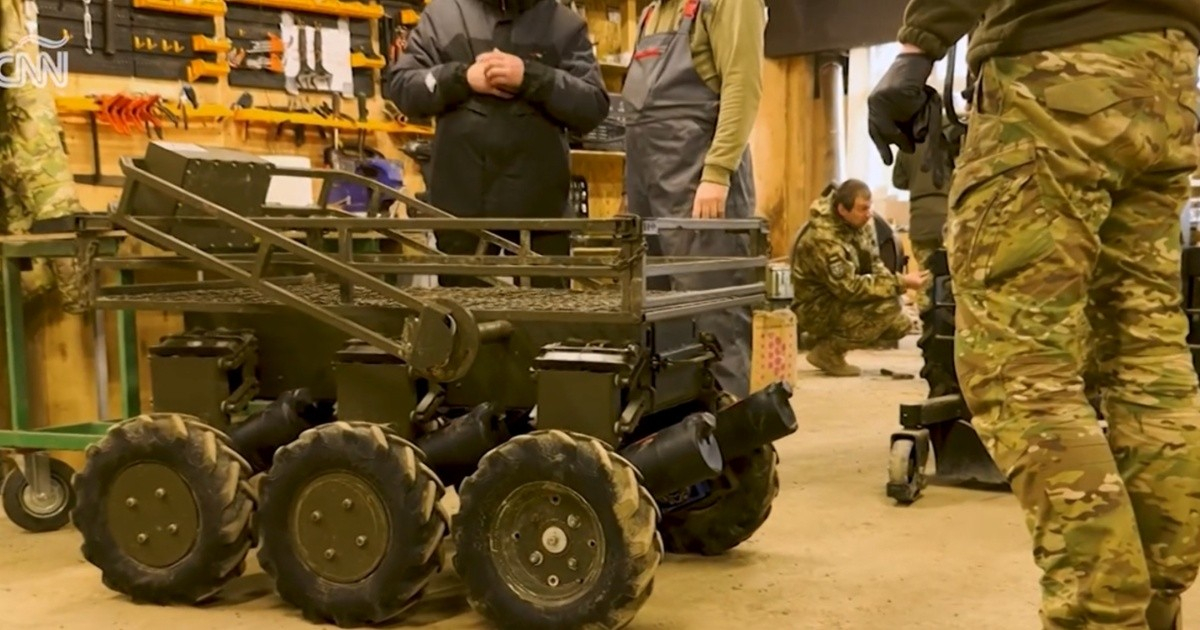
Two Russian soldiers surrendered last summer to ground robots and remotely controlled Ukrainian drones, with not a single human captor present.
According to a report from CNN, the position was taken without firing a single shot, in what the commander of the operation described as the first time in history that an enemy position was assaulted and prisoners were taken exclusively by unmanned systems.
The mission leader was Mykola "Makar" Zinkevych, commander of the NC13 unit of the Third Separate Assault Brigade of Ukraine, responsible for ground-based robotic attack systems.
"We must understand that we will never have more personnel, and we will never have a numerical advantage over the enemy," Zinkevych told CNN. "So we need to achieve that advantage through technology."
Since that operation, missions where robots replace human soldiers have become routine for the unit.
The stated objective of NC13 is to replace up to 30% of frontline infantry with robotic technology this year.
President Volodymyr Zelensky confirmed the extent of the change on April 14: drones and robots had completed over 22,000 missions in the last three months. "More than 22,000 lives were saved when a robot entered the most dangerous areas instead of a warrior," he stated.
The deployed systems include platforms such as Ratel, TerMIT, Ardal, Rys, Zmiy, Protector, and Volia. Only in March 2026, the ground robots completed over 9,000 missions for logistics and evacuation.
By the end of 2025, the Third Army Corps reported that a single ground robot equipped with a machine gun halted a Russian advance for 45 days, requiring only light maintenance and battery recharges every two days.
The momentum has accelerated under the new Minister of Defense, Mykhailo Fedorov, who announced on April 18 the purchase of 25,000 ground robotic systems in the first half of 2026, more than double the number acquired throughout 2025. Fedorov signed 19 contracts worth 11 billion hryvnias and set an ambitious goal: "100% of logistics on the front line must be conducted by robotic systems."
The Ukrainian ground robotics sector comprises over 280 companies and 550 active solutions, supported by the state cluster Brave1, which has issued 175 grants to developers.
The Bizon-L robot—capable of carrying 300 kilograms and having a range of 50 kilometers—has been classified under NATO standards for joint operational use.
Russia is also making progress in robotics, although it is lagging behind. For Zinkevych, the key is not who develops the technology first: "On the battlefield, the decisive factor is who has managed to scale it in the long term."
Robert Tollast, an expert in ground warfare from the Royal United Services Institute in the UK, warned that ground drones are likely to struggle to hold territory on their own, but acknowledged that they are already saving lives in evacuations, resupply, and combat.
"Even imagining a future in which NATO does not fight exactly like Ukraine, it is almost certain that these systems will find many uses in other forces," he added.
The Institute for the Study of War assessed that Ukraine's superiority in drones "is likely contributing to the stagnation of Russian advances and the recent Ukrainian counterattacks," although it cautioned that "the challenge for Ukraine now will be to stay one step ahead as Russia responds."
Filed under: