
Related videos:
A mother residing in the Cerro municipality in Havana reported a fly infestation that makes life unbearable in her home, where she lives with a baby.
"This is in Cerro, Zequeira, and San Joaquín. Within an hour, the traps fill up with flies, and yet my house is still full of flies. I have a baby, and this is unbearable," the woman wrote in her complaint sent to the independent CubaNet Noticias.
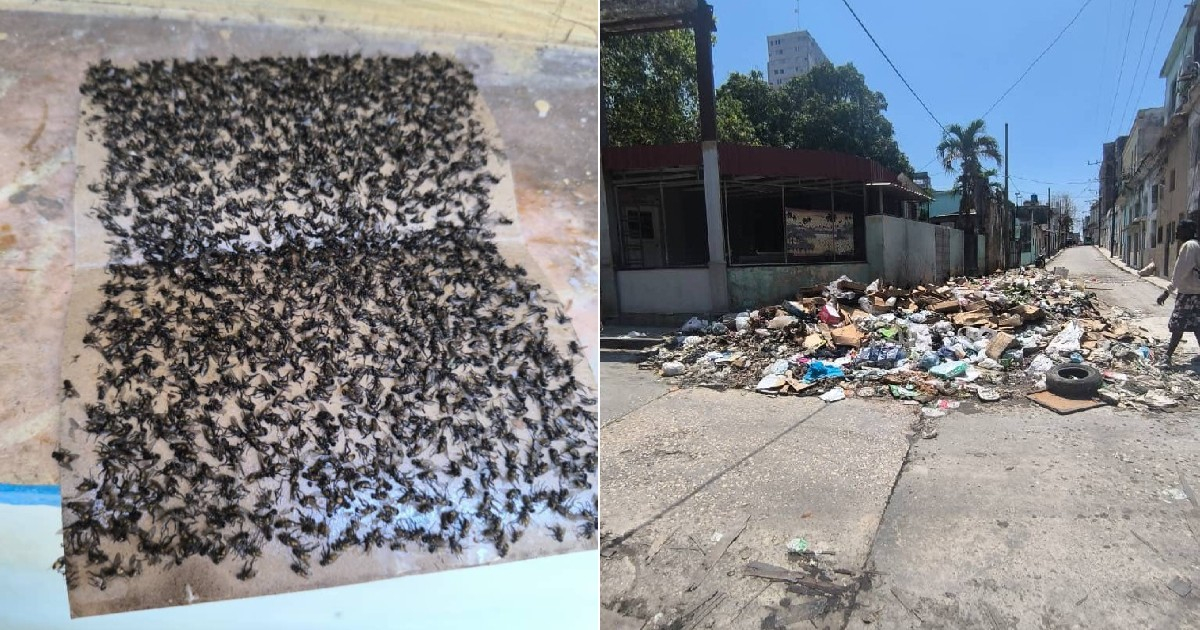
One of the images accompanying the testimony, published on Facebook, shows a sticky trap covered with hundreds of trapped flies that nearly covers the entire surface of the sheet. According to her complaint, the trap filled up in just one hour without any decrease in the presence of insects inside her home, located at the intersection of Zequeira and San Joaquín.
The proliferation of flies poses a significant health risk to the population, as they act as vectors for pathogens that can contaminate food and water, transmitting infectious diseases such as salmonellosis, gastroenteritis, cholera, typhoid fever, and dysentery.
The photographs shared by CubaNet reveal the origin of the problem: at the mentioned corner, a huge accumulation of garbage and debris, with cardboard, plastics, bags, tires, and construction materials scattered on the public road, forming an improvised open-air microdump.
The situation in Cerro is not new. In July 2025, residents of the popular council Armada set fire to trash containers as a desperate measure due to the proliferation—at least eight hotspots between June and July—of rats, flies, and cockroaches.
In December, residents from another neighborhood in the municipality reported a chronic sewage leak on Zaldo Street, with leaks on the sidewalks and odors dating back several years, while San Joaquín Street had already been flagged for illegal wastewater discharges that cause a proliferation of flies.
The background is the collapse of the waste collection system in the capital in recent years. The lack of fuel has plunged Havana into mountains of garbage, with only 44 out of 106 collection trucks operational in January; while the city generates between 24,000 and 30,000 cubic meters of solid waste daily.
The garbage crisis in Havana made headlines in the international press in February, when the news agency Reuters published a report on the mountains of waste in the city.
The government announced around that time an investment project with Portuguese capital to modernize waste management, but none of those measures have changed the situation.
The deterioration of sanitary conditions is spreading throughout the capital of the country. Recently, the opposition member Silverio Portal documented extreme unsanitary conditions on Dragones Street, in Centro Habana, with feces and trash creating an active infection hotspot, just meters away from businesses, homeless individuals, and passersby.
But the situation is equally serious in other cities. A island of plastic and organic waste floats beneath the iconic Yayabo Bridge in Sancti Spíritus.
In Holguín, the garbage dumps burn every night, producing toxic smoke with dioxins, furans, and at least 30 hazardous compounds, as warned by the Center for Neurosciences of Cuba, which has documented effects on respiratory, cardiovascular, and neurological health, particularly in children and the elderly.
The health consequences are serious: according to official data, Cuba ended 2025 with 55 deaths from arboviruses —dengue and chikungunya— diseases transmitted by mosquitoes that breed in the same garbage and stagnant water that fuel fly infestations. However, independent records from the Cuban Citizen Audit Observatory report at least 87 deaths just between October and November of that year.
Filed under: