
Related videos:
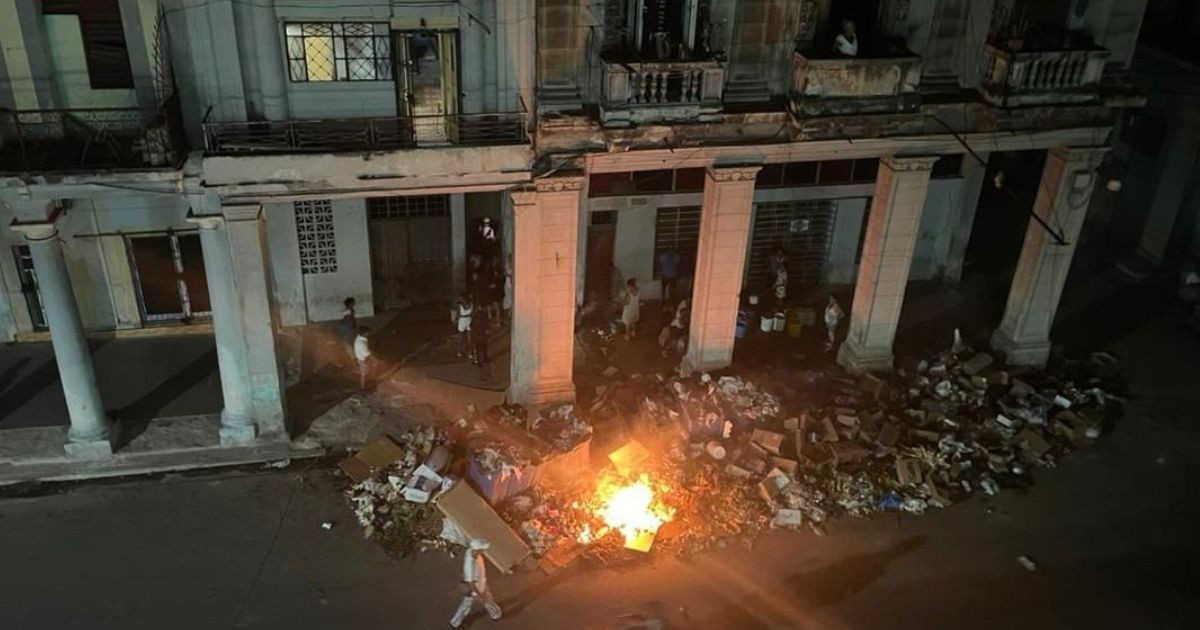
Residents of the Reina neighborhood in the Centro Habana municipality have begun to deliberately set fire to the trash heaps accumulated in public areas to force the arrival of firefighters and take advantage of the water from their trucks, as documented by the Food Monitor Program (FMP) between April 13 and 14.
A local resident described the practice bluntly: "They just set the trash can on fire to call the firefighters, who will put out the fire and, in the process, fill a few small tanks with water."
The FMP, an independent organization that monitors food security in Cuba, published a thread on X this Tuesday alerting about the seriousness of the situation and tagging several independent Cuban media outlets.
The scene was not an isolated incident: testimonies gathered by the FMP reveal that "the same dumpster was set on fire as many as three times in one night," with a large part of the neighborhood gathered around the flames, buckets in hand.
The FMP warns that the practice has spread to several municipalities in Havana and is a response to the convergence of three simultaneous crises: a shortage of supplies for urban sanitation, a lack of fuel for the garbage collection trucks of Comunales, and a critical shortage of drinking water.
The organization is adamant in its interpretation: "It is not vandalism; it is a precarious solution born out of necessity and the lack of institutional response."
The lack of fuel that has sunk Havana into mountains of garbage is a structural crisis that has persisted since 2025, and the government itself has admitted that it does not know how to resolve it sustainably.
In November 2025, Cuban authorities confessed to being unaware of the exact volumes of waste generated in the capital, while approximately 30,000 cubic meters of waste are produced daily with a much lower collection capacity.
The water situation is equally critical. In April 2026, power outages leave more than 200,000 Cubans without water, nearly 11% of the capital's population, without regular access to drinking water.
The 87% of the national supply system depends on the National Electro-Energy System, which means that every blackout halts the pumps; only 135 out of 480 pumping stations are protected against outages.
Residents of Centro Habana and nearby areas report up to 35 consecutive days without water this month, and last Sunday a failure in the Palatino pump left neighborhoods in Víbora and Plaza de la Revolución without water.
Data from mid-2025 indicates that 43% of Cubans received water every three days or more, while at the national level, over 3.1 million people—30% of the population—suffer from total or partial lack of service.
The FMP indicates that the deterioration has had roots since 2019, but "intensified from January 3, 2026," in a context that the organization describes as a chronic humanitarian emergency, worse than the Special Period of the 1990s, a assessment that 80% of Cubans share, seeing the current crisis as worse than the Special Period.
That same proportion —the 80% of respondents by the FMP— points to poor state management as the primary cause of the food and water crisis, not external factors.
The organization summarizes the situation as follows: “The population prioritizes immediate survival over the security risks posed by fire,” describing what they call “the struggle for survival in a state of collapse.”
Filed under: