
Related videos:
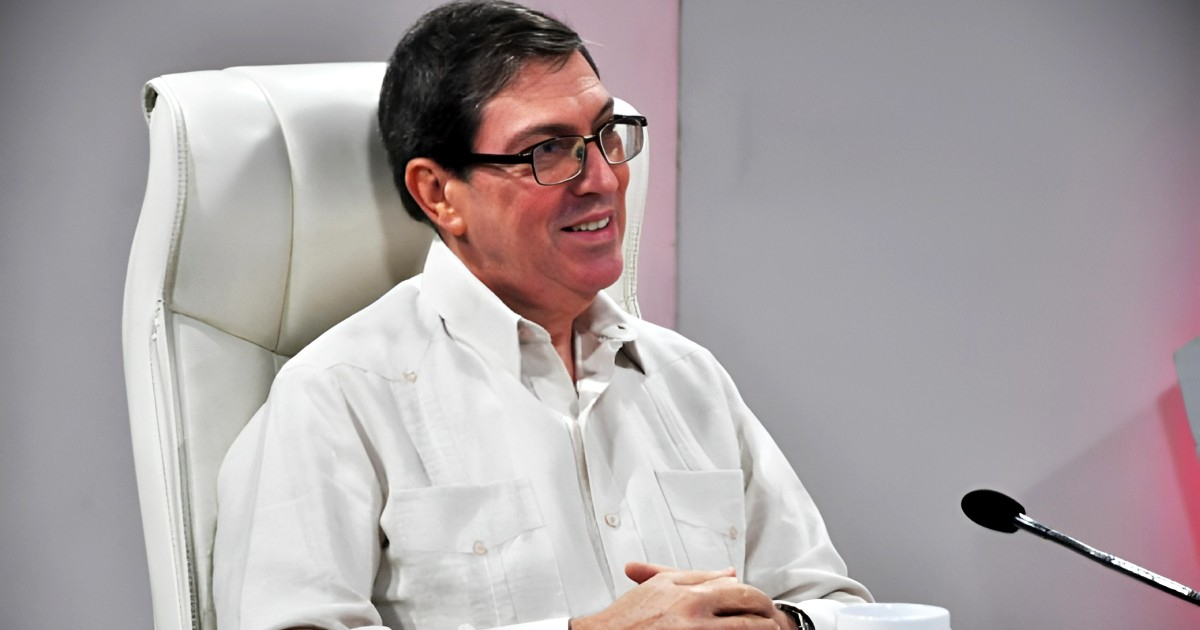
Cuban Foreign Minister Bruno Rodríguez Parrilla published a message on Wednesday on his X social media account, where he described it as "absurd" for the State Department to claim that Cuba poses a threat to the United States, in a new episode of the victimization narrative that the regime has adopted in response to the maximum pressure from the Trump administration.
"It is absurd for the State Department to claim that Cuba, a developing country, relatively small and subjected to a brutal economic war, could pose a threat to the world’s greatest military, technological, and economic power," Rodríguez Parrilla wrote in his post.
The chancellor added that Cuba "is a peaceful country that does not aggress against others, does not allow its territory to be used against others, and has a clean record against terrorism, organized international crime, and violence", and concluded by stating that "it is not possible to manufacture excuses with such weak and fallacious arguments."
The message arrives three months after President Donald Trump signed Executive Order 14380, which declared Cuba a "national emergency and extraordinary threat" to the national security of the U.S. and imposed tariffs of up to 50% on countries that supply oil to the island.
Washington's justification is based on the regime's alliances with Russia, China, Iran, and North Korea, the harboring of fugitives from U.S. justice, the protection of leaders from the Colombian ELN, and support for the regime of Nicolás Maduro in Venezuela.
Various reports and previous analyses have indicated that the Cuban regime has maintained strategic ties in military and intelligence matters with adversarial powers to the United States for years.
Among them stands out the reactivation of military cooperation with Russia —including the modernization of capabilities on the island and the potential use of facilities like Lourdes for electronic intelligence— as well as technological and security agreements with China, linked to telecommunications infrastructure with possible espionage purposes.
This is complemented by political and operational alliances with Iran and North Korea, as well as the historical collaboration with actors such as the Colombian ELN and support for Chavism in Venezuela.
These elements have been cited by Washington as part of the argument to consider Cuba a risk to its national security, in contrast to Havana's official narrative that insists on its peaceful nature.
What makes Rodríguez Parrilla's stance striking is the contrast with the rhetoric that the regime itself has upheld for decades: that of a revolutionary David capable of standing up to the imperial Goliath.
Cuba deployed up to 300,000 military personnel in Angola between 1975 and 1991, and also intervened in Ethiopia, the Congo, and Syria, building an official identity based on "proletarian internationalism" and the ability to challenge the "empire."
Recently, while addressing troops during military drills, Miguel Díaz-Canel stated that “the cost of aggression for imperialism must always be higher than any potential benefits.” In the Extraordinary Plenary of the Communist Party, he declared that “surrender will never be an option”.
Now, that same regime that prides itself on its capacity for defiance appeals to its smallness and harmlessness before international forums.
This Wednesday, the Cuban ambassador to the United Nations, Ernesto Soberón Guzmán, denounced a "maritime blockade" by the U.S. before the UN, and in April the regime even proposed cooperation with Washington on transnational crimes, a shift that analysts interpret as a sign of structural weakness in the face of economic suffocation.
The trend extends to the official language: the Ministry of Foreign Affairs (MINREX) issued in 2026 a statement without using the words "blockade" or "empire", an unprecedented rhetorical shift in the diplomatic rhetoric of the regime.
Cuba was re-incorporated into the list of state sponsors of terrorism by Trump in January 2025, and in April of this year, the U.S. also certified it as a country that does not fully cooperate in the fight against drug trafficking, two designations that the regime rejects but frame Washington's position, and which Marco Rubio, Secretary of State, has firmly defended.
Filed under: