
Related videos:
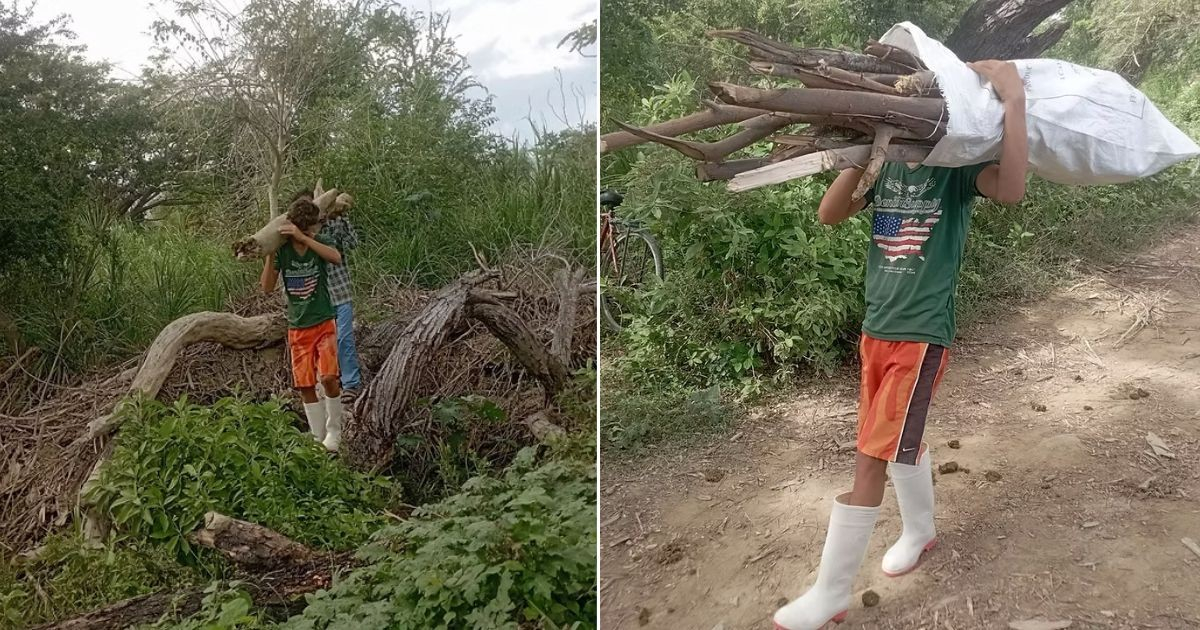
Joaquín is 16 years old, lives in the eastern region of Cuba, and every morning faces a decision that shouldn't fall on him: before going to school, he must head into the woods to gather firewood so his family can cook.
His story, documented by Food Monitor Program and published this Thursday, starkly portrays what the energy crisis under the dictatorship has taken away from an entire generation of Cuban children.
In the household, there are three: him, his mother, and his grandmother. Since power outages became a regular occurrence, firewood has become the only fuel that ensures food can be cooked.
The energy crisis has surged the use of firewood in Cuba to the point where it has become a daily necessity for millions of families, especially in rural areas of the eastern part of the country, and sometimes, the responsibility of gathering it falls on children and teenagers.
"It's not easy because you have to walk quite a bit, and I have to borrow the machete, and it also tires you out. I have a neighbor who helps me from time to time, but he's not always around," the teenager recounts.
Joaquín should be in class, but he carries the responsibility of bringing fuel home at the risk of not being able to eat.
Over time, he also found in this task a source of income: each bag of firewood is sold for 500 Cuban pesos, just under a quarter of the national minimum wage of 2,100 pesos.
"Yes, it's true that firewood is sold. For example, if I gather two sacks, I keep one for cooking and another for the house. But I have to walk further each time to collect firewood, which is why I can't sell everything I gather," she explains.
The activity involves real physical risks. The places he frequents— the riverbank and the surrounding farms—have become increasingly treacherous because Cubans are cutting down trees out of desperation and the available firewood is diminishing. Joaquín works without any protective equipment.
"I once cut my foot and had to walk a kilometer holding the bleeding with a little cloth. It's true that it's dangerous, but I'm not afraid," she says.
Your case is not exceptional. Cuban teenagers are leaving school to work in construction, street vending, or gathering firewood, in a country where 89% of families live in extreme poverty and the minimum cost of living exceeds 50,000 pesos per month.
Cuba legally prohibits child labor, setting the minimum age at 17, but the regulation is merely paper.
The electrical deficit reached 1,850 MW daily in April 2026, exacerbated by the shutdown of the Antonio Guiteras thermoelectric plant and the definitive cutoff of Venezuelan oil supply in January of this year. More than nine million Cubans cook without stable access to gas or electricity.
The environmental consequence is equally serious. Deforestation and fires strike a triple blow to Cuban forests, and Cuba lost 42,000 hectares of natural forest between 2021 and 2024. The area reforested dropped from 12,615 hectares in 2020 to 8,191 in 2024.
The Food Monitor Program summarizes the dimension of the problem with a question that has no easy answer: "What country will be left for us Cubans to live in when we have exhausted all its biodiversity to survive?"
Filed under: