
Related videos:
Although Cuba has a 31% forest cover, the most recent official data confirms that the country is losing its reforestation capacity year after year. Since 2020, the production of seedlings has decreased by almost 40%, the area planted is declining, and wildfires have affected thousands of hectares so far in 2025.
Meanwhile, the risks associated with climate change continue to grow, and state plans fail to reverse environmental degradation.
The report "Forestry in Cuba," published by the National Office of Statistics and Information (ONEI), shows that in 2024 only 8,191.7 hectares (ha) were planted, far below the 12,615.9 ha reported in 2020.
It is also noted that there has been a decrease in the production of seedlings, which dropped from 24.77 million to 14.75 million during the same period.
Effective reforestation also decreased: 19,954.8 hectares were promoted and only 3,750.3 hectares of forests were restored. The most active provinces were Santiago de Cuba, Camagüey, and Pinar del Río, but the effort is insufficient in the face of the rate of deforestation, driven by land use for agriculture, the expansion of human settlements, and wildfires.
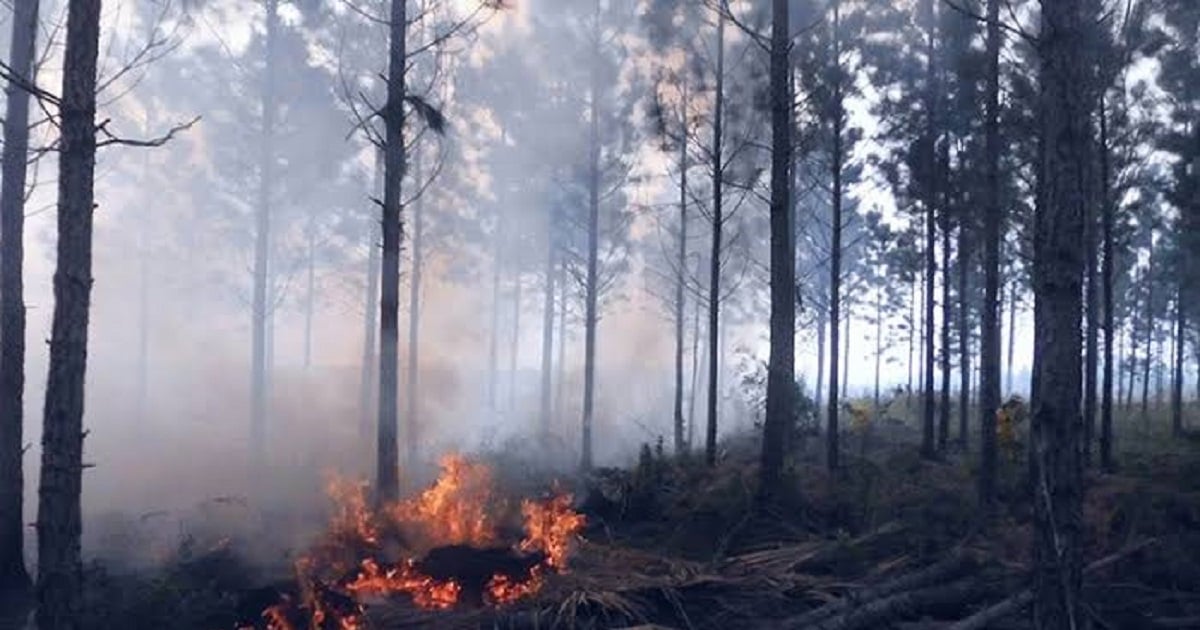
Between January and March of this year, 136 wildfires were reported, devastating more than 813 hectares. Pinar del Río topped the list with 30 fires and nearly 480 burned hectares, followed by Isla de la Juventud and Cienfuegos. In March alone, two large-scale incidents affected over 480 hectares between Pinar del Río and Holguín.
Preventive tools have also faced setbacks. Firebreaks and green strips (areas of vegetation that are strategically planted in forests to serve key ecological functions), which are essential for containing fires and preserving biodiversity, have been implemented less than in previous years. In 2024, the green strips covered only 520.7 kilometers, compared to 802.1 in 2023.
Despite the country having valuable forest ecosystems—such as the tropical rainforests of Moa and Sierra Cristal or the mountainous pine forests—its preservation seems to be increasingly at risk.
Regarding the topic, the official site Cubadebate reminded us that Cuba also hosts one of the largest mangrove areas in the Caribbean, covering more than 5% of its territory, but many coastal areas are at risk if sanitation and reforestation processes are not reinforced.
A United Nations report warns that 21 Cuban coastal communities could disappear before the end of the century if urgent measures are not taken. Another 98 would be severely affected by erosion and sea level rise.
Despite legal frameworks such as the 1998 Forestry Law, the "Tarea Vida" initiative of 2017, and the new Law on the System of Natural Resources and the Environment of 2024, concrete actions have not succeeded in reversing the trend. Plans are in place, but their implementation is inconsistent, and the statistics indicate a greater inertia than progress.
The future of Cuba's forests still relies on decisions that have yet to be put into practice. Forestry, as noted by a commentator in the official media, continues to be “the Cinderella” of the national agroforestry system.
But the pressure on forest ecosystems is not limited to agricultural activity. The energy crisis has also triggered rampant deforestation to obtain firewood or charcoal, as citizens themselves report in the comments.
"The lack of electricity and gas is stripping the slopes of the emblematic Loma de la Cruz in Holguín," warned one user. Another estimated that "there won't be a tree left standing" if the current situation continues.
This is compounded by the deterioration of urban greenery. In cities like Havana and Bayamo, there is a reported accelerated decline in the number of trees, with inadequate replacement and lack of professional maintenance.
The stumps of felled trees, a true reflection of a shameful neglect, are rampant in our tree-lined streets and avenues and there is no noticeable action to curb this excess and the mistreatment by many citizens and state entities that should care for the green lungs of the capital. Neglect, a lot of neglect," denounced another reader.
A more structural analysis points to the lack of strategy and technical incapacity within the Forest Directorates of the Ministry of Agriculture. "Since 2016, several directors have come and gone who lack knowledge of forest activities. Between trips abroad and collaboration projects, they lose sight of the fact that the most important task for agroforestry companies is the Forest Management Plan for their forest resources as well as for non-timber resources," argued a forum member.
The picture is completed by the shadow of economic exploitation over forest resources. “I hope we don’t see them as a source of foreign currency because we will be left without forests in the eagerness to 'partially dollarize' the economy,” warned a reader with an ironic tone. “Where we set our sights, we pull the trigger. But the trigger of disaster.”
Despite legal frameworks such as the Forestry Law of 1998, the State Plan for addressing climate change known as "Tarea Vida" from 2017, and the Law on the System of Natural Resources and the Environment approved in 2024, the realities on the ground do not support the official narrative. Actions are insufficient, resources are scarce, and management remains tied to inefficient structures.
Frequently asked questions about the deforestation crisis and forest management in Cuba
What is the current situation of forests in Cuba?
In Cuba, despite maintaining 31% forest coverage, the country is facing a process of deforestation and setbacks in reforestation due to fires, indiscriminate logging, and insufficient seedling production. Since 2020, seedling production has dropped by 40% and the area planted has decreased, while by 2025, more than 136 forest fires have already been recorded.
What measures is the Cuban government taking to combat deforestation?
Despite having legal frameworks such as the Forestry Law of 1998, the "Tarea Vida" of 2017, and the Law on the System of Natural Resources and the Environment of 2024, the actions of the Cuban government have not been able to reverse the trend of environmental deterioration. The measures implemented have been insufficient and resources scarce, which has exacerbated the situation.
What impact do wildfires have in Cuba?
Wildfires have devastated thousands of hectares in Cuba, severely impacting ecosystems, biodiversity, and air quality. In 2025, Pinar del Río has been the hardest-hit province, with over 8,000 hectares burned. The fires are driven by both natural factors such as drought and human negligence.
How do deforestation and the energy crisis affect Cuban forests?
The energy crisis in Cuba has increased the indiscriminate felling of trees for firewood and charcoal, exacerbating deforestation. The lack of electricity and gas has led to the cutting down of trees in iconic areas such as the Loma de la Cruz in Holguín, endangering the sustainability of Cuban forests.
Filed under: