
Related videos:
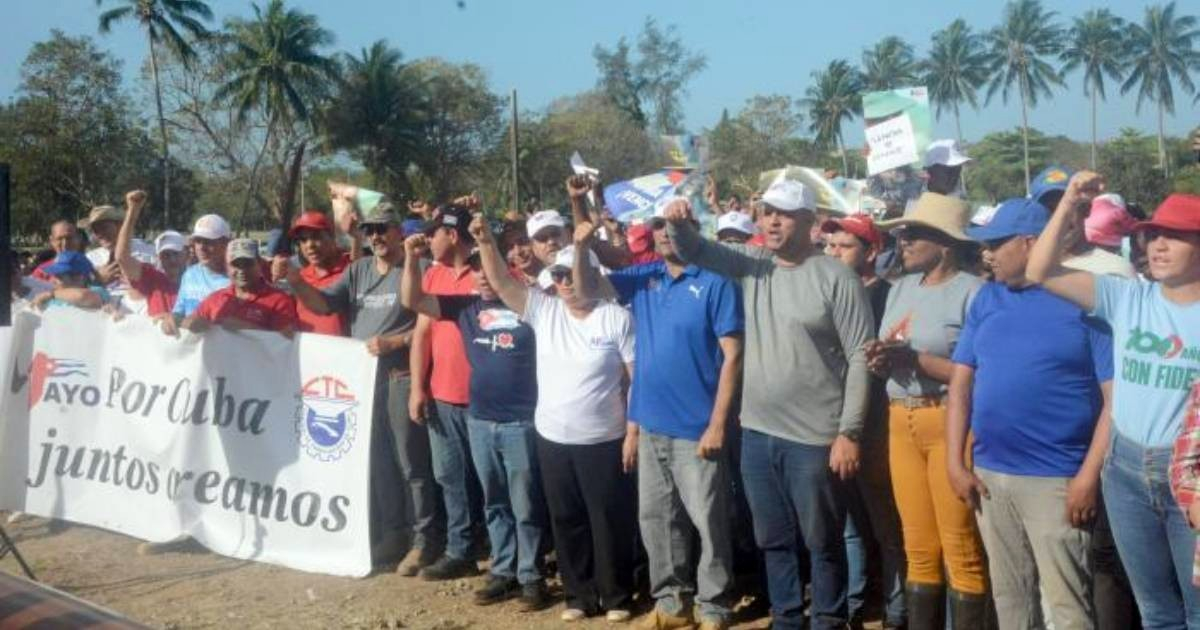
The Central Workers' Union of Cuba (CTC), its national unions, and the National Association of Innovators and Rationalizers (ANIR) launched the official call for May 1, 2026, under the slogan "The Homeland is Defended," with a distinctly warlike and anti-American tone that reflects the escalating tensions between Havana and Washington.
The call was presented by Osnay Miguel Colina Rodríguez, president of the organizing committee of the XXII Congress of the CTC, in the presence of figures from the Communist Party such as Liván Izquierdo Alonso, first secretary in Havana, and governor Yanet Hernández Pérez.
Colina Rodríguez affirmed that, in light of the pressures from the U.S. government intensified by the executive order of January 29, there is nothing more important and decisive today than to work together and strengthen ourselves as a nation.
The call invokes historical references of resistance such as Antonio Maceo's Protest of Baraguá, José Martí's speech "Los Pinos Nuevos," and Fidel Castro's concept of Revolution from May 1, 2000.
The document calls for defending the country "from the fields, the factories, the classrooms, the scientific centers, the thermoelectric plants, the hospitals, culture, sports; from every combat trench," and openly acknowledges the existence of "a real military threat," referencing the line from the National Anthem: "To die for the Homeland is to live."
That warlike rhetoric directly responds to Donald Trump's statements on March 28 in Miami, where he claimed that sometimes military force must be used, and Cuba is next, prompting the regime to activate the mobilization of its Armed Forces and invoke the doctrine of "people's war."
The call comes at the worst economic and energy moment Cuba has experienced in decades. Since January 3, 2026, the capture of Nicolás Maduro interrupted shipments of Venezuelan oil—which the island relied on for between 25,000 and 30,000 barrels daily—and Mexico suspended its shipments on January 9 under pressure from Washington.
The result is a devastating electrical crisis: blackouts lasting between 10 and 25 hours daily, a generation deficit of up to 2,040 megawatts against a demand of 3,000 megawatts, and at least three total collapses of the national electrical system in March, including one lasting nearly 30 hours on the 16th of that month.
This is coupled with an economy projected to shrink by 7.2% in 2026, with 89% of the population living in extreme poverty, according to data from the research dossier.
In this context, the announcement itself implicitly acknowledges the material limitations by calling to celebrate May 1st "with the rationality we have had to adopt in light of the imposed restrictions," a veiled admission that the grand parades of previous years are not feasible under current conditions.
The rhetoric of unity clashes with demographic reality: over a million Cubans have emigrated since 2021, the population has dropped from 11.3 million to between 8.6 and 8.8 million, and 93% of those who remain on the island say they would leave if they could.
The White House declared in April 2026 that the Cuban regime is destined to fall, while Colina Rodríguez concluded his call with these words: "We invite you to a May 1st that moves us as a country, united in the commitment to be useful, to contribute, and to defend the project that Martí dreamed of, and Fidel fulfilled."
Filed under: