
Related videos:
Miguel Díaz-Canel interpreted the new executive order of sanctions signed by Donald Trump on May 1 as a reaction from Washington to the May Day mobilization in Cuba, and he presented it to his supporters as proof that the regime had provoked the adversary.
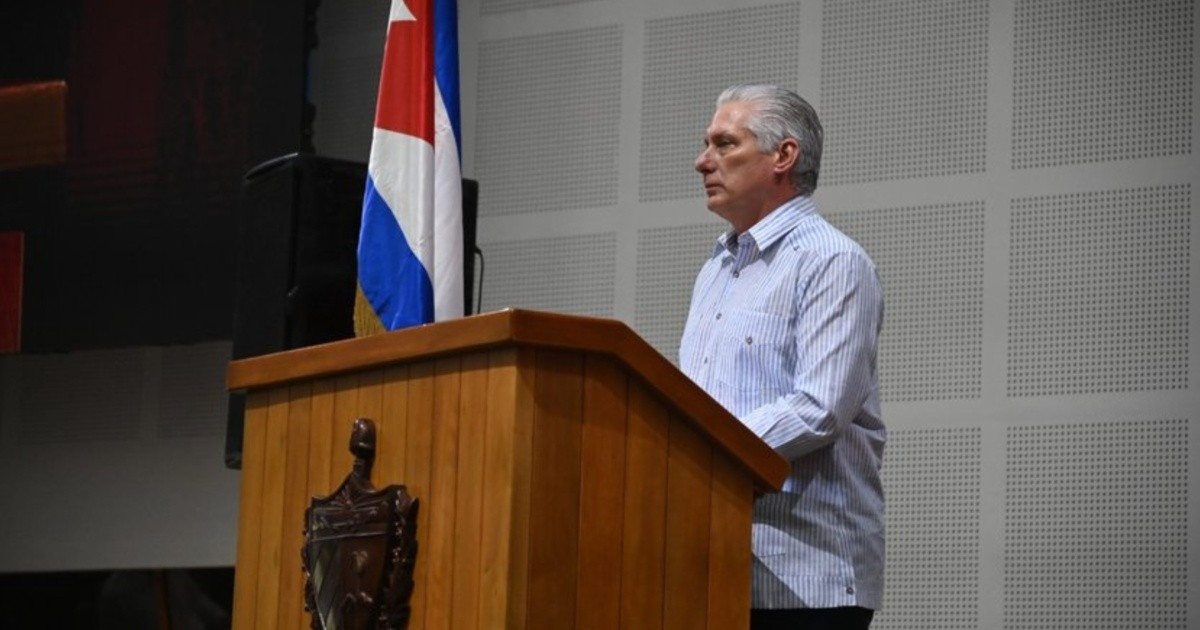
At minute 19:20 of his speech at the International Solidarity Meeting with Cuba, held on Saturday at the Palace of Conventions in Havana, Díaz-Canel stated: "It seems that May Day upset them, as they say here. It seems that the massive display of determination from the Cuban people really got under their skin."
The executive order signed by Trump on that same day expands sectoral sanctions on the energy, defense, mining, and financial services sectors of the island, establishes global financial tracking against banks in third countries that operate with Cuban entities, and implements the measures immediately and without a grace period.
Díaz-Canel described the measure as "a collective punishment" and "total suffocation" designed to provoke "a social explosion and a regime change," framing it within what he termed an ideological, cultural, and media war waged by the "fascist government" of the United States.
The Cuban leader also acknowledged the severity of the energy crisis facing the island: "We went four months without receiving fuel until a fuel ship from Russia arrived, which helped us change the energy situation in the country over the last 15 days. But that oil is running out now, and we don't know when more fuel will come to Cuba."
This admission contrasts with the triumphalist narrative of the speech. Trump signed the new executive order against the dictatorship on the same day that the regime was celebrating its annual parade, and hours later, at an event in The Villages, Florida, he asserted that he would take Cuba almost immediately and described a scenario in which the USS Abraham Lincoln aircraft carrier would stop 100 yards off the Cuban coast until the regime surrendered.
Díaz-Canel presented May Day as a double victory: over 80% of signatures from the active population over 17 in the campaign "My Signature for the Homeland," and more than five million people on the streets across the country. The regime boasted of more than six million signatures collected since April 19, a figure that analysts and opponents have questioned.
The academic Hilda Landrove described the May 1st parade as a "staged display of a corpse" lacking genuine fervor, while Alina Bárbara López labeled the 6.23 million signatures as a "mathematically impossible exaggeration" given the population decline and mass emigration. Reports of coercion in workplaces, schools, and the Committees for the Defense of the Revolution accompanied the campaign since its launch.
In his speech, Díaz-Canel also invoked the 32 Cuban soldiers who died in Venezuela during the U.S. operation that captured Nicolás Maduro in January 2026, presenting them as an example of resistance in the face of a potential military aggression: "They fought for more than 45 minutes under those conditions. Just imagine what would happen in a military aggression against Cuba."
The chancellor Bruno Rodríguez rejected the sanctions as "illegal and abusive unilateral coercive measures" and stated that the regime will not be intimidated: "The Homeland, the Revolution, and Socialism are defended with ideas and with arms."
While the regime celebrates its mobilization figures, The Economist's Intelligence Unit projects an economic contraction of 7.2% for Cuba in 2026, and blackouts affect up to 25 hours daily in more than 55% of the national territory.
Filed under: